Textile Machinery Manufacturing SME | Surat, Gujarat
Case Studies
Manufacturing SME | Surat, Gujarat
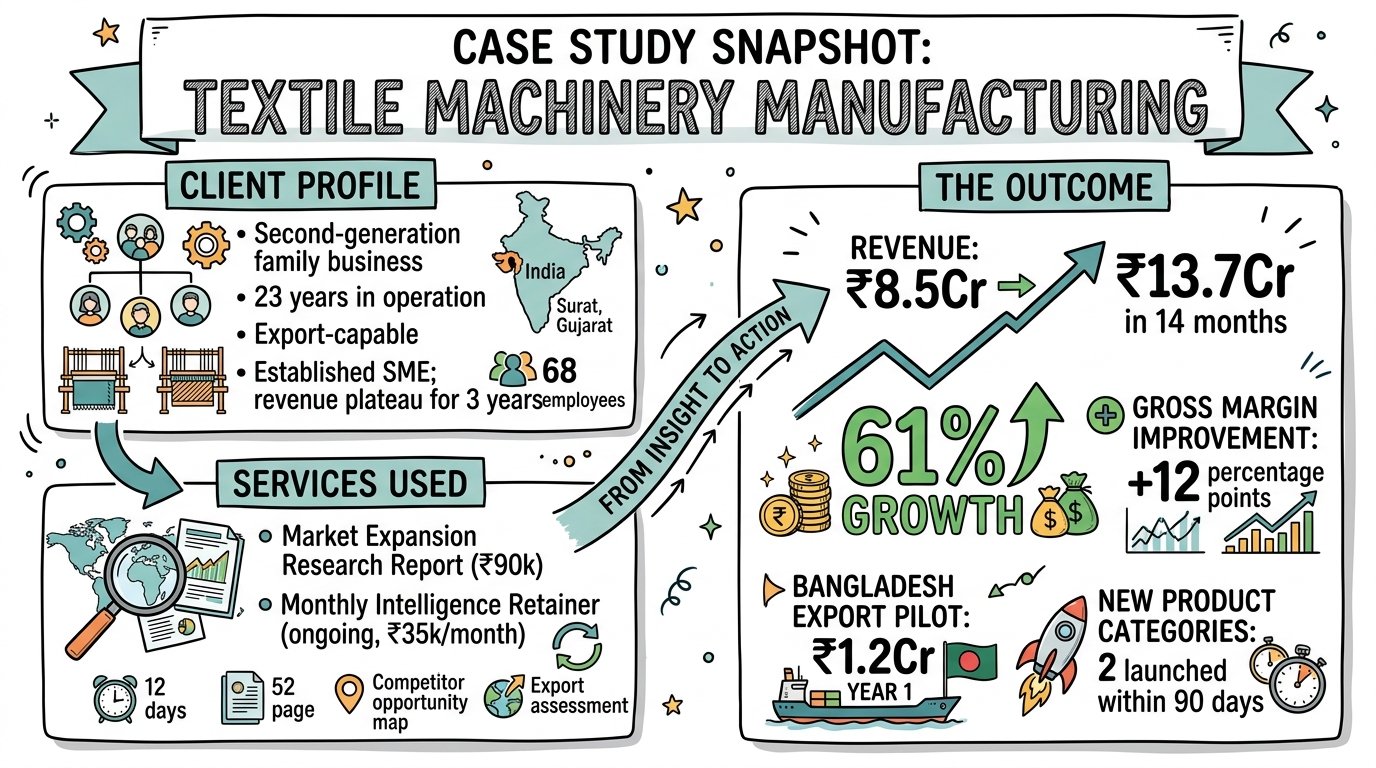
A Surat Manufacturer Who Was About to Sell His Business Discovered Three Growth Directions Hidden Inside His Existing Customer Base. Revenue Grew 61% in 14 Months.
PART 1 — THE SITUATION
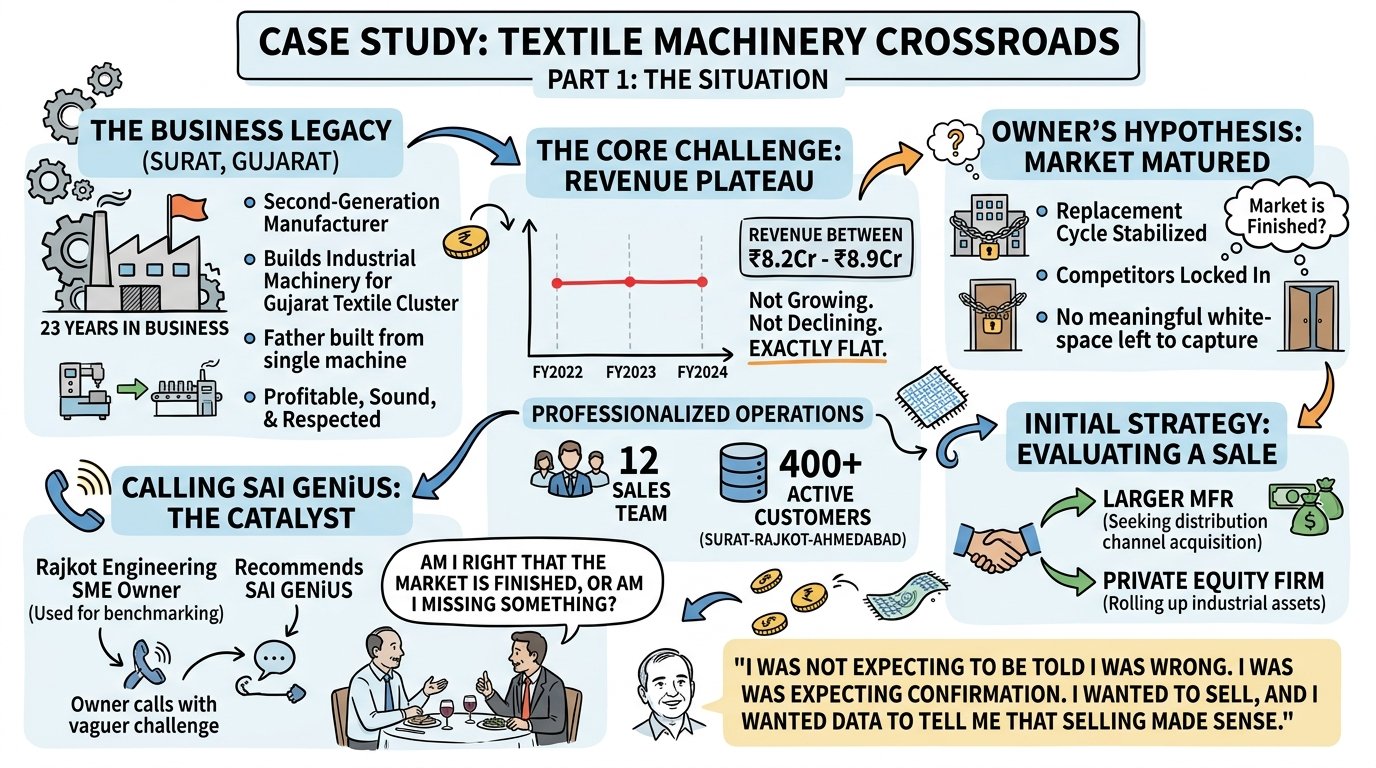
The business: A second-generation textile machinery manufacturer in Surat had been building and distributing industrial textile machinery to Gujarat’s massive textile cluster for 23 years. The business was profitable, operationally sound, and respected in its market — the owner’s father had built it from a single machine, and the second generation had professionalised operations, built a sales team of 12, and maintained relationships with over 400 active business customers across the Surat-Rajkot-Ahmedabad manufacturing corridor.
But for three consecutive financial years — FY2022, FY2023, and FY2024 — revenue had plateaued between ₹8.2Cr and ₹8.9Cr. Not declining. Not growing. Exactly flat.
The owner’s hypothesis: The market had matured. Gujarat’s textile machinery replacement cycle had stabilised. His competitors had locked in the same customers. There was no meaningful white-space left to capture. He had begun preliminary conversations with two potential buyers — one a larger machinery manufacturer seeking distribution channel acquisition, the other a private equity firm rolling up Gujarat industrial equipment businesses — and was evaluating whether to sell.
Why he called SAI GENiUS: A business associate — a Rajkot engineering SME owner who had used SAI GENiUS for competitor benchmarking — mentioned the firm during a dinner conversation. The textile machinery owner had no specific research question. He called with a broader, vaguer challenge: “I want to know if I am right that the market is finished, or if I am missing something.”
“I was not expecting to be told I was wrong. I was expecting confirmation. I wanted to sell, and I wanted data to tell me that selling made sense.”
PART 2 — THE RESEARCH BRIEF
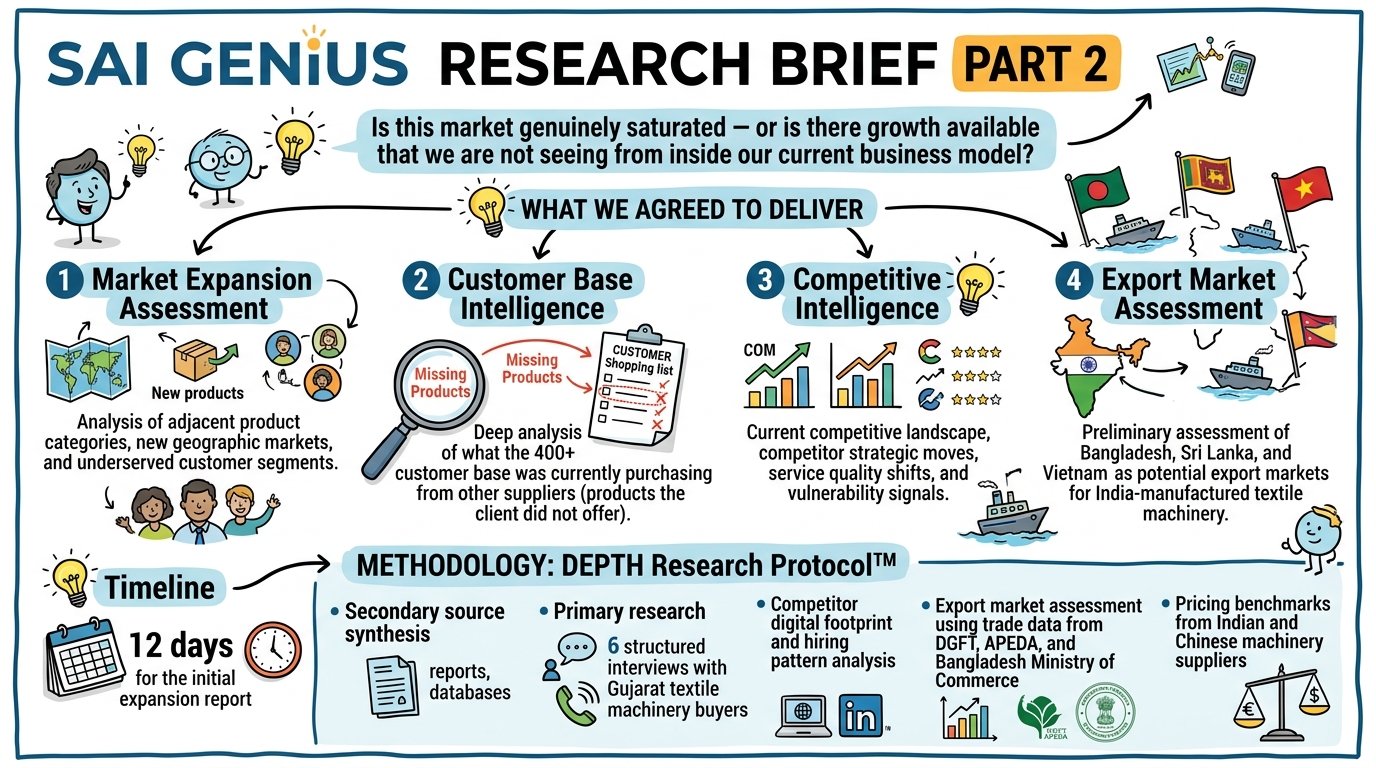
The core question SAI GENiUS was asked to answer:“Is this market genuinely saturated — or is there growth available that we are not seeing from inside our current business model?”
What we agreed to deliver:
Market Expansion Assessment: Analysis of adjacent product categories, new geographic markets, and underserved customer segments potentially accessible from the client’s existing position
Customer Base Intelligence: Deep analysis of what the client’s existing 400+ customer base was currently purchasing from other suppliers — products the client did not offer, but the customer needed
Competitive Intelligence: Current competitive landscape, including recent competitor strategic moves, service quality shifts, and vulnerability signals
Export Market Assessment: Preliminary assessment of Bangladesh, Sri Lanka, and Vietnam as potential export markets for India-manufactured textile machinery
Timeline: 12 days for the initial expansion report Methodology: DEPTH Research Protocol™ — secondary source synthesis; primary research including 6 structured interviews with Gujarat textile machinery buyers (conducted via SAI GENiUS’s industry research network); competitor digital footprint and hiring pattern analysis; export market assessment using trade data from DGFT, APEDA, and Bangladesh Ministry of Commerce; pricing benchmarks from Indian and Chinese machinery suppliers.
PART 3 — WHAT THE RESEARCH FOUND
Finding 01 — The Adjacent Revenue Hiding Inside the Existing Customer Base
The most significant finding in the research was not about new markets or new geographies. It was about what was happening inside the client’s existing 400-customer base every day — specifically, what those customers were buying from other suppliers that they could have been buying from the client.
Our analysis — built from industry supplier databases, dealer network interviews, and structured buyer conversations — identified two adjacent product categories with significant revenue concentration in the client’s customer base:
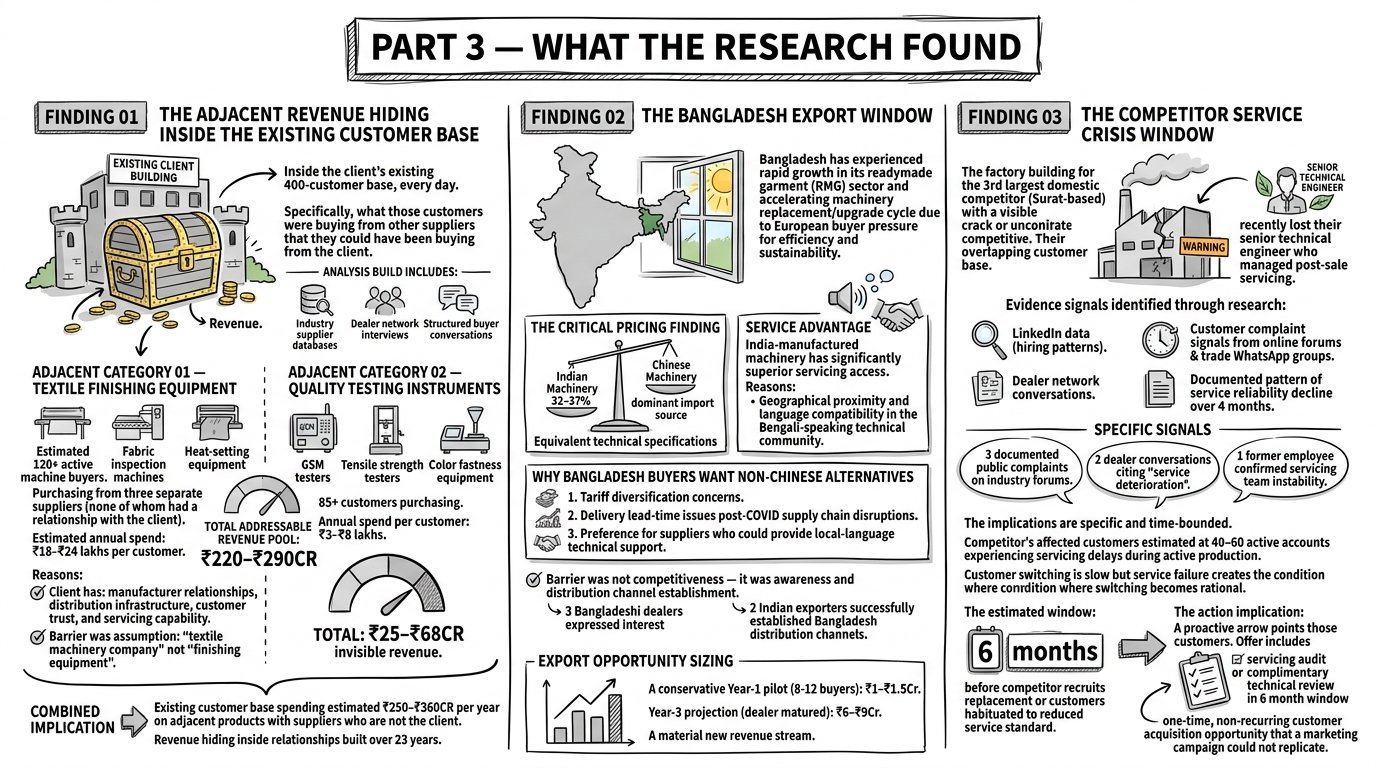
Adjacent Category 01 — Textile Finishing Equipment An estimated 120+ of the client’s active machine buyers also operated textile finishing operations — stenters, fabric inspection machines, heat-setting equipment — and were purchasing these from three separate suppliers, none of whom had a relationship with the client. The estimated annual spend of these 120 customers on textile finishing equipment was ₹18–₹24 lakhs per customer — a total addressable revenue pool of ₹220–₹290Cr within the client’s existing customer base alone.
The client had the manufacturer relationships, the distribution infrastructure, the customer trust, and the servicing capability to enter this category without acquiring a single new customer. The barrier was not market access — it was the assumption that the client was a “textile machinery company” and finishing equipment was “someone else’s business.”
Adjacent Category 02 — Quality Testing Instruments A second analysis revealed that 85+ of the client’s customers were purchasing fabric quality testing instruments — GSM testers, tensile strength testers, color fastness equipment — from suppliers with no relationship to the client’s business. The annual spend per customer was ₹3–₹8 lakhs. A total of ₹25–₹68Cr in annual purchasing was happening within the existing customer base, invisible to the client’s business.
The combined implication: The client’s existing customer base was spending an estimated ₹250–₹360Cr per year on adjacent products with suppliers who were not the client. This was not a new market opportunity. It was revenue hiding inside relationships the client had already built over 23 years.
Finding 02 — The Bangladesh Export Window
The export market assessment identified an opportunity that the client had never seriously considered. Bangladesh — India’s most significant near-geography textile manufacturing neighbor — had experienced rapid growth in its readymade garment (RMG) sector over the preceding decade, and its machinery replacement and upgrade cycle was accelerating in response to European buyer pressure for more efficient, sustainable production.
The critical pricing finding: India-manufactured textile machinery was priced at a 32–37% discount to comparable Chinese machinery — the dominant import source for Bangladesh manufacturers — while delivering equivalent technical specifications and significantly superior servicing access (given geographical proximity and language compatibility in the Bengali-speaking technical community).
Bangladesh machinery buyers were actively seeking non-Chinese alternatives for three documented reasons: tariff diversification concerns, delivery lead-time issues post-COVID supply chain disruptions, and a preference for suppliers who could provide local-language technical support. Indian suppliers were structurally advantaged on all three dimensions.
The barrier was not competitiveness — it was awareness and distribution channel establishment. The research identified three Bangladeshi machinery dealers who had expressed interest in Indian supplier relationships through trade bodies, and two Indian exporters in adjacent machinery categories who had successfully established Bangladesh distribution channels through the same channels.
The export opportunity sizing: A conservative Year-1 pilot targeting 8–12 Bangladesh machinery buyers through a single dealer relationship was modelled at ₹1–₹1.5Cr. A Year-3 projection, assuming the dealer relationship matured, was ₹6–₹9Cr — which would represent a material new revenue stream on top of the domestic base.
Finding 03 — The Competitor Service Crisis Window
The competitive intelligence component of the research produced an unexpected and time-sensitive finding.
The client’s third-largest domestic competitor — a Surat-based machinery manufacturer with an overlapping customer base — had recently lost their senior technical engineer: the individual who managed their post-sale servicing operations across their customer base. LinkedIn data (hiring patterns), dealer network conversations, and customer complaint signals aggregated from online forums and trade WhatsApp groups revealed a documented pattern of service reliability decline over the preceding 4 months.
Specific signals: 3 documented public complaints on industry forums; 2 dealer conversations citing “service deterioration”; 1 former employee of the competitor who had joined a machinery dealer and confirmed the servicing team instability.
The implications were specific and time-bounded. The competitor’s affected customers — estimated at 40–60 active accounts — were experiencing servicing delays at a time when their machinery was in active production. Customer switching behavior in B2B machinery markets is slow — relationships and switching costs are significant — but service failure creates the specific condition where switching becomes rational.
The estimated window: 6 months before the competitor either recruited a replacement technical engineer or customers became habituated to the reduced service standard.
The action implication: A proactive outreach campaign to the competitor’s most active customers — offering a servicing audit or a complimentary technical review — during the 6-month window represented a one-time, non-recurring customer acquisition opportunity that a marketing campaign could not replicate.
PART 4 — THE RECOMMENDATION
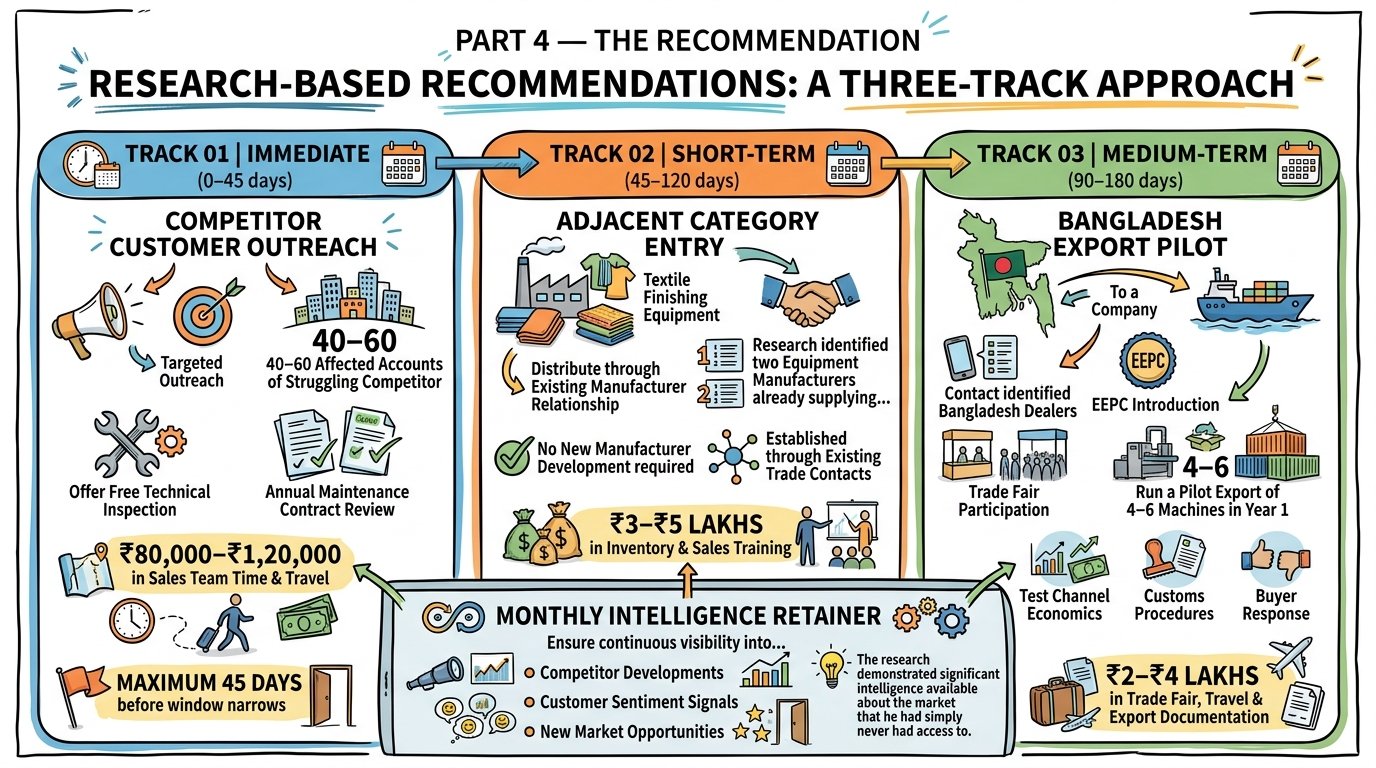
The research recommendations were organized into three tracks, sequenced by timeline and capital requirement:
Track 01 — Immediate (0–45 days): Competitor Customer Outreach Design and deploy a targeted outreach campaign to the 40–60 estimated affected accounts of the struggling competitor. Offer a free technical inspection or annual maintenance contract review. Investment required: ₹80,000–₹1,20,000 in sales team time and travel. Timeline: maximum 45 days from research delivery before the window narrows.
Track 02 — Short-Term (45–120 days): Adjacent Category Entry. Enter textile finishing equipment distribution through an existing manufacturer relationship — the research identified two equipment manufacturers already supplying to customers in the client’s geographic market who were seeking additional dealer relationships. No new manufacturer development required — the distribution relationship could be established through existing trade contacts. Investment required: ₹3–₹5 lakhs in inventory and sales training.
Track 03 — Medium-Term (90–180 days): Bangladesh Export Pilot. Establish contact with identified Bangladesh dealers through EEPC (Engineering Export Promotion Council) introduction and trade fair participation. Run a pilot export of 4–6 machines in Year 1 to test the channel economics, customs procedures, and buyer response. Investment required: ₹2–₹4 lakhs in trade fair participation, travel, and initial export documentation setup.
The research also recommended a Monthly Intelligence Retainer to ensure the client had continuous visibility into competitor developments, customer sentiment signals, and new market opportunities — because the research had demonstrated that significant intelligence was available about the market that he had simply never had access to.
PART 5 — THE DECISION
The owner’s response to the research delivery was, in his words, “the most uncomfortable conversation I have had about my own business in twenty years.”
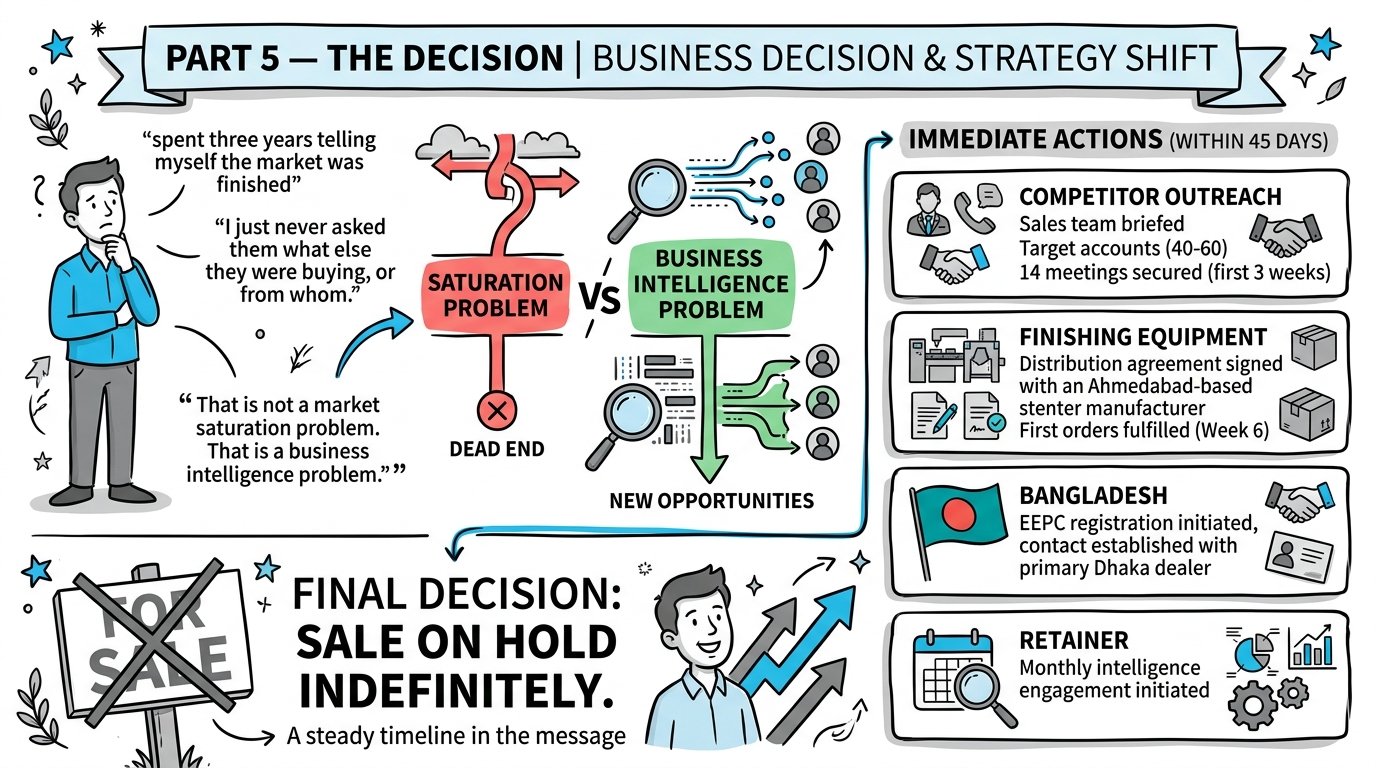
“I had spent three years telling myself the market was finished. What the research showed me was that I had stopped looking. The adjacent revenue was in my customer base — I visited these customers every quarter. I just never asked them what else they were buying, or from whom. That is not a market saturation problem. That is a business intelligence problem. And I had been pretending they were the same thing.”
Within 45 days of research delivery:
Competitor outreach: Sales team briefed and deployed to the 40-60 identified accounts; 14 meetings secured in the first 3 weeks
Finishing equipment: Distribution agreement signed with an Ahmedabad-based stenter manufacturer; first orders fulfilled in Week 6
Bangladesh: EEPC registration initiated; contact established with the primary identified Dhaka dealer
The decision to sell the business was put on hold indefinitely.
PART 6 — THE OUTCOME
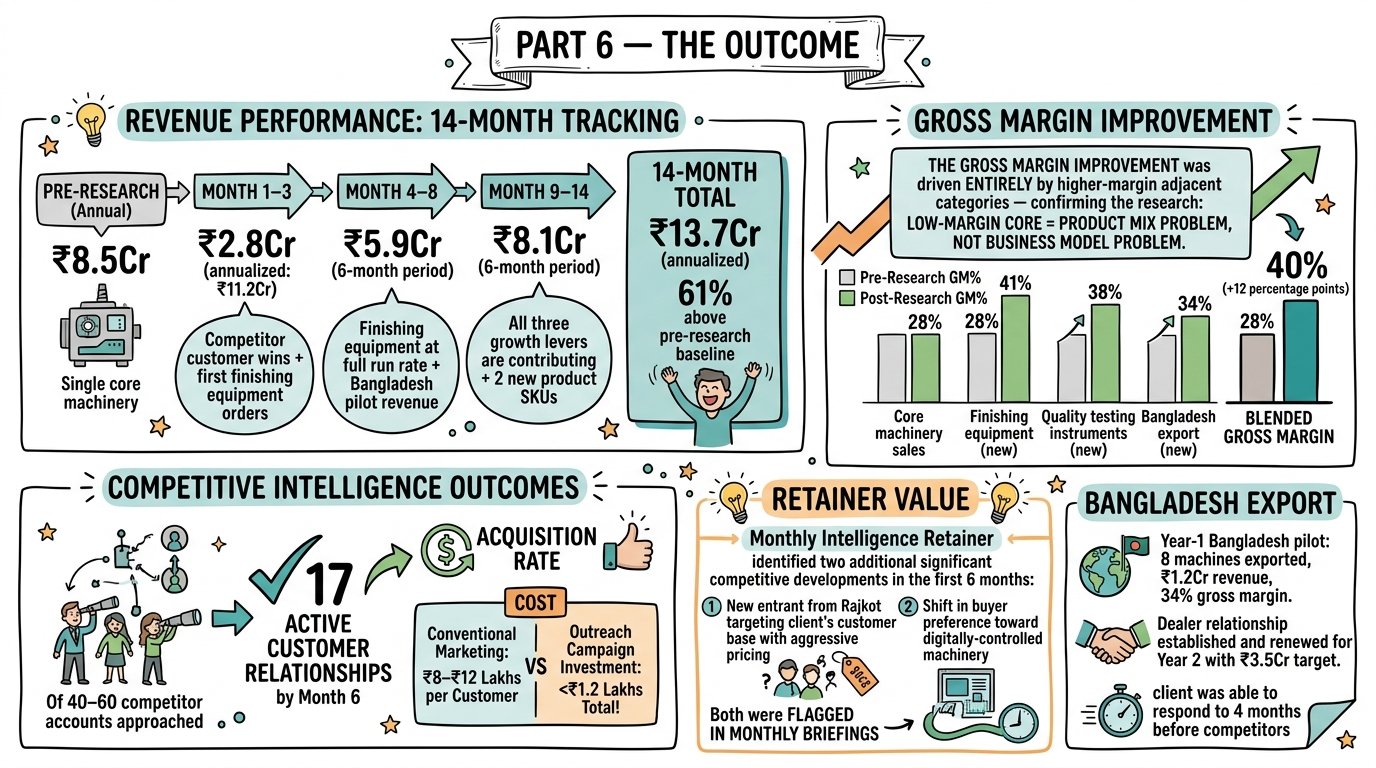
Revenue performance — 14-month tracking:
Period
Revenue
Key Driver
Pre-Research (Annual)
₹8.5Cr
Core machinery sales only
Month 1–3
₹2.8Cr (annualized: ₹11.2Cr)
Competitor customer wins + first finishing equipment orders
Month 4–8
₹5.9Cr (6-month period)
Finishing equipment at full run rate + Bangladesh pilot revenue
Month 9–14
₹8.1Cr (6-month period)
All three growth levers are contributing + 2 new product SKUs
14-Month Total
₹13.7Cr (annualized)
61% above pre-research baseline
Gross margin improvement:
Revenue Stream
Pre-Research GM%
Post-Research GM%
Core machinery sales
28%
28% (unchanged)
Finishing equipment (new)
—
41%
Quality testing instruments (new)
—
38%
Bangladesh export (new)
—
34%
Blended gross margin
28%
40% (+12 percentage points)
The gross margin improvement was driven entirely by the higher-margin adjacent categories — confirming the research finding that the low-margin core product was not a business model problem but a product mix problem.
Competitive intelligence outcomes: Of the 40–60 competitor accounts approached in the initial outreach campaign, 17 had converted to active customer relationships by Month 6 — an acquisition rate that would have cost ₹8–₹12 lakhs per customer through conventional marketing channels. The outreach campaign investment was under ₹1.2 lakhs total.
Bangladesh export: Year-1 Bangladesh pilot: 8 machines exported, ₹1.2Cr revenue, 34% gross margin. Dealer relationship established and renewed for Year 2 with ₹3.5Cr target.
Retainer value: The Monthly Intelligence Retainer identified two additional significant competitive developments in the first 6 months: a new entrant from Rajkot targeting the client’s customer base with aggressive pricing, and a shift in buyer preference toward digitally-controlled machinery that the client was able to respond to 4 months before competitors. Both were flagged in monthly briefings.
PART 7 — THE CLIENT’S VOICE
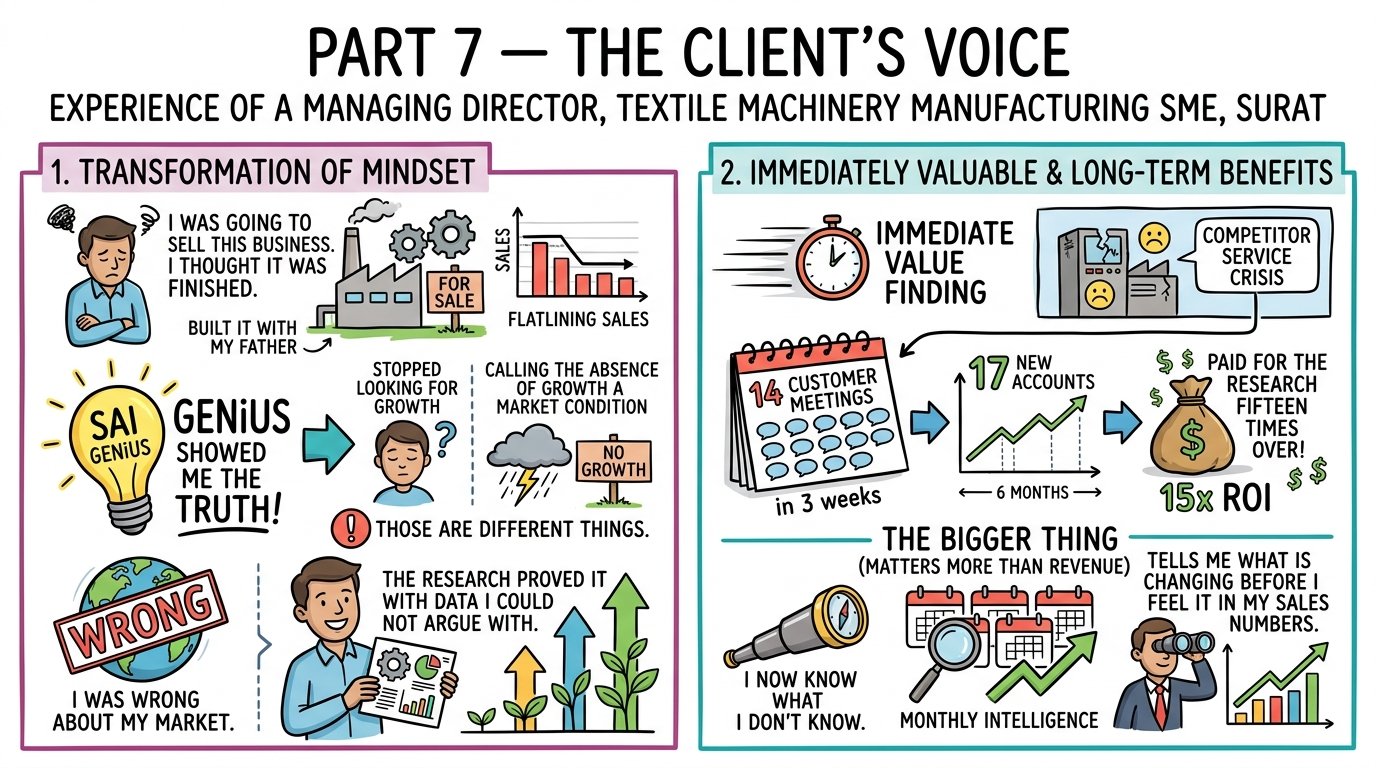
“I was going to sell this business. I had built it with my father, and I was going to sell it because I thought it was finished. What SAI GENiUS showed me was that I had stopped looking for growth and started calling the absence of growth a market condition. Those are different things. I was wrong about my market. The research proved it with data I could not argue with.” — Managing Director, Textile Machinery Manufacturing SME, Surat.
“The competitor service crisis finding was the most immediately valuable thing in the report. We had 14 customer meetings in the first three weeks. We converted 17 accounts in six months. That alone paid for the research fifteen times over. But the bigger thing — the thing that matters more than the revenue number — is that I now know what I don’t know. I have the monthly intelligence that tells me what is changing before I feel it in my sales numbers.” — Managing Director, Textile Machinery Manufacturing SME, Surat.
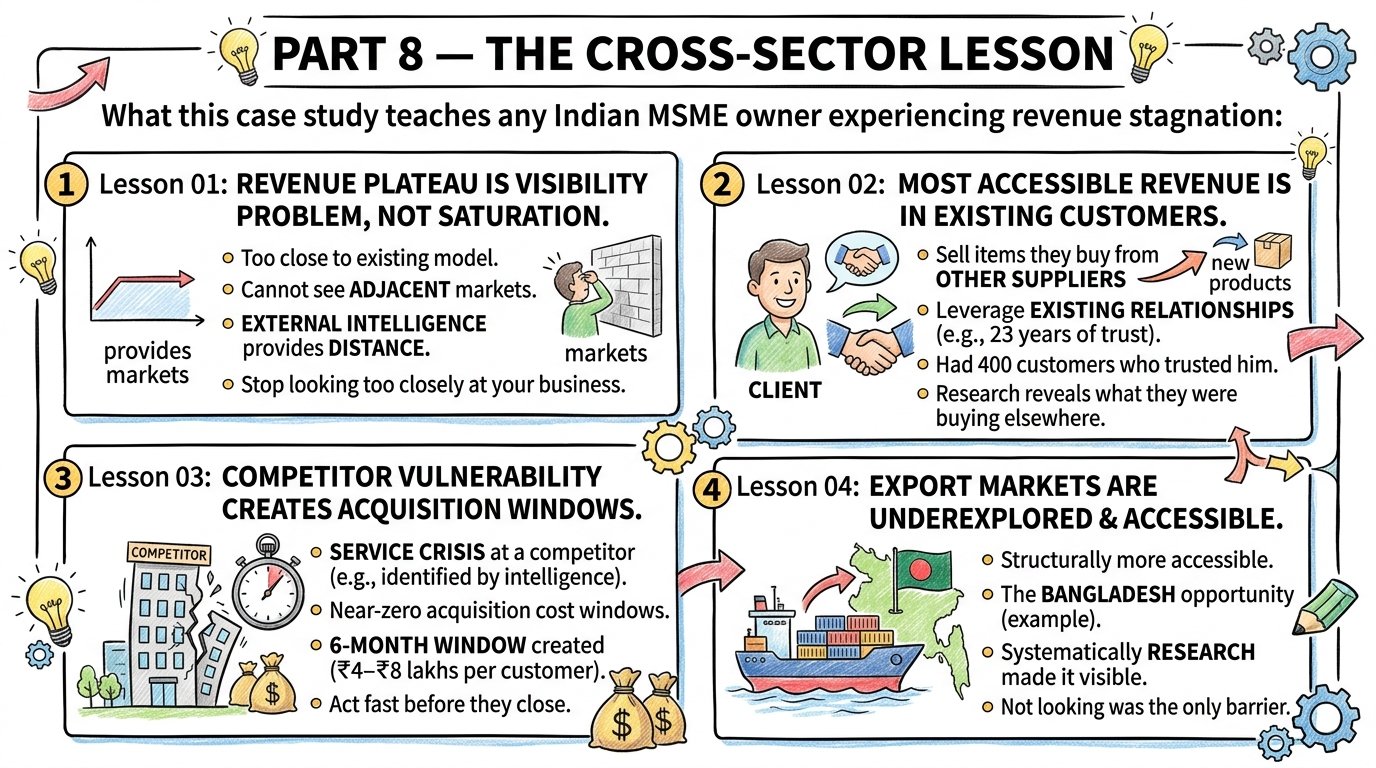
PART 8 — THE CROSS-SECTOR LESSON
What this case study teaches any Indian MSME owner experiencing revenue stagnation:
Lesson 01: Revenue plateau is almost never market saturation. It is almost always a visibility problem — you have stopped seeing the market clearly because you are too close to your existing business model to see what lies adjacent to it. External intelligence provides the distance that internal analysis cannot.
Lesson 02: The most accessible revenue is usually inside your existing customer base — in the products and services those customers buy from other suppliers. 23 years of relationship-building had given this client access to 400 customers who trusted him. He was not using that trust to sell them anything beyond his core product. The research revealed what they were buying elsewhere — and how to get it.
Lesson 03: Competitor vulnerability creates acquisition windows that marketing spend cannot replicate. The service crisis at a competitor — surfaced by systematic competitive intelligence — created a 6-month window worth ₹4–₹8 lakhs per converted customer at near-zero acquisition cost. These windows exist in every market. Intelligence is the only way to see them before they close.
Lesson 04: Export markets are underexplored by most Indian SMEs — and structurally more accessible than they appear. The Bangladesh opportunity had always been available. The client had never looked for it systematically because looking for it was not part of his business process. Research made it visible.
At vero eos et accusamus et iusto odio digni goikussimos ducimus qui to bonfo blanditiis praese. Ntium voluum deleniti atque.