How a ₹1,20,000 Research Engagement Saved a D2C Brand from a ₹40 Lakh Metro Launch That Would Have Failed — and Redirected Them to ₹3.2Cr in 8 Months.
PART 1 — THE SITUATION
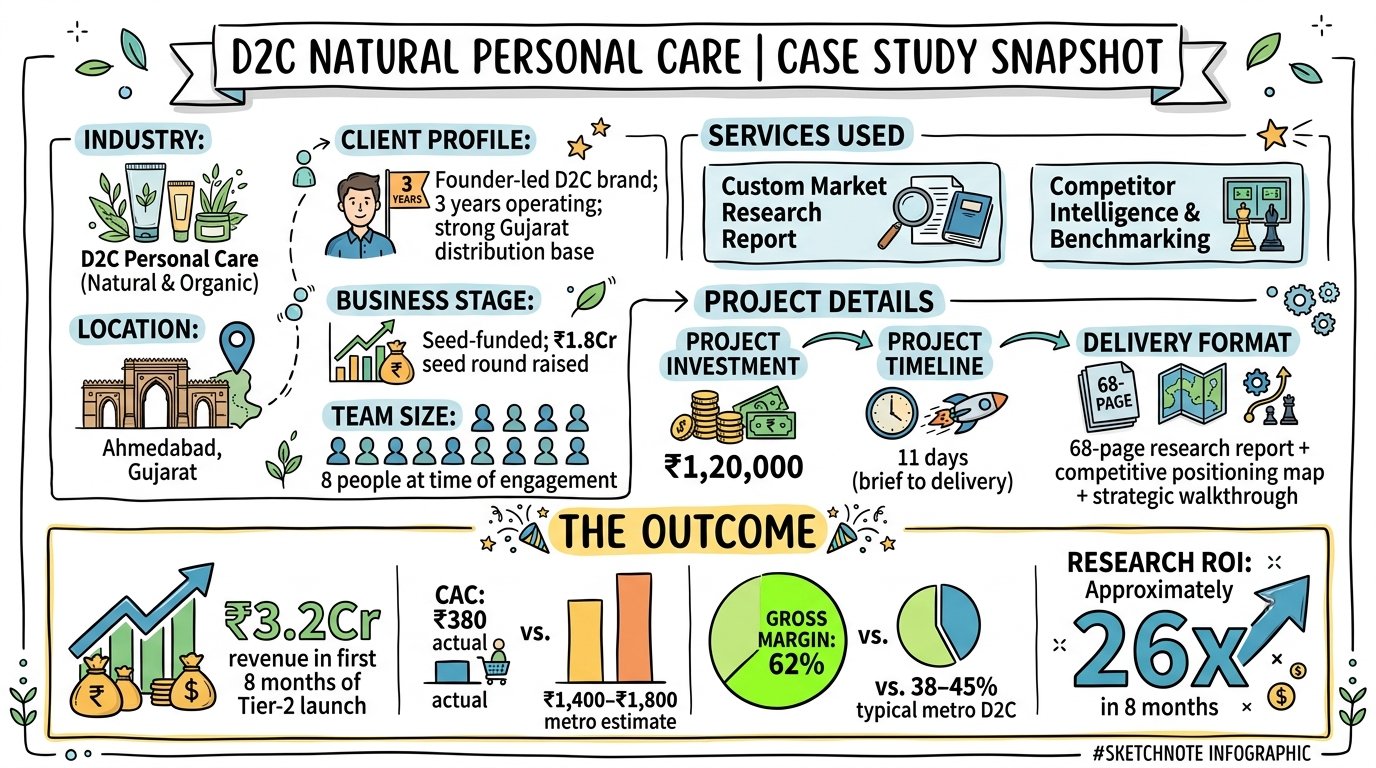
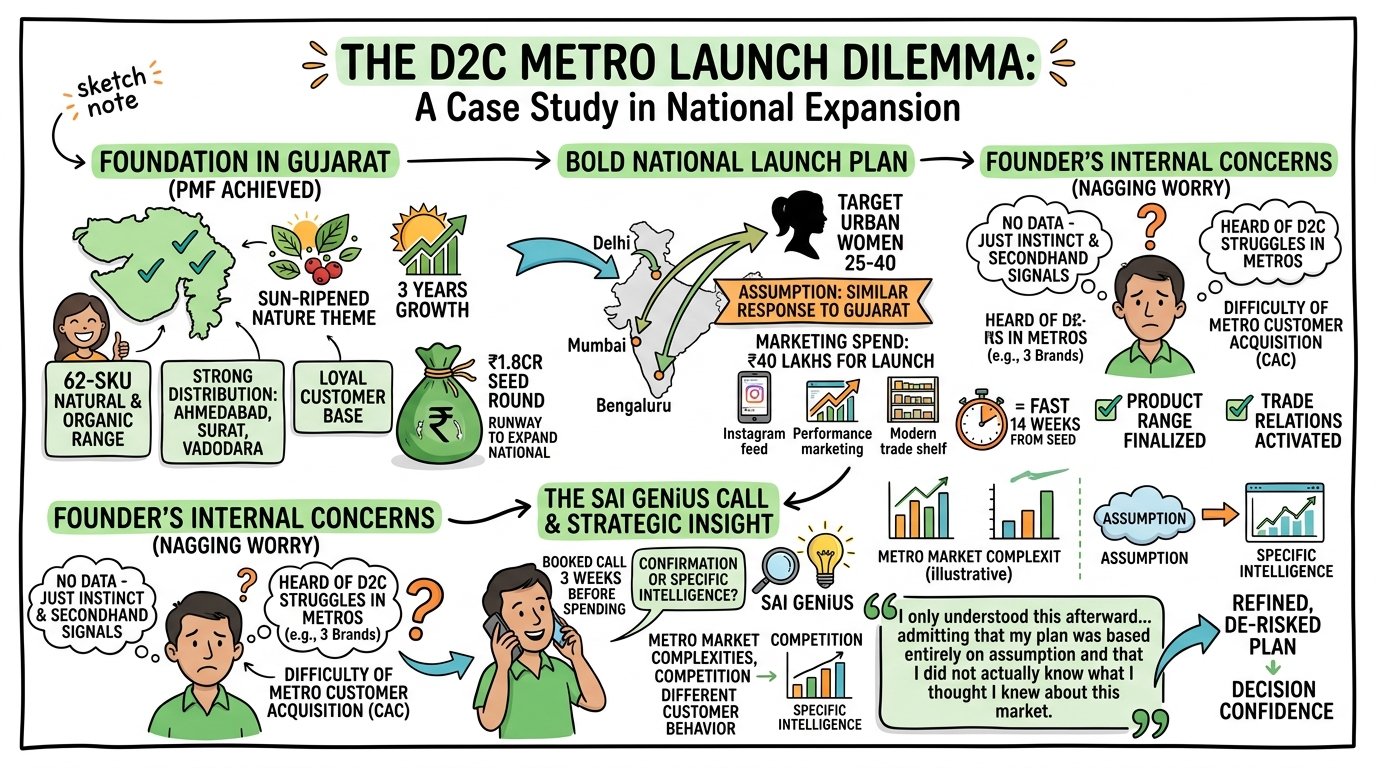
The business: A D2C personal care brand founded in Ahmedabad had built genuine product-market fit in Gujarat over three years — a loyal customer base, a 62-SKU natural and organic personal care range, strong kirana and modern trade distribution in Ahmedabad, Surat, and Vadodara, and a ₹1.8Cr seed round that gave them the runway to expand nationally.
The founder had a specific, confident plan: launch in Mumbai, Delhi, and Bengaluru — India’s three largest metro markets — targeting urban women between 25 and 40. The product had tested well with this segment in Gujarat. The assumption was that the segment would respond similarly in metros. ₹40 lakhs had been allocated for the launch marketing campaign across Instagram, digital performance marketing, and premium modern trade placement.
The decision timeline: The launch was scheduled for 14 weeks from the date of the seed round close. The founder wanted to move fast. The marketing agency was already briefed. The product range was finalized. The metro trade relationships were being activated.
Why they called SAI GENiUS: The founder had a nagging concern she could not fully articulate. She had read about the difficulty of D2C brand customer acquisition in metros. She had heard that three brands she admired had struggled with exactly the metro launch she was planning. But she had no data — just instinct and secondhand signals.
She booked a SAI GENiUS discovery call three weeks before the marketing spend was due to be deployed — wanting either confirmation that her plan was sound or specific intelligence about what she was missing.
“I told myself I was getting a second opinion. What I was actually doing — and I only understood this afterward — was admitting that my plan was based entirely on assumption and that I did not actually know what I thought I knew about this market.”
PART 2 — THE RESEARCH BRIEF
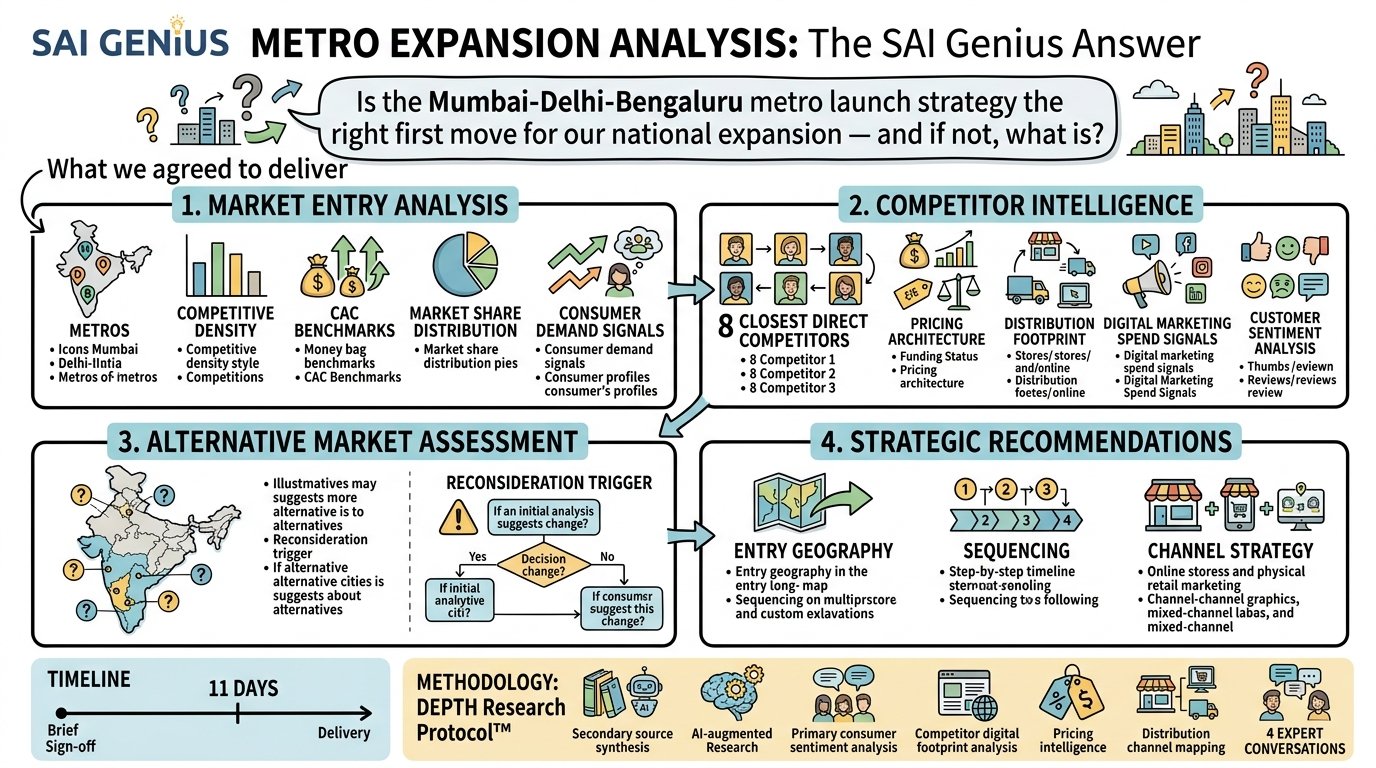
The core question SAI GENiUS was asked to answer:“Is the Mumbai-Delhi-Bengaluru metro launch strategy the right first move for our national expansion — and if not, what is?”
What we agreed to deliver:
Market Entry Analysis: D2C personal care sector in the three target metros — competitive density, CAC benchmarks, market share distribution, consumer demand signals
Competitor Intelligence: Comprehensive profiling of the 8 closest direct competitors, including funding status, pricing architecture, distribution footprint, digital marketing spend signals, and customer sentiment analysis
Alternative Market Assessment: Identification of alternative geographic entry points if the metro analysis warranted reconsideration
Strategic Recommendations: Specific, actionable guidance on entry geography, sequencing, and channel strategy
Timeline: 11 days from brief sign-off to delivery. Methodology: DEPTH Research Protocol™ applied — secondary source synthesis (AI-augmented), primary consumer sentiment analysis, competitor digital footprint analysis, pricing intelligence, distribution channel mapping, and 4 expert conversations with D2C sector operators
PART 3 — WHAT THE RESEARCH FOUND
Finding 01 — The Metro Market Was Already Crowded and Getting More Expensive
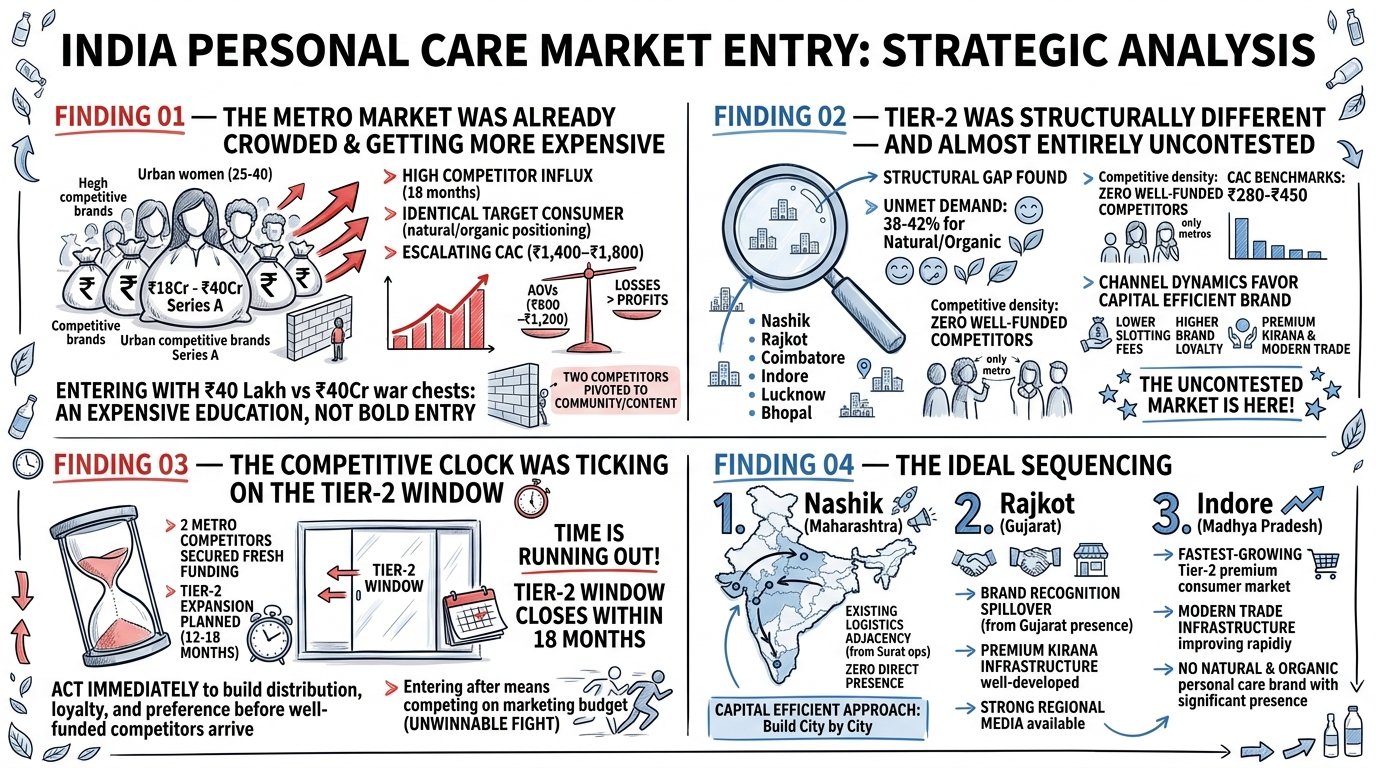
Our competitor intelligence revealed that the metro D2C personal care market had experienced a significant influx of well-funded competitors in the 18 months preceding the engagement. Five brands with Series A funding between ₹18Cr and ₹40Cr were actively competing for the identical target consumer — urban women, 25–40, natural and organic positioning — in Mumbai, Delhi, and Bengaluru simultaneously.
The consequence: customer acquisition costs in this segment in metros had escalated significantly. Our analysis of digital advertising spend signals, social media performance benchmarks, and discussions with operators in adjacent segments produced a CAC range of ₹1,400–₹1,800 per acquired customer — for a product category where a typical first-order value of ₹800–₹1,200 made those economics structurally loss-making.
The more revealing data: two of the five well-funded competitors had already pivoted away from pure digital performance marketing after 12 months of expensive customer acquisition — moving toward content-led and community-led strategies that required longer payback periods than a seed-funded brand could sustain.
The implication: Entering the metro market with a ₹40 lakh launch budget against competitors with ₹40Cr war chests, at CAC economics that did not work even for the well-funded players, was not a bold market entry. It was an expensive education in why the metro market was already oversaturated.
Finding 02 — Tier-2 Was Structurally Different — and Almost Entirely Uncontested
The alternative market assessment produced a finding that the founder had not anticipated. Our analysis of consumer demand signals, competitor distribution maps, and channel economics across Tier-2 cities — specifically Nashik, Rajkot, Coimbatore, Indore, Lucknow, and Bhopal — revealed a structural gap that was both large and, critically, not being served by any of the well-funded competitors.
The specific data:
Demand gap: Consumer demand signals for natural and ingredient-transparent personal care in these six Tier-2 cities showed a 38–42% unmet demand — meaning 38–42% of the addressable consumer base in the segment was actively searching for products that no existing supplier was reaching them with effectively
Competitive density: Zero of the five well-funded metro competitors had meaningful Tier-2 distribution — their investor mandates and metro-focused marketing infrastructure made Tier-2 entry structurally expensive for them
CAC benchmarks: Available benchmarks from D2C brands that had tested Tier-2 channels showed CAC in the ₹280–₹450 range — less than one-third of metro benchmarks
Channel dynamics: Tier-2 modern trade and premium kirana channels in these cities showed significantly lower slotting fees, lower promotional spend requirements, and higher brand loyalty once established — economics that favoured a capital-efficient, founder-led brand over well-funded competitors
The implication: The uncontested market was not in metros. It was in six Tier-2 cities that the well-funded competitors structurally could not serve efficiently.
Finding 03 — The Competitive Clock Was Ticking on the Tier-2 Window
Two of the five primary metro competitors had secured fresh funding rounds in the preceding 6 months. Both had publicly indicated Tier-2 expansion as a 12–18 month strategic priority. Both had the capital to execute that expansion once they had stabilised their metro operations.
This finding added urgency that the opportunity sizing alone did not: the Tier-2 window was open now and would close within 18 months as well-funded competitors arrived with marketing budgets the client could not match.
The implication: Speed mattered. Entering Tier-2 immediately — before the competitors arrived — would allow the brand to build the distribution relationships, consumer loyalty, and retailer preference that create switching costs. Entering after them would mean competing for marketing budget, which was an unwinnable fight.
Finding 04 — The Ideal Sequencing
Our analysis of the six candidate Tier-2 cities produced a prioritisation based on demand signal intensity, existing distribution adjacency (cities where the brand already had logistics infrastructure from Gujarat operations), competitive density, and consumer demographic match to the brand’s core buyer profile.
Recommended entry sequence:
Nashik (Maharashtra) — highest demand signal, existing logistics adjacency from Surat operations, zero direct competitor presence
Rajkot (Gujarat) — brand recognition spillover from Gujarat presence, premium kirana infrastructure, well-developed, strong regional media available
Indore (Madhya Pradesh) — fastest-growing Tier-2 premium consumer market, modern trade infrastructure improving rapidly, no natural and organic personal care brand with significant market presence
The sequencing allowed the brand to build distribution infrastructure, consumer trust, and retailer relationships in one city before deploying capital in the next — a capital-efficient approach that metro launches structurally do not permit.
PART 4 — THE RECOMMENDATION
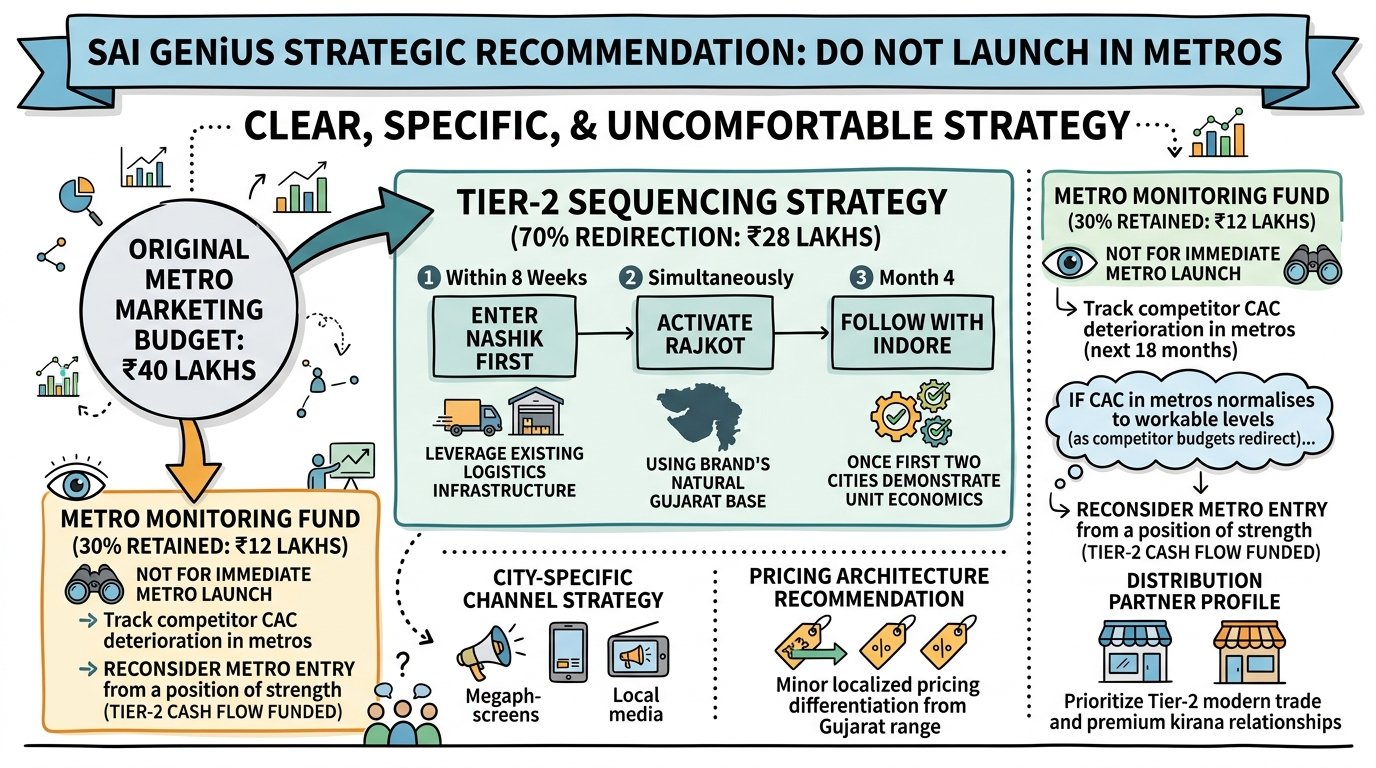
The SAI GENiUS recommendation was clear, specific, and uncomfortable: do not launch in metros.
Redirect 70% of the planned ₹40 lakh metro marketing budget toward the Tier-2 sequencing strategy. Enter Nashik first — within 8 weeks — leveraging existing logistics infrastructure. Activate Rajkot simultaneously, using the brand’s natural Gujarat base. Follow with Indore at month 4, once the first two cities have demonstrated unit economics.
Retain 30% of the original budget as a metro monitoring fund — not for immediate metro launch, but to track competitor CAC deterioration in metros over the 18 months following the Tier-2 launch. If CAC in metros normalised to workable levels as competitor budgets were redirected, a metro entry could be reconsidered from a position of strength, with Tier-2 cash flows funding it.
The recommendation also included a specific channel strategy for each city, a pricing architecture recommendation (a minor localized pricing differentiation from the Gujarat range), and a distribution partner profile for the Tier-2 modern trade and premium kirana relationships to prioritize.
PART 5 — THE DECISION
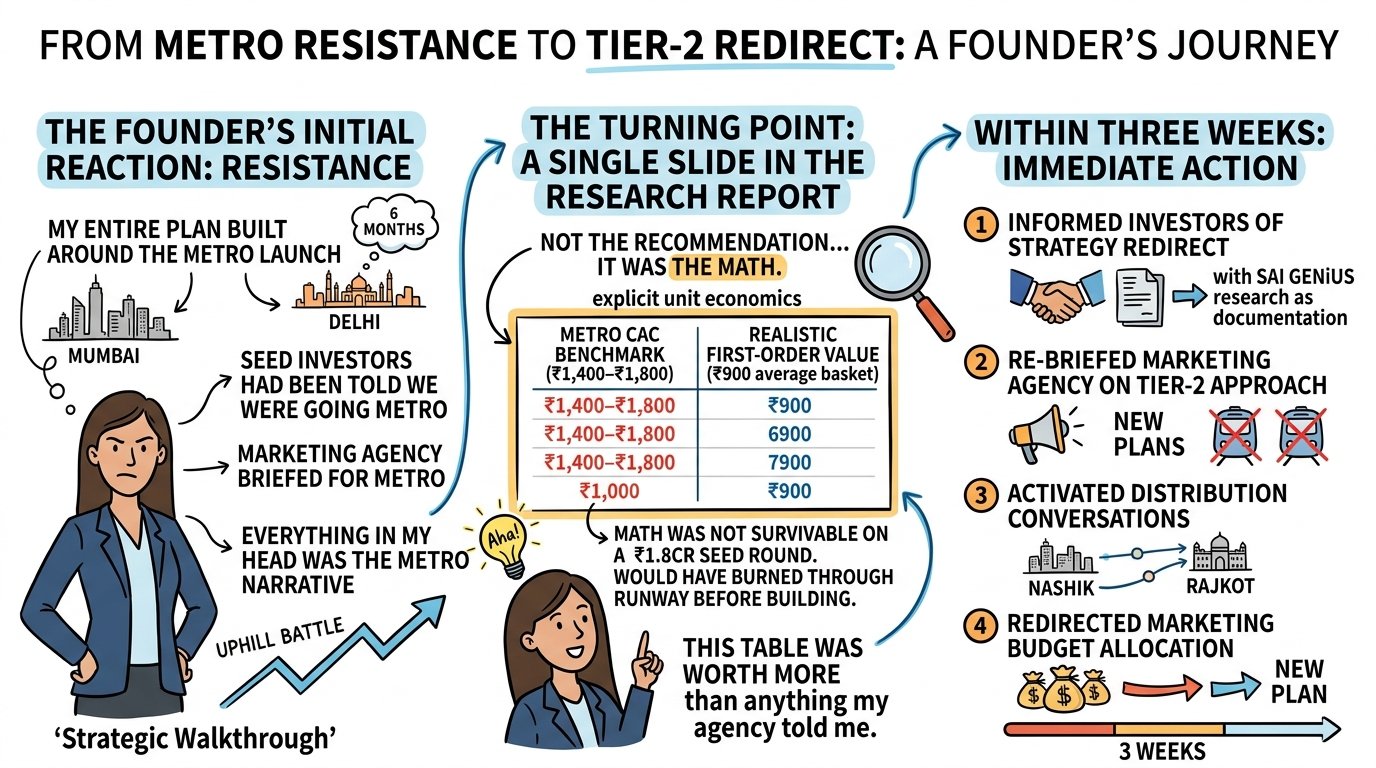
The founder’s initial reaction — she told us at the Strategic Walkthrough — was resistance.
“My entire plan was built around the metro launch. My seed investors had been told we were going to Mumbai and Delhi. My marketing agency was briefed for Metro. Everything in my head for the past six months was built around the metro narrative.”
What changed her mind was not the recommendation. It was a single slide in the research report: the side-by-side comparison of the metro CAC benchmark (₹1,400–₹1,800) against a realistic first-order value (₹900 average basket), with the unit economics laid out explicitly. The math was not survivable on a ₹1.8Cr seed round.
“I could see, in a single table, that the metro plan would have burned through our runway before we built anything. That table was worth more than anything my agency had told me.”
Within three weeks of the research delivery, the client had:
Informed her investors of the strategy redirect (with the SAI GENiUS research as supporting documentation)
Re-briefed her marketing agency on the Tier-2 approach
Activated distribution conversations in Nashik and Rajkot
Redirected the marketing budget allocation
PART 6 — THE OUTCOME
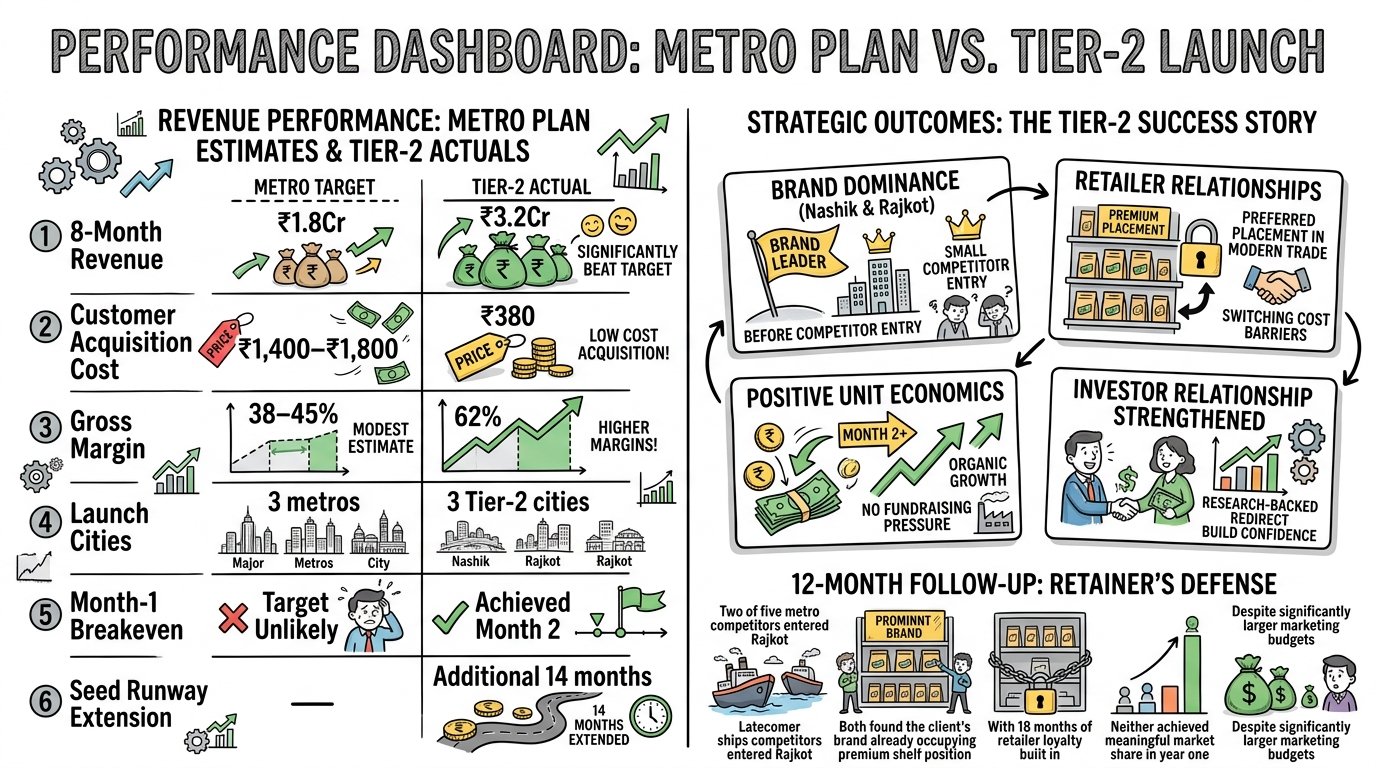
Revenue performance:
Metric
Target (Metro Plan)
Actual (Tier-2 Launch)
8-Month Revenue Target
₹1.8Cr
—
8-Month Revenue Actual
—
₹3.2Cr
Customer Acquisition Cost
₹1,400–₹1,800 (estimated)
₹380 (actual)
Gross Margin
38–45% (metro estimate)
62% (actual)
Launch Cities
3 metros
3 Tier-2 cities
Month-1 Breakeven
Unlikely
Achieved Month 2
Seed Runway Extension
—
An additional 14 months
Strategic outcomes:
Brand established dominant positioning in Nashik and Rajkot before any well-funded competitor entered either market
Retailer relationships in Tier-2 modern trade are locked in with preferred placement — creating switching cost barriers before competitor arrival
Positive unit economics in all three Tier-2 cities from Month 2 — enabling organic reinvestment without further fundraising pressure
Investor relationship strengthened — the research-backed redirect demonstrated strategic rigor that seed investors found confidence-building
12-month follow-up: At the 12-month mark, two of the five metro competitors had entered Rajkot. Both found the client’s brand already occupying a premium shelf position with 18 months of retailer loyalty built in. Neither achieved a meaningful market share in year one despite significantly larger marketing budgets.
PART 7 — THE CLIENT’S VOICE
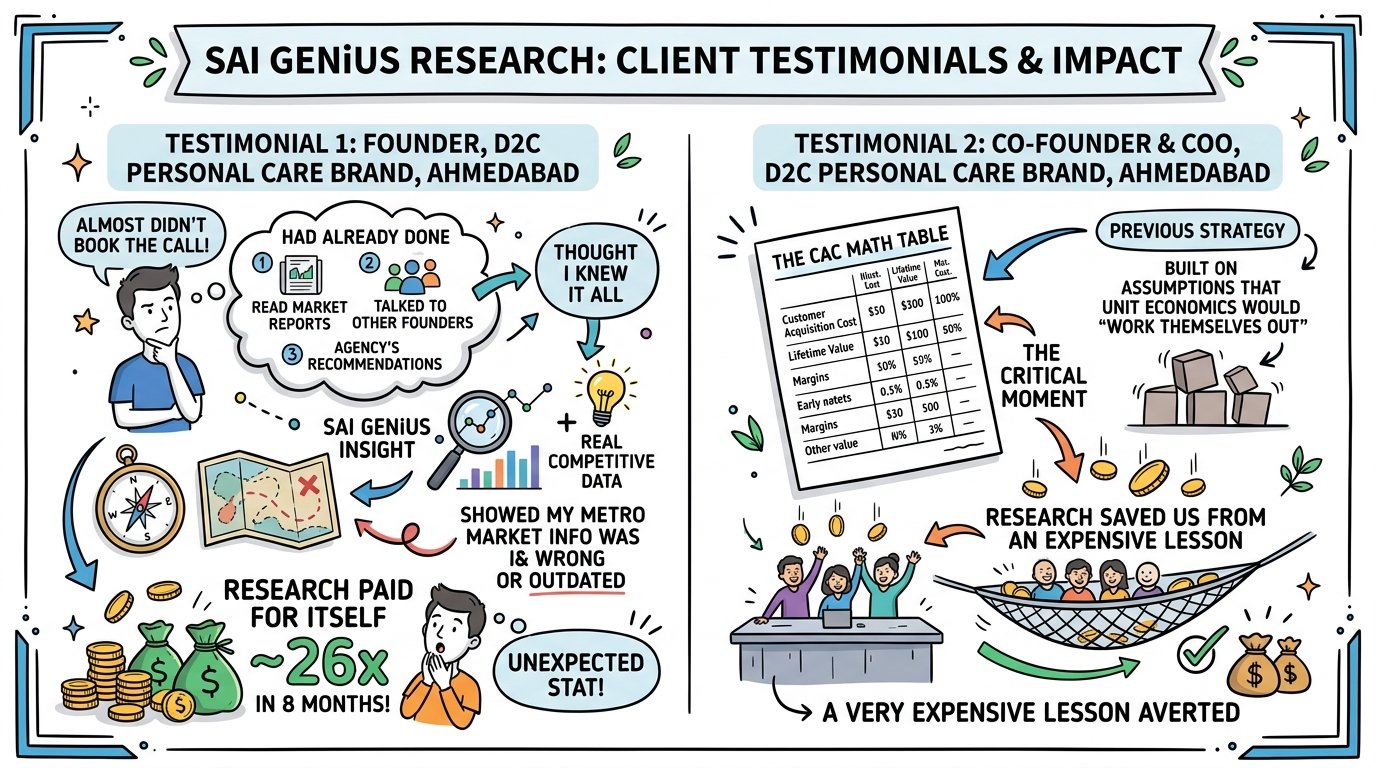
“I almost did not book that discovery call. I kept thinking I had already done enough research — I had read market reports, I had talked to other founders, I had my agency’s recommendations. What I had not done was actually research my specific competitive situation with real data. The SAI GENiUS research showed me that everything I thought I knew about the metro market was either wrong or outdated. That one research engagement paid for itself approximately 26 times over in 8 months. That is not a sentence I expected to be able to say.” — Founder, D2C Personal Care Brand, Ahmedabad.
“The table that showed us the CAC math on a single page — that was the moment. We had been building an entire launch strategy on top of an assumption that the unit economics would work themselves out. They would not have. The research saved us from a very expensive lesson.” — Co-Founder & COO, D2C Personal Care Brand, Ahmedabad.
PART 8 — THE CROSS-SECTOR LESSON
What this case study teaches any Indian business, regardless of sector:
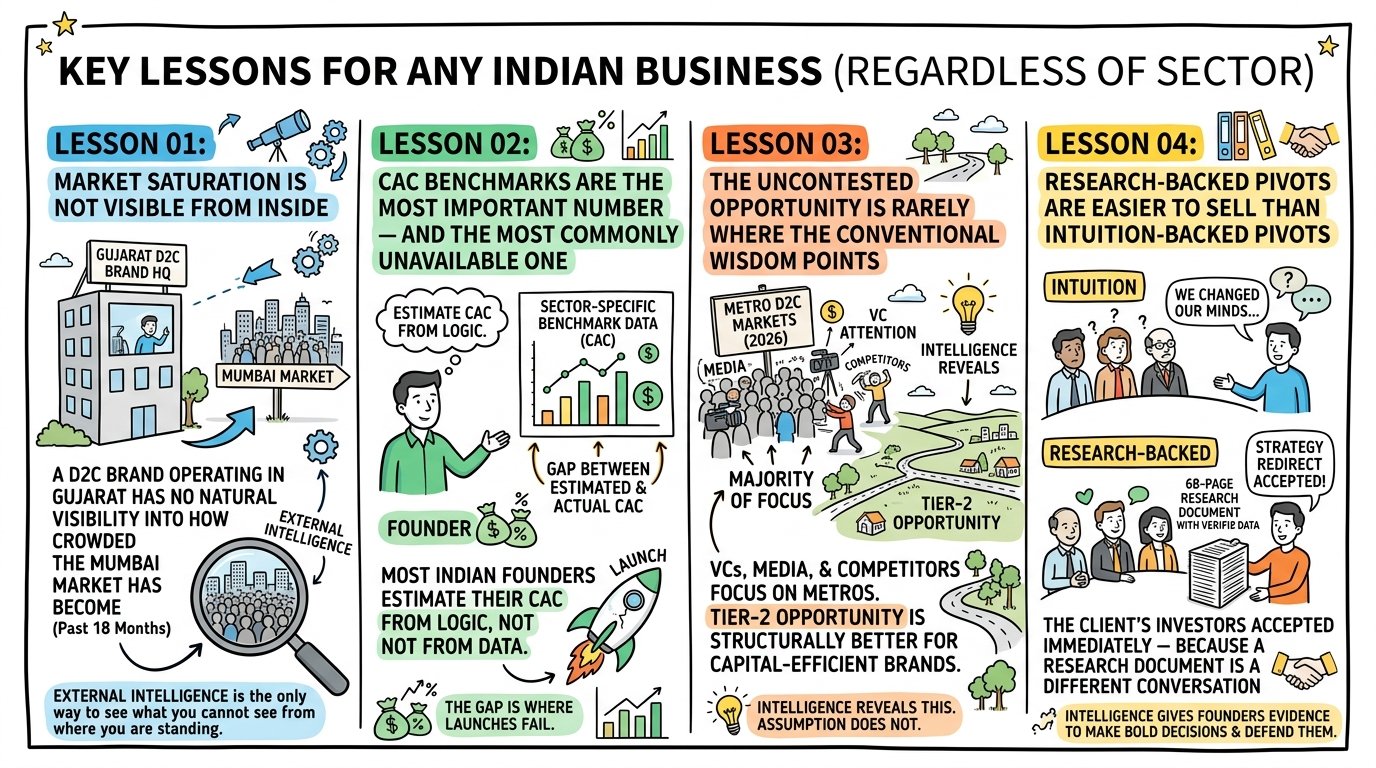
Lesson 01: Market saturation is not visible from inside the market. A D2C brand operating in Gujarat has no natural visibility into how crowded the Mumbai market has become in the past 18 months. External intelligence is the only way to see what you cannot see from where you are standing.
Lesson 02: CAC benchmarks are the most important number in any market entry decision — and the most commonly unavailable one. Most Indian founders estimate their CAC from logic, not from sector-specific benchmark data. The gap between estimated and actual CAC is where launches fail.
Lesson 03: The uncontested opportunity is rarely where the conventional wisdom points. In 2026, metro D2C markets in India receive the majority of VC attention, media coverage, and competitor focus — which is precisely why the Tier-2 opportunity is structurally better for capital-efficient brands. Intelligence reveals this. Assumption does not.
Lesson 04: Research-backed pivots are easier to sell than intuition-backed pivots. The client’s investors accepted the strategy redirect immediately — because a 68-page research document with verified competitive data is a different conversation than “we changed our minds.” Intelligence gives founders the evidence they need to make bold decisions and defend them.
At vero eos et accusamus et iusto odio digni goikussimos ducimus qui to bonfo blanditiis praese. Ntium voluum deleniti atque.