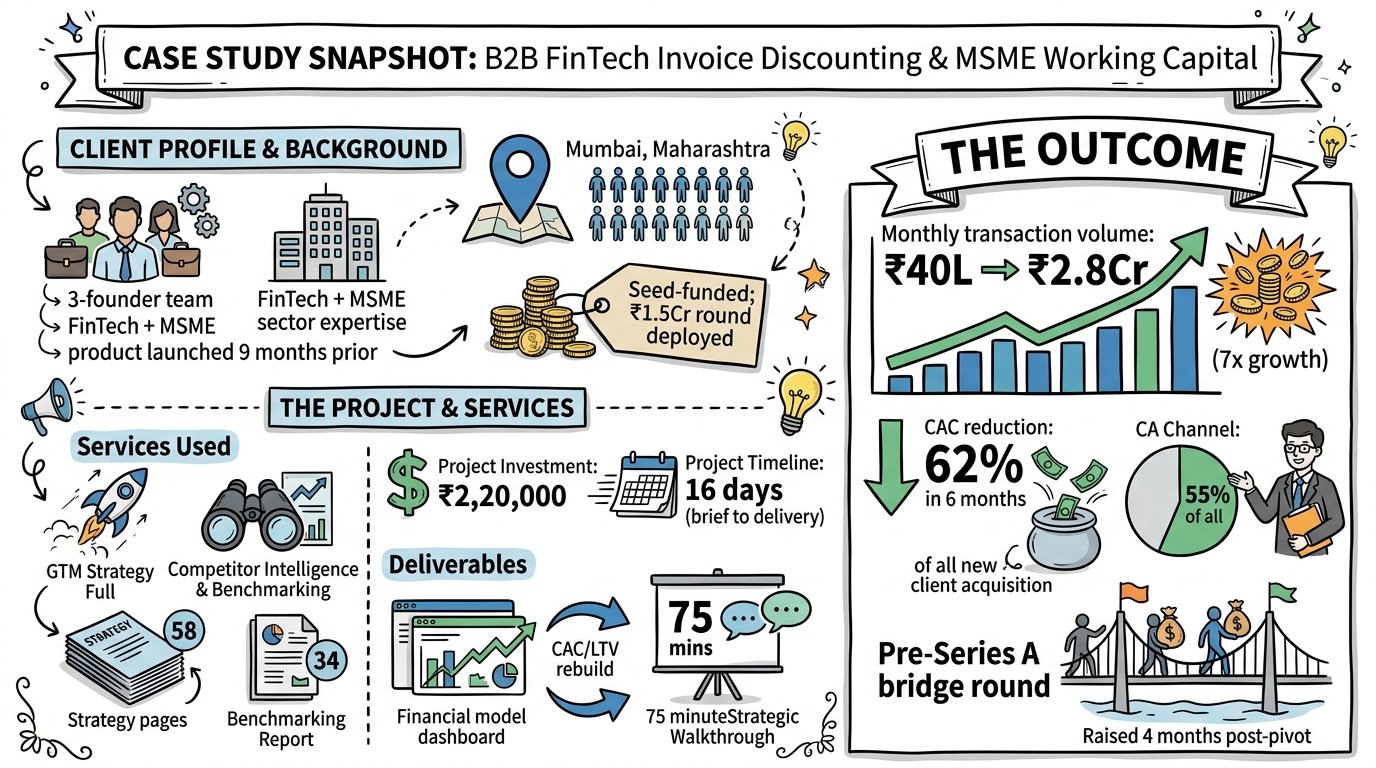
A FinTech Startup Targeting 5 Segments Simultaneously Was Converting None of Them Well. A GTM Strategy Rebuild Grew Transaction Volume 7x in 6 Months and Unlocked a Bridge Round.
PART 1 — THE SITUATION
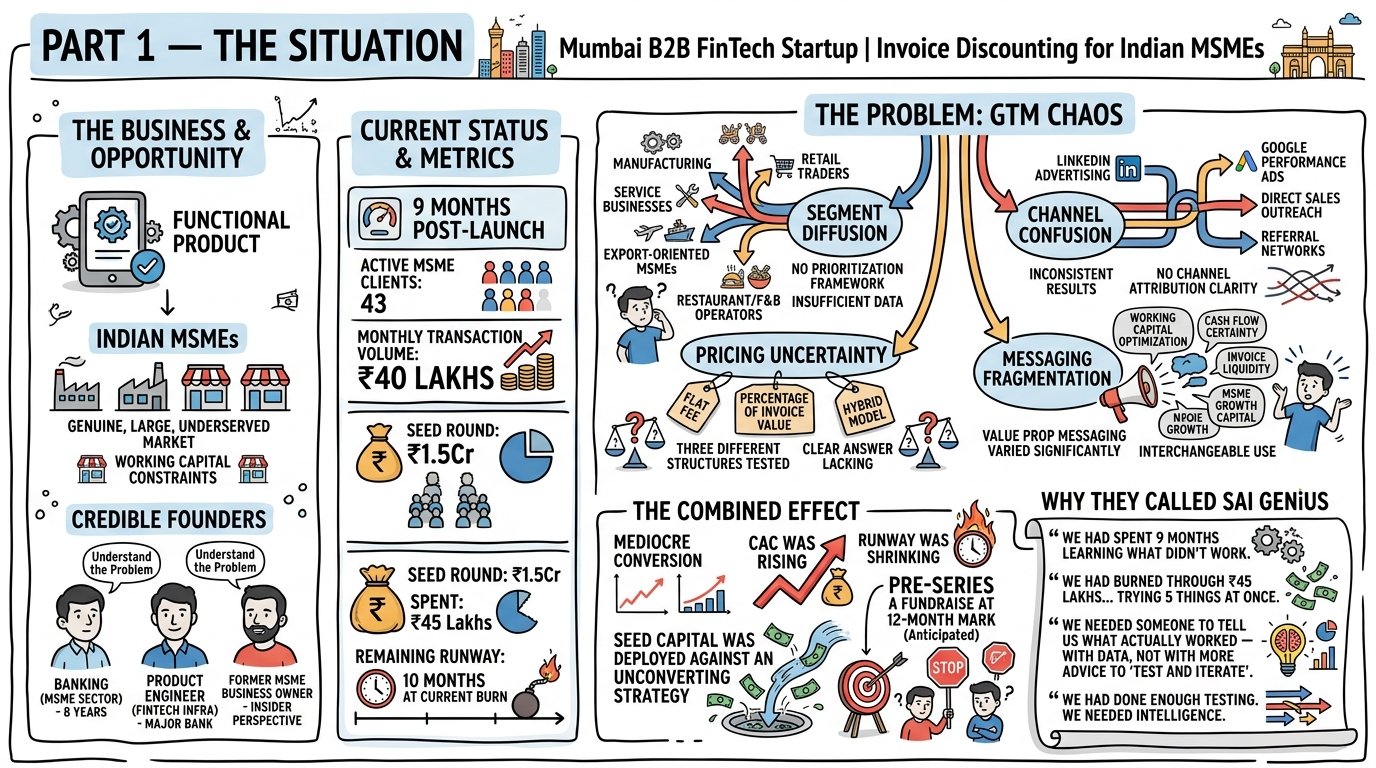
The business: A Mumbai-based B2B FinTech startup had built an invoice discounting platform designed to solve working capital constraints for Indian MSMEs — a genuine, large, and underserved market. The product was functional. The founders were credible: one had 8 years of MSME sector banking experience, one was a product engineer who had built fintech infrastructure at a major Indian bank, and one was a former MSME business owner who understood the problem from the inside.
Nine months after product launch, the platform had 43 active MSME clients, processed ₹40 lakhs in monthly transaction volume, and had spent approximately ₹45 lakhs of their ₹1.5Cr seed round — leaving 10 months of runway at the current burn rate.
The problem was not the product. It was not the market. It was the GTM strategy.
The specific GTM symptoms:
Segment diffusion: The founders were actively pursuing 5 different customer segments simultaneously — manufacturing SMEs, retail traders, service businesses, export-oriented MSMEs, and restaurant/F&B operators — with no prioritization framework and insufficient data to understand which segment converted best
Channel confusion: The team was experimenting with 4 marketing and sales channels simultaneously — LinkedIn advertising, Google performance ads, direct sales outreach, and referral networks — with inconsistent results and no channel attribution clarity
Pricing uncertainty: Three different pricing structures had been tested in 9 months — flat fee, percentage of invoice value, and a hybrid model — without a clear answer on which produced the best conversion and retention economics
Messaging fragmentation: The value proposition messaging varied significantly across channels, team members, and pitch contexts — “working capital optimization,” “cash flow certainty,” “invoice liquidity,” and “MSME growth capital” were all being used interchangeably
The combined effect: mediocre conversion across all segments, all channels, and all pricing structures. CAC was rising as seed capital was deployed against an unconverting strategy. The runway was shrinking. The pre-Series A fundraise that the founders had anticipated at the 12-month mark was becoming increasingly difficult to justify on current metrics.
Why they called SAI GENiUS:“We had spent nine months learning what didn’t work. We had burned through ₹45 lakhs of seed money trying five different things at once. We needed someone to tell us what actually worked — with data, not with more advice to ‘test and iterate.’ We had done enough testing. We needed intelligence.”
PART 2 — THE RESEARCH BRIEF
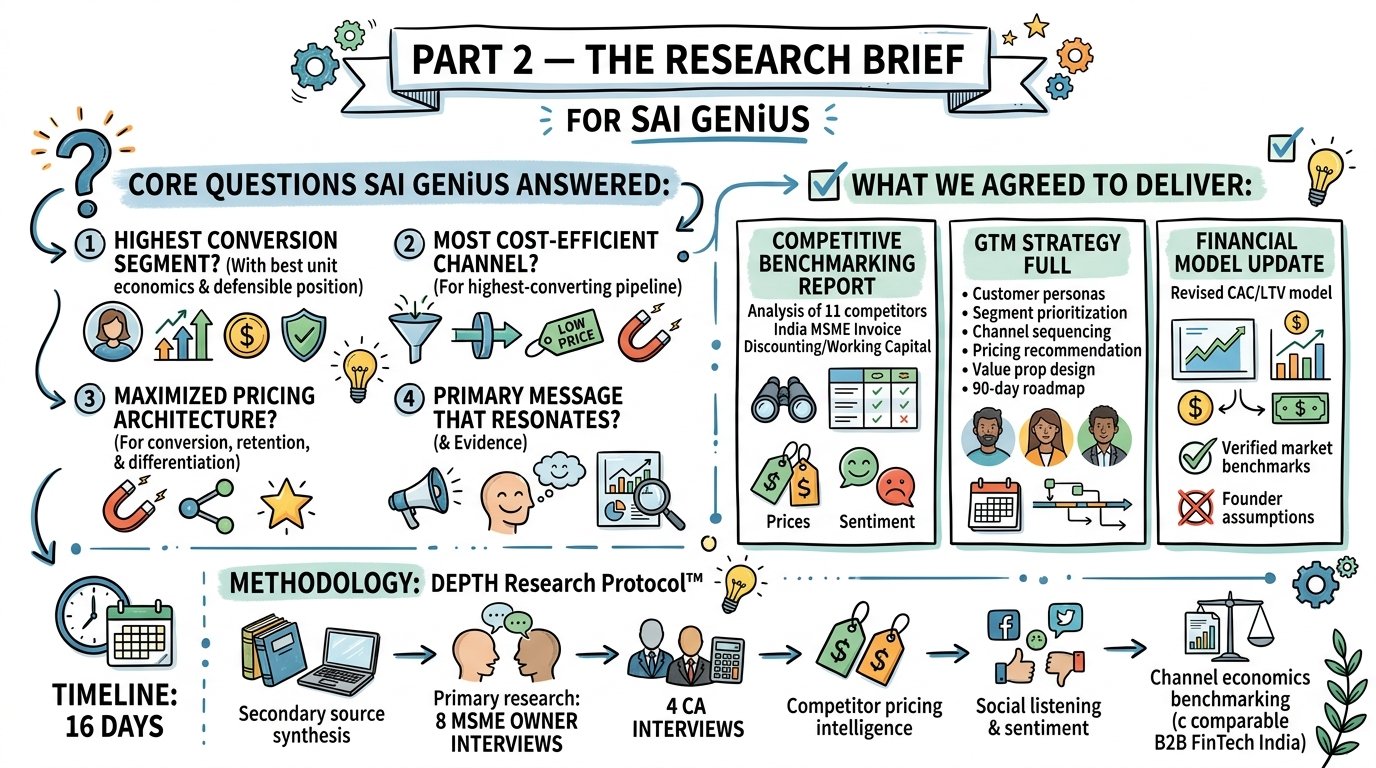
The core questions SAI GENiUS was asked to answer:
Which customer segment has the highest conversion rate, the best unit economics, and the most defensible positioning for this specific product?
Which channel produces the most cost-efficient, highest-converting pipeline for this segment?
What is the pricing architecture that maximises conversion, retention, and competitive differentiation?
What is the primary message that resonates with the target buyer — and what is the evidence for it?
What we agreed to deliver:
Competitive benchmarking report: Analysis of 11 competitors in the India MSME invoice discounting/working capital space — business models, pricing structures, target segment positioning, channel strategies, customer acquisition methods, customer reviews, and sentiment
GTM strategy full: Customer persona development (3 detailed behavioral personas), segment prioritization framework, channel selection and sequencing, pricing architecture recommendation, value proposition design, and 90-day implementation roadmap
Financial model update: Revised CAC/LTV model built from verified market benchmarks rather than founder assumptions
Timeline: 16 days Methodology: DEPTH Research Protocol™ — secondary source synthesis; primary research including 8 structured interviews with Indian MSME owners (the target buyer), 4 structured interviews with Chartered Accountants who advise MSMEs, competitor pricing intelligence, social listening and customer sentiment analysis, channel economics benchmarking from comparable B2B FinTech products in India
PART 3 — WHAT THE RESEARCH FOUND
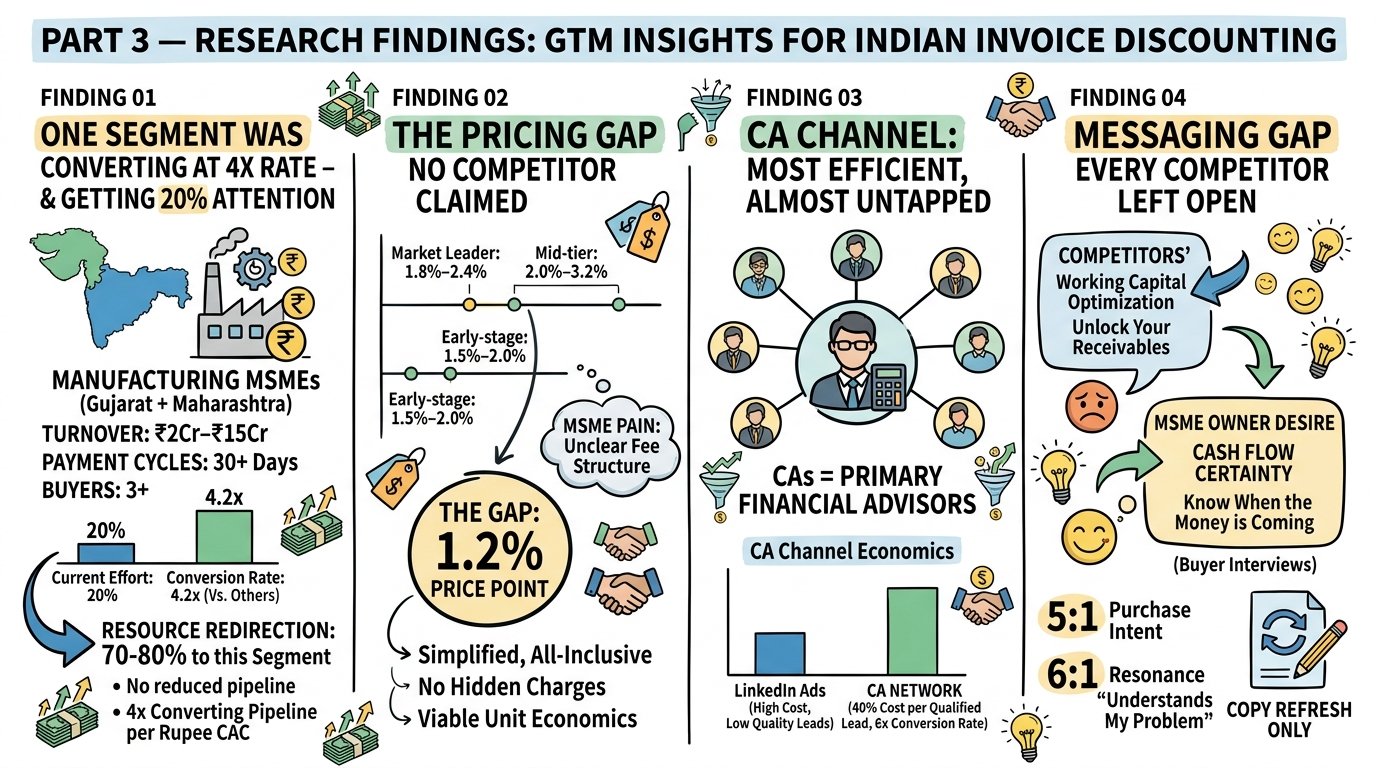
Finding 01 — One Segment Was Converting at 4x the Rate of the Others — and Getting 20% of the Attention
The analysis of the platform’s 43 existing clients — combined with conversion rate data from the sales pipeline and the structured buyer interviews — produced a finding that was both clear and immediately actionable:
Manufacturing SMEs in Gujarat and Maharashtra — specifically those with ₹2Cr–₹15Cr annual turnover, 30+ day invoice payment cycles, and 3+ active buyers — were converting from lead to active client at 4.2 times the rate of any other segment. They were also producing 60% higher transaction volumes in the first 90 days post-acquisition, demonstrating superior product-market fit signals at every measurement point.
The segment was not obscure. The founders knew it was their best segment. The problem: it was receiving only 20% of the total marketing and sales resource allocation, because the team was spreading effort equally across 5 segments without data to justify prioritization.
The prioritization implication: Redirecting 70–80% of sales and marketing resources to manufacturing MSMEs in Gujarat and Maharashtra — a decision the data fully supported — would not reduce the total addressable pipeline. It would concentrate effort on the segment where conversion was 4x more likely, and every rupee of CAC would produce 4x the converting pipeline.
Finding 02 — The Pricing Gap That No Competitor Had Claimed
The competitive intelligence on pricing produced a specific, actionable finding. The analysis of 11 competitors’ pricing structures revealed a clear concentration:
Market leader pricing: 1.8%–2.4% of invoice value per transaction
Mid-tier competitor pricing: 2.0%–3.2% of invoice value per transaction
Early-stage competitor pricing: 1.5%–2.0%, with complex fee structures
A 1.2% price point — with a simplified, transparent fee structure and no hidden charges — was completely uncontested by any competitor in the Indian invoice discounting market. This was not a race to the bottom. At 1.2%, the platform’s unit economics were viable (the margin analysis from verified operational costs confirmed this), and the price point created a positioning gap that was simultaneously differentiated, defensible, and genuinely valuable to the target MSME buyer who experienced fee complexity from competitors as a significant pain point.
The pricing intelligence research also revealed that MSME buyers — confirmed through the buyer interviews — consistently cited “unclear fee structure” as their primary dissatisfaction with incumbent providers. A 1.2% flat, all-inclusive, no-hidden-charges structure addressed the primary buyer pain point and the pricing gap simultaneously.
Finding 03 — The CA Channel Was the Most Efficient Customer Acquisition Channel — and Almost Completely Untapped
This was the finding that the founders found most surprising — and most immediately valuable.
The buyer interview research — specifically the 4 structured conversations with Chartered Accountants who advise MSME clients — revealed a channel dynamic that the founders had not considered in their marketing strategy: Chartered Accountants are the primary financial decision advisor for Indian MSMEs, and they actively recommend working capital solutions to clients.
The mechanism: Indian MSMEs — especially manufacturing businesses with ₹2Cr–₹15Cr turnover — typically do not have internal finance directors. They rely on their CA for tax compliance, financial reporting, and financial product recommendations. A CA who trusts an invoice discounting platform will recommend it to 15–30 MSME clients. A single CA relationship is equivalent to a 15–30 member sales pipeline that arrives pre-qualified and pre-trusted.
The conversion rate data from the existing 43 clients confirmed this: 8 of the 43 active clients had been acquired through informal CA referrals — a referral rate of 18.6% against an investment of approximately ₹0 in the CA channel. The channel was converting without being activated intentionally. The implication: deliberate CA network development would produce a far larger effect.
The channel economics benchmark — from conversations with B2B FinTech operators who had tested both LinkedIn advertising and CA network strategies — showed CA referral producing leads at 40% of the cost per qualified lead versus LinkedIn, with a 6x higher conversion rate from qualified lead to active client.
The action implication: Redirecting significant resources from LinkedIn advertising (expensive, high-volume, low-quality leads) to deliberate CA network engagement (low cost, low volume, extremely high-quality leads) was the single highest-ROI GTM change available to the platform.
Finding 04 — The Messaging Gap That Every Competitor Had Left Open
The social listening and buyer interview research produced a specific, verifiable messaging insight.
Every competitor in the Indian invoice discounting space used some variation of “working capital optimization” or “unlock your receivables” as their primary messaging. The language was financial-professional — technically accurate but emotionally distant from the actual MSME buyer experience.
The buyer interviews revealed something different. When MSME owners described why they needed invoice discounting, they used a consistent, specific phrase that appeared in 6 of 8 interviews: “I need to know when the money is coming.” Not “optimize working capital.” Not “unlock receivables.” The primary psychological need was certainty — predictability of cash inflow — not optimization of financial efficiency.
“Cash flow certainty” — tested against “working capital optimization” in a structured messaging exercise with 6 MSME owners in the target segment — outperformed the competitor standard language 5:1 on self-reported purchase intent, and 6:1 on the measure of “this company understands my problem.”
The message every competitor was using was the message buyers found least resonant. The message buyers actually responded to — “cash flow certainty,” “know when your money is coming” — was being used by no one.
The messaging implication: A messaging pivot from “working capital optimization” to “cash flow certainty” would not require product changes, pricing changes, or channel changes. It would require a copy refresh across every sales channel — and would immediately differentiate the platform in a way that competitors, locked into financial-professional language by their marketing teams, would struggle to replicate quickly.
PART 4 — THE RECOMMENDATION
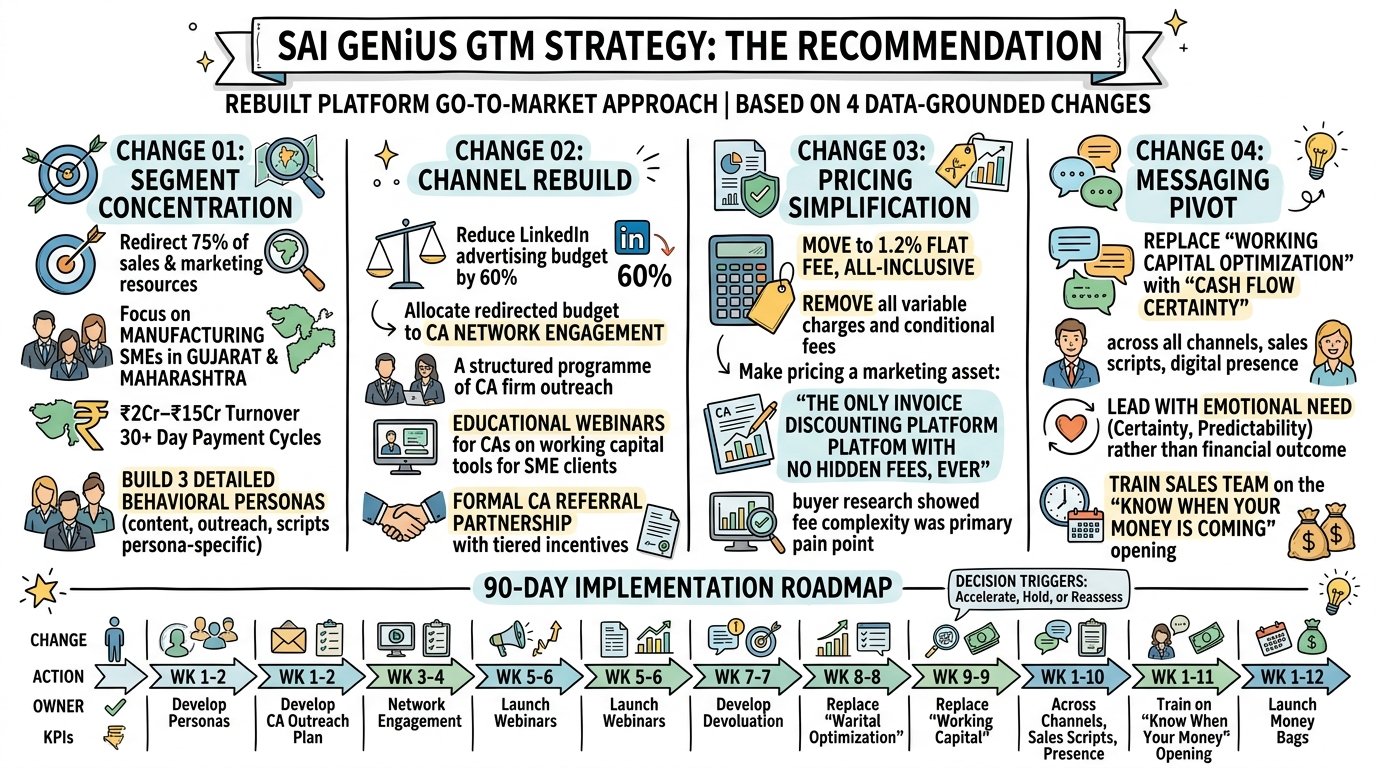
The SAI GENiUS GTM strategy rebuilt the platform’s go-to-market approach around four specific, data-grounded changes:
Change 01 — Segment Concentration: Redirect 75% of sales and marketing resources to manufacturing SMEs in Gujarat and Maharashtra, ₹2Cr–₹15Cr turnover, 30+ day payment cycles. Build 3 detailed behavioral personas for this segment — the content, outreach, and sales conversation script are all persona-specific.
Change 02 — Channel Rebuild: Reduce LinkedIn advertising budget by 60%. Allocate redirected budget to CA network engagement — a structured programme of CA firm outreach, educational webinars for CAs on working capital tools for SME clients, and a formal CA referral partnership with tiered incentives.
Change 03 — Pricing Simplification Move to 1.2% flat fee, all-inclusive. Remove all variable charges and conditional fees. Make the pricing structure a marketing asset — “the only invoice discounting platform with no hidden fees, ever” — because the buyer research showed fee complexity was the primary pain point with incumbents.
Change 04 — Messaging Pivot Replace “working capital optimization” with “cash flow certainty” across all channels, sales scripts, and digital presence. Lead with the buyer’s emotional need (certainty, predictability) rather than the financial outcome (optimization). Train the sales team on the “know when your money is coming” conversational opening.
The 90-day implementation roadmap assigned specific actions, owners, KPIs, and decision gates to each change — week by week, with clear decision triggers for when to accelerate, when to hold, and when to reassess.
PART 5 — THE DECISION
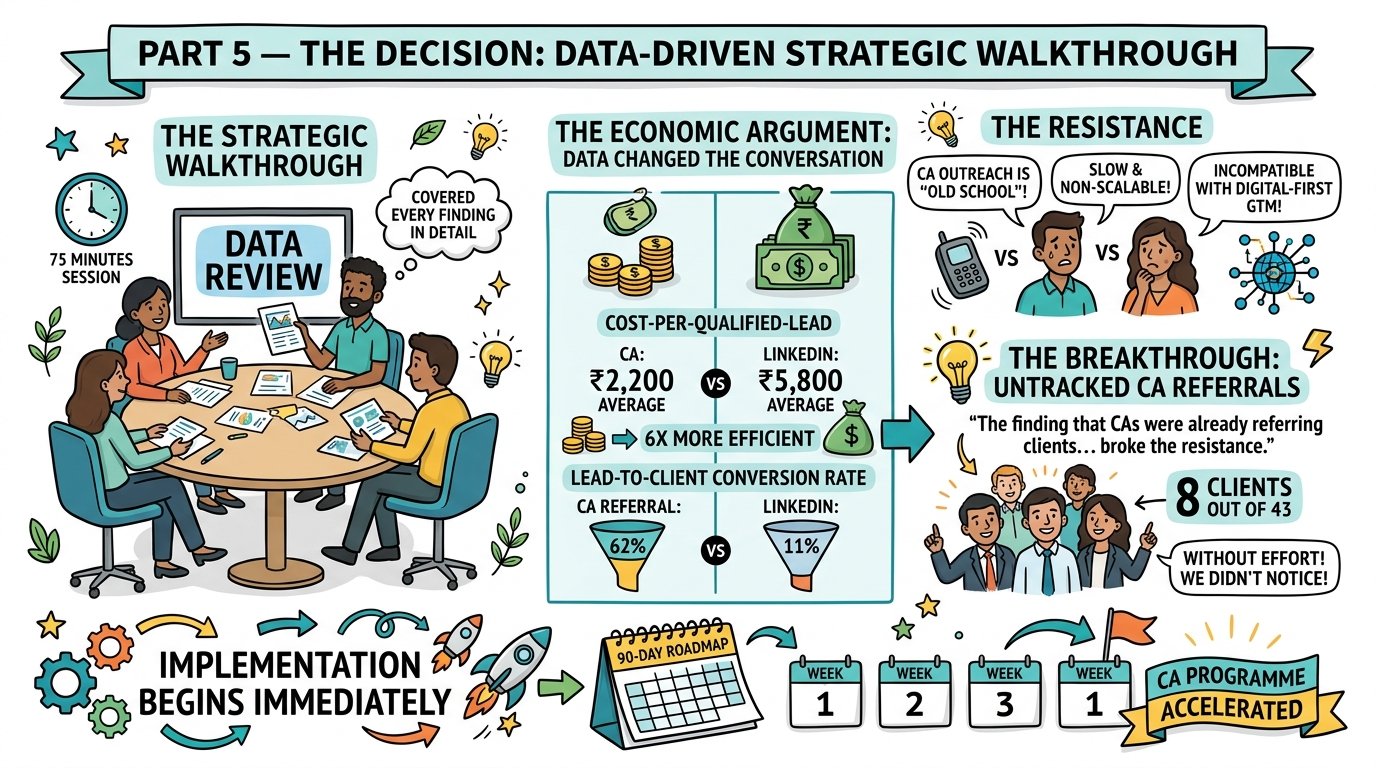
The founders reviewed the research at the Strategic Walkthrough — all three founders, full team. The session lasted 75 minutes and covered every significant finding in detail.
The CA channel finding generated the most discussion — and the most resistance. The founding team’s instinct was that CA outreach was “old school,” slow, and incompatible with the digital-first, scalable GTM model they had envisioned.
The data changed the conversation. When the cost-per-qualified-lead comparison was presented (CA: ₹2,200 average; LinkedIn: ₹5,800 average) alongside the conversion rate differential (CA referral: 62% lead-to-client; LinkedIn: 11% lead-to-client), the economic argument was unambiguous. The “old school” channel was six times more efficient than the “scalable” channel.
“The finding that CAs were already referring clients to us at zero investment — 8 clients out of 43, without us even trying — was the thing that broke the resistance. We were already getting CA referrals. We just hadn’t noticed because we weren’t tracking the source. The research showed us a channel we were already winning in, that we were paying no attention to.”
Implementation began immediately after the walkthrough. The 90-day roadmap was adopted with one modification: the CA programme was accelerated to Week 1 rather than Week 3, given the founders’ recognition that the window was already open.
PART 6 — THE OUTCOME
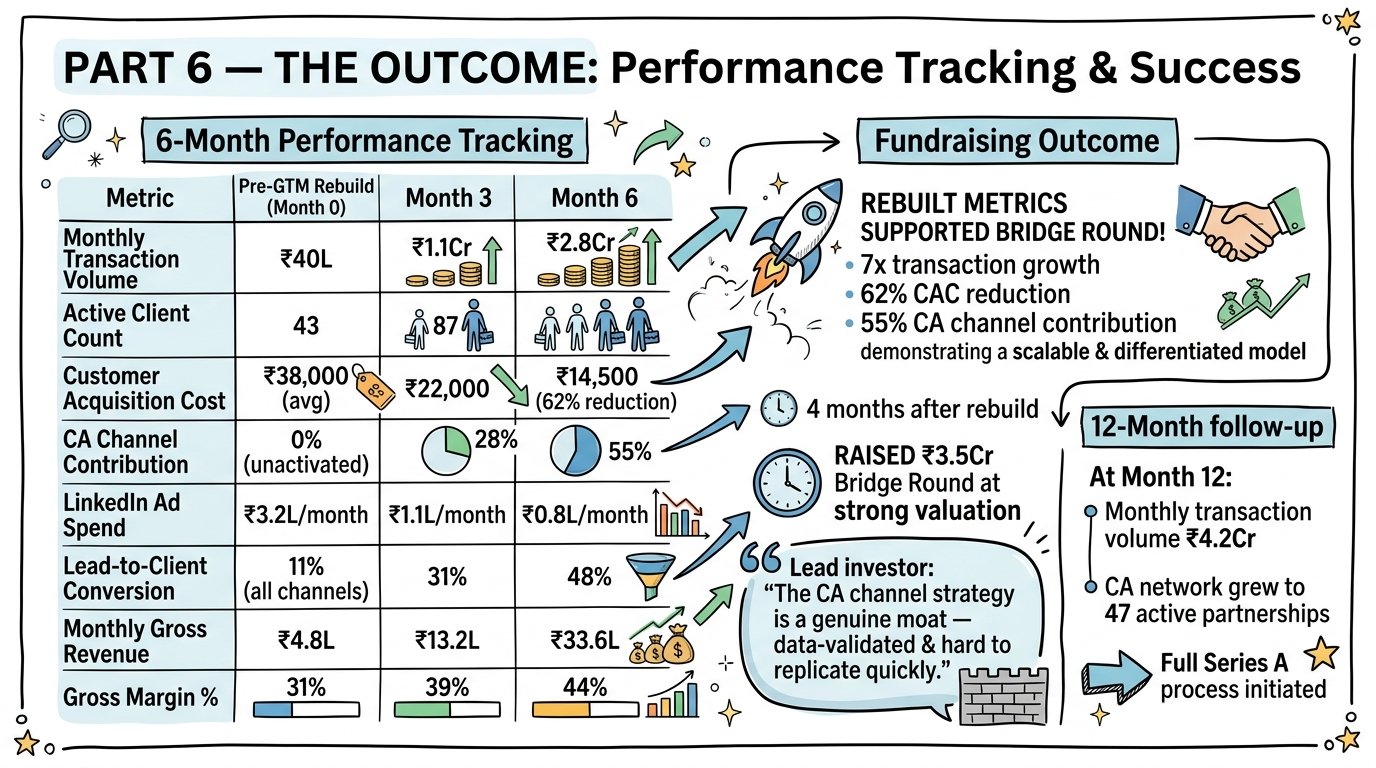
6-Month Performance Tracking:
Metric
Pre-GTM Rebuild (Month 0)
Month 3
Month 6
Monthly Transaction Volume
₹40L
₹1.1Cr
₹2.8Cr
Active Client Count
43
87
164
Customer Acquisition Cost
₹38,000 (avg)
₹22,000
₹14,500 (62% reduction)
CA Channel Contribution
0% (unactivated)
28%
55%
LinkedIn Ad Spend
₹3.2L/month
₹1.1L/month
₹0.8L/month
Lead-to-Client Conversion
11% (all channels)
31%
48%
Monthly Gross Revenue
₹4.8L
₹13.2L
₹33.6L
Gross Margin %
31%
39%
44%
Fundraising outcome: The rebuilt metrics — 7x transaction volume growth, 62% CAC reduction, 55% CA channel contribution, demonstrating a scalable and differentiated acquisition model — supported a pre-Series A bridge round conversation that had been impossible at pre-pivot metrics.
Four months after the GTM rebuild, the platform raised a ₹3.5Cr bridge round at a valuation reflecting the post-pivot growth trajectory. The lead investor cited the CA channel strategy as a genuine moat — a distribution insight that was both data-validated and difficult for competitors to replicate quickly.
12-Month follow-up: At Month 12, the platform was processing ₹4.2Cr in monthly transaction volume. The CA network had grown to 47 active referral partnerships. A full Series A process was initiated.
PART 7 — THE CLIENT’S VOICE
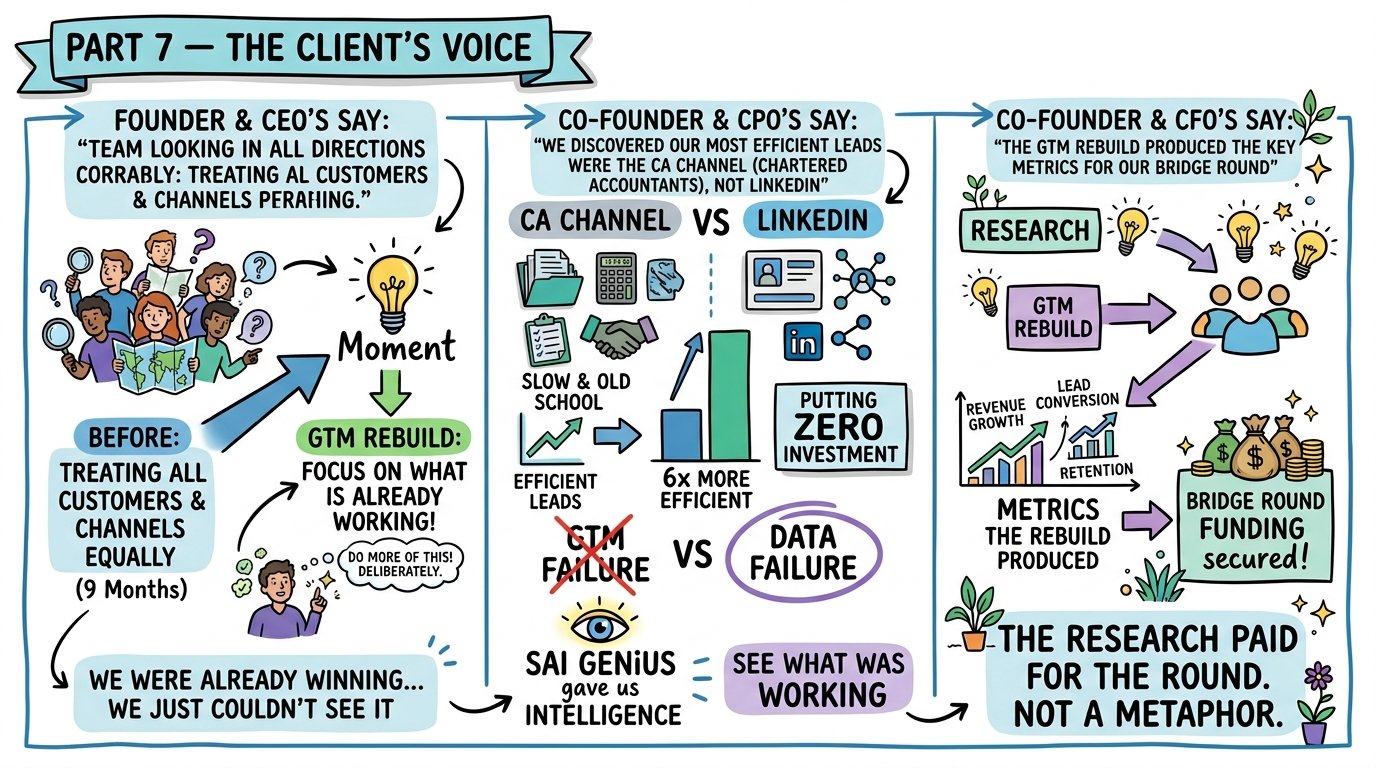
“We had been treating every customer segment, every channel, and every message as equally worthy of attention for nine months. What the research showed us was that we were already winning in one specific place — we just couldn’t see it because we were looking everywhere at once. The GTM rebuild was not about finding new things to try. It was about seeing what was already working and doing more of it, deliberately.” — Founder & CEO, B2B FinTech Startup, Mumbai.
“The CA channel insight changed everything. We had written off CA relationships as ‘slow and old school.’ The data showed us they were the most efficient lead source we had — six times more efficient than LinkedIn — and we were putting zero investment into them. That is not a GTM failure. That is a data failure. We did not have the intelligence to see what was working. SAI GENiUS gave us that intelligence.” — Co-Founder & CPO, B2B FinTech Startup, Mumbai
“The bridge round happened because of the metrics the GTM rebuild produced. And the GTM rebuild happened because of the research. The research paid for the round. That is not a metaphor.” — Co-Founder & CFO, B2B FinTech Startup, Mumbai.
PART 8 — THE CROSS-SECTOR LESSON
What this case study teaches any startup founder whose GTM is not producing consistent results:
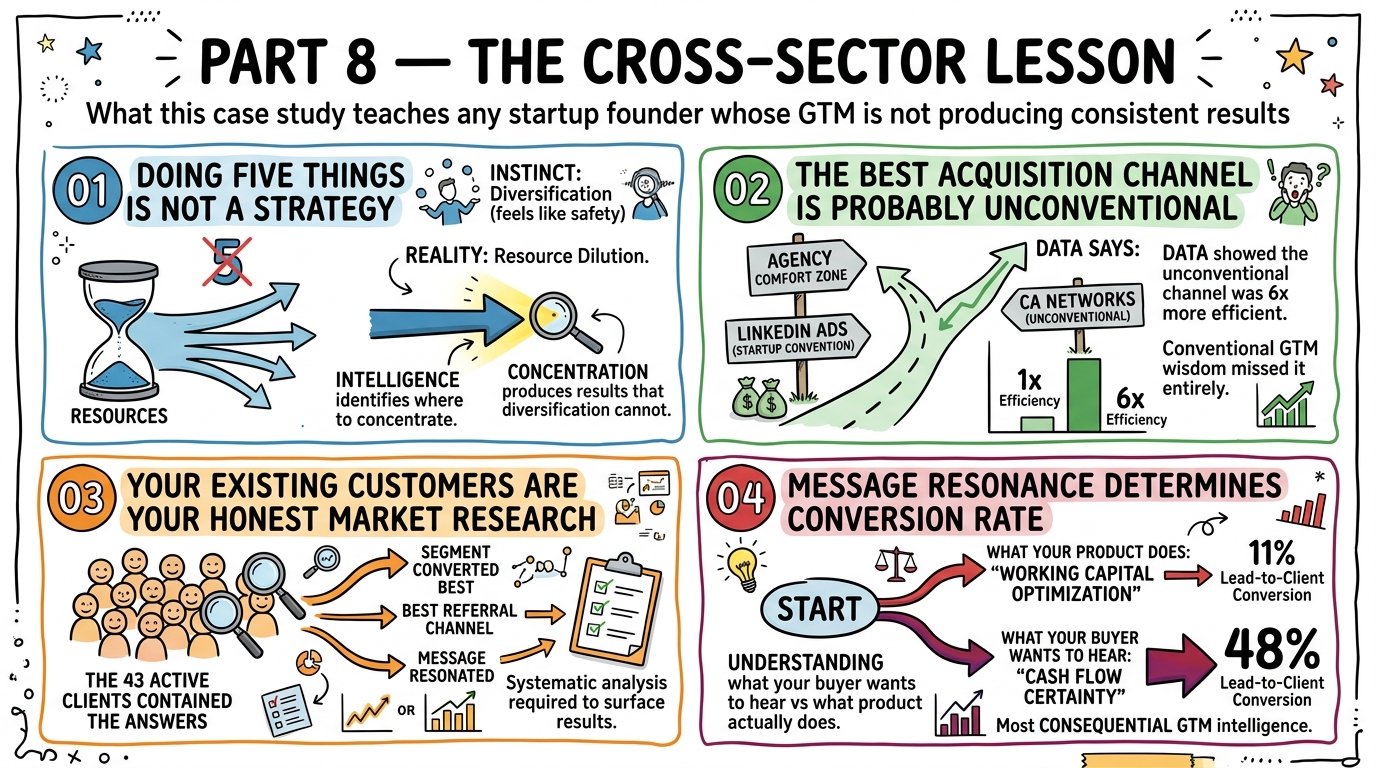
Lesson 01: Doing five things simultaneously is not a strategy — it is the absence of one. The instinct to pursue multiple segments, channels, and messages simultaneously feels like risk diversification. It is actually resource dilution. Intelligence identifies where to concentrate, and concentration produces results that diversification cannot.
Lesson 02: The best customer acquisition channel for your business is probably not the one your marketing agency is most comfortable with. CA networks are not a startup marketing convention. LinkedIn advertising is. The data said the unconventional channel was 6x more efficient. Conventional GTM wisdom would have missed it entirely.
Lesson 03: Your existing customers are your most honest market research. The 43 active clients in this case study contained the answer to every significant GTM question — which segment converted best, which channel produced the best referrals, which message resonated. The answers were available. They required a systematic analysis to surface.
Lesson 04: Message resonance determines conversion rate before any other GTM variable. The difference between “working capital optimization” and “cash flow certainty” is not a copywriting detail. It is the difference between 11% and 48% lead-to-client conversion. Understanding what your buyer actually wants to hear — versus what your product actually does — is the most consequential GTM intelligence available.
At vero eos et accusamus et iusto odio digni goikussimos ducimus qui to bonfo blanditiis praese. Ntium voluum deleniti atque.