

The DEPTH Research Protocol™: Why Every SAI GENiUS Deliverable Is Built to a Standard That Holds Up Under Pressure.
What the DEPTH Protocol Is
The DEPTH Research Protocol is SAI GENiUS’s proprietary quality standard — a 5-layer research framework that every project follows, regardless of scope, price, or timeline. It is the operational expression of our commitment to research that is not just comprehensive, but genuinely reliable and immediately actionable.
It exists because “market research” as an industry category has an accountability problem. A freelancer and a Big-4 consulting firm both call their output “market research.” The quality difference is enormous. The terminological difference is zero.
The DEPTH Protocol is our answer to that problem — a verifiable, documented, reproducible standard that defines exactly what our research process includes, and that allows clients to hold us accountable to it.
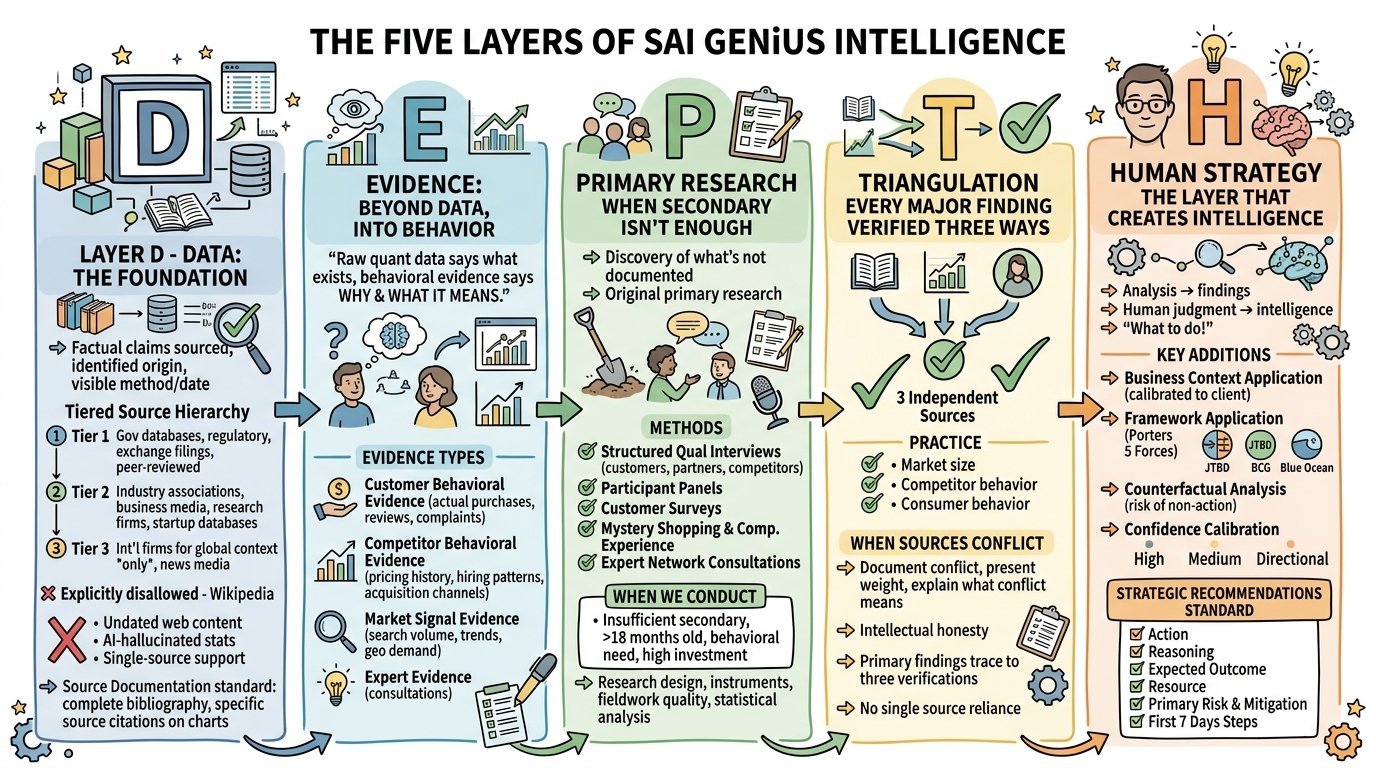
Data: The Foundation of Everything
What this layer ensures: Every factual claim in an SAI GENiUS deliverable is sourced. Every data point has an identified origin. Every quantitative finding is presented with its methodology and recency date visible.
How we apply it:
We operate with a tiered source hierarchy — meaning different types of data claims require different types of source standards:
Tier 1 Sources (Required for all primary market sizing and competitive claims)
- Government databases: Ministry of MSME, DPIIT, RBI, SEBI, MCA21, Ministry of Commerce
- Regulatory publications: TRAI, FSSAI, BIS, IRDAI sector reports
- Exchange filings: BSE/NSE annual reports, SEBI disclosures for listed companies
- Peer-reviewed academic research from Indian business schools and economic research institutions
Tier 2 Sources (Required for sector trend analysis and market behavior claims)
- Industry association publications: CII, FICCI, NASSCOM, ASSOCHAM, sectoral associations
- Reputable Indian business media: Economic Times, Business Standard, Mint, Livemint
- Credible research firms: CRISIL, ICRA, India Ratings, Technopak, RedSeer (with recency standards)
- Startup and investment databases: Tracxn, Crunchbase India, VCCEdge, Venture Intelligence
Tier 3 Sources (Supporting evidence only — never the primary basis for a major claim)
- International research firms: Statista, Gartner, McKinsey Global Institute — used for global context and macro trends, never as the primary source for India-specific claims
- News media coverage, industry blogs, founder interviews — used for directional corroboration only
What we explicitly do not allow:
- Wikipedia as a data source
- Undated web content as evidence for market size claims
- AI-hallucinated statistics (every AI-generated figure is manually verified against source documents)
- Single-source support for any claim that will become a primary recommendation driver
The source documentation standard: Every deliverable includes a complete source bibliography. Every chart and data visualization cites the specific source and recency date. If you want to verify any claim in a SAI GENiUS deliverable, you have everything you need to do so — within the document.
Evidence: Beyond Data, Into Behavior
What this layer ensures: Raw quantitative data tells you what exists. Behavioral evidence tells you why it exists and what it means. Both are required for intelligence that drives good decisions.
The evidence types we gather:
Customer Behavioral Evidence. Where we can access it, we gather direct evidence of customer behavior — not just customer preference surveys (which tell you what people say they do) but observable behavioral signals: actual purchase patterns, product review content analysis, complaint frequency data, customer service escalation patterns from competitor review databases, and community forum discussion analysis.
Competitor Behavioral Evidence We analyze competitor behavior — not just what they say about themselves on their website, but what they actually do: their pricing history (through archive tools), their hiring patterns (through LinkedIn job posting analysis, which reliably predicts strategic direction 6–9 months before public announcement), their content publication patterns (which reveal strategic priorities), and their customer acquisition channels (through digital traffic analysis tools).
Market Signal Evidence We track observable market signals: search volume trends on Google (India-specific), category-level consumer interest shifts, geographic demand distribution through digital engagement patterns, and regulatory activity patterns that predict policy-driven market shifts.
Expert Evidence. Where projects require it, we conduct structured expert consultations — targeted conversations with industry veterans, ex-founders, distribution operators, or sector-specific operators who have ground-level visibility that no database can replicate.
Primary Research: When Secondary Data Is Not Enough
What this layer ensures: Secondary research synthesizes what is already known. Primary research discovers what is not yet documented. For decisions that require it, we conduct original primary research rather than relying exclusively on existing published data.
Our primary research methods:
Structured Qualitative Interviews 10–20 minute structured telephone or video interviews with: target customer profiles, channel partners and distributors, industry operators and sector experts, competitor customers (to understand switching behavior and satisfaction drivers), and regulatory or policy experts.
For projects where this is required, we maintain a panel of pre-recruited research participants across key sectors and geographies — reducing recruitment time and allowing rapid turnaround on primary research projects.
Customer Surveys Designed, distributed, and statistically analyzed consumer surveys — through panel providers, industry association networks, or digital distribution. Sample sizes appropriate to the confidence interval requirements of the specific decision being informed.
Mystery Shopping & Competitive Experience Research. Where competitive intelligence requires it, we conduct structured mystery shopping exercises — experiencing the competitor's sales process, customer service, and product quality firsthand and documenting it systematically.
Expert Network Consultations Access to domain specialists — ex-Big-4 consultants, sector-specific operators, former industry executives, regulatory advisors — who provide depth of insight that secondary research cannot replicate.
When we conduct primary research: Primary research is conducted when: (1) secondary data sources are insufficient, contradictory, or more than 18 months old for a rapidly evolving sector; (2) the specific business question requires behavioral data that does not exist in published form; or (3) the investment size of the client's decision justifies the additional investment in primary research certainty.
All primary research projects include: research design documentation, data collection instruments, fieldwork quality controls, and statistical analysis with appropriate confidence interval disclosures.
Triangulation: Every Major Finding Verified Three Ways
What this layer ensures: No single source is reliable enough to carry a major business recommendation on its own. Every significant finding in a SAI GENiUS deliverable is verified across a minimum of three independent sources before it enters the document.
The triangulation standard in practice:
For market size claims: Three independent methodologies or data sources must converge before we state a market size figure with confidence. If they diverge significantly, we document the divergence, explain the likely methodological reasons for it, and present a reasoned synthesis — never hiding conflicting data.
For competitor behavior claims: Three independent data types must corroborate a competitor behavioral pattern before we recommend strategic action based on it. We do not tell a client "your competitor is losing market share" based on one negative review thread on Reddit.
For consumer behavior claims: Behavioral evidence, survey evidence, and third-party research must align before we present a consumer behavior pattern as strategically reliable.
What happens when sources conflict: We document the conflict in the deliverable. We present both perspectives with appropriate weight. We explain what the conflict means for the decision — sometimes conflicting evidence means the answer is genuinely unclear, and the intellectually honest response is to say so, not to pick the more convenient interpretation.
The triangulation documentation: Every primary finding in our executive summary can be traced to three source verifications within the research body. If a client's investor asks, "How do you know this?" — the answer is documented within the deliverable.
Human Strategy: The Layer That Creates Intelligence From Data
What this layer ensures: Data analysis produces findings. Human strategic judgment produces intelligence. The H layer is what transforms a well-organized research document into something that tells you specifically what to do.
What the human strategy layer adds:
Business Context Application A senior SAI GENiUS strategist reads every deliverable with the client's specific business context front of mind — your current revenue, your team capability, your funding position, your existing customer relationships, your competitive vulnerabilities — and ensures that every recommendation is calibrated to your actual situation, not a theoretical business with infinite resources.
Framework Application We apply proven strategic frameworks — Porter's Five Forces, Jobs-to-Be-Done, Blue Ocean Strategy analysis, BCG Growth-Share Matrix, Roger Martin's Playing to Win, GTM Velocity Frameworks — not as templates to complete, but as interpretive lenses that surface strategic implications that data analysis alone cannot reveal.
Counterfactual Analysis. For every major recommendation, we explicitly analyze the counterfactual: what happens if you do not act on this finding? What happens if the finding is directionally correct but the magnitude is off by 50%? This makes recommendations more robust to real-world uncertainty.
Confidence Calibration We explicitly label our findings by confidence level — High Confidence (triangulated across three+ sources, consistent with behavioral evidence), Medium Confidence (two sources, directionally consistent), and Directional Signals (single source or emerging data, worth monitoring but not the basis of major resource allocation alone). This prevents the most common failure mode of market research: treating uncertain findings with the same weight as facts.
The Strategic Recommendations Standard Every SAI GENiUS recommendation includes: the specific action recommended, the reasoning (data evidence + strategic logic), the expected outcome and timeline, the resource requirement, the primary risk and its mitigation, and the first concrete step to take within 7 days.
A recommendation that does not include all of these elements is not a recommendation — it is an opinion. We do not deliver opinions.
The DEPTH Protocol — Summary Table
Layer | What It Does | Why It Matters |
D — Data | Sources every claim to verified, tiered data origins | Eliminates unverifiable statistics and AI hallucination |
E — Evidence | Adds behavioral evidence beyond quantitative data | Captures the “why” behind market patterns |
P — Primary Research | Conducts original research when secondary data is insufficient | Answers questions that no existing database can address |
T — Triangulation | Validates every major finding across 3+ independent sources | Prevents single-source errors from driving strategy |
H — Human Strategy | Applies strategic frameworks and client-specific judgment | Converts data into actionable, calibrated recommendations |
Every deliverable. Every time. No exceptions.
The 25-Point DEPTH Quality Checklist
Every completed SAI GENiUS deliverable passes through this checklist before delivery. Clients receive a copy of their completed checklist upon request.
Factual Accuracy (7 checks)
- All quantitative claims are sourced to Tier 1 or Tier 2 sources
- All data points include publication/recency dates
- India-specific sources are prioritized over global aggregates for India market claims.
- All AI-generated statistics have been manually verified against primary sources.
- No claims are presented without attribution.
- All regulatory references reflect current applicable law (as of project date)
- Company-specific facts have been verified against company-owned primary sources (filings, official statements)
Analytical Rigour (6 checks)
- All major findings are triangulated across 3+ independent sources
- Conflicting data sources are documented and reconciled in the deliverable
- Statistical claims include appropriate confidence interval disclosures
- Market size calculations use a documented, bottom-up methodology for India-specific figures
- Competitor behavioral claims are supported by observable evidence, not stated positioning alone
- All assumptions are explicitly stated as assumptions (not presented as verified facts)
Strategic Depth (5 checks)
- Every major finding is connected to a specific strategic implication for the client’s business.
- All recommendations include: action, reasoning, expected outcome, resource requirement, risk, and first step.
- Recommendations are prioritized by impact, speed, resource requirement, and risk.
- Counterfactual analysis is included for primary recommendations
- Confidence levels are assigned and disclosed for all major findings
India-Market Accuracy (4 checks)
- Consumer behavior claims reflect India-specific research (not extrapolated from Western markets)
- Regional variations within India are appropriately captured, where strategically relevant.
- Tier-1/Tier-2/Tier-3 market dynamics are differentiated where applicable to the research question.
- Regulatory implications are accurate, current, and India-jurisdiction specific.
Communication Clarity (3 checks)
- An executive summary can be acted on independently without reading the full document.
- All charts and visualizations are self-explanatory with titles, axis labels, and source attributions.
- Document structure follows decision-maker reading patterns (findings and implications before methodology details)