Built on Real Market Intelligence, Not Optimistic Assumptions.

The Business Plan Problem Most Indian Founders Have
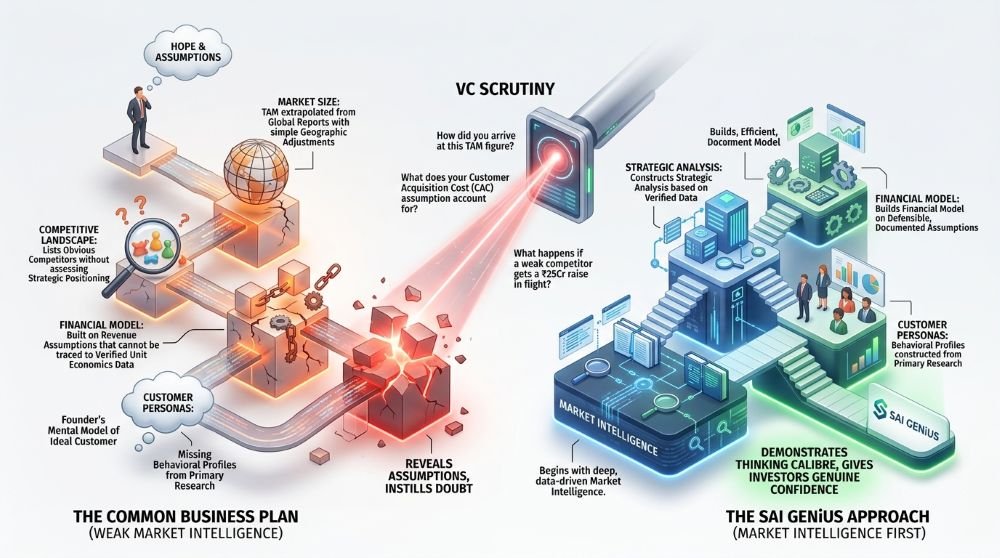
Most business plans written by Indian founders, even strong ones, have the same fundamental weakness: the market intelligence section is built from hope, not from research.
The market size is extrapolated from a global report with a geographic adjustment factor. The competitive landscape lists the obvious competitors without assessing their actual strategic positioning. The financial model is built on revenue assumptions that cannot be traced to verified unit economics data from comparable businesses. The customer personas are descriptions of the founder’s own mental model of the ideal customer, not behavioural profiles constructed from primary research.
Sophisticated VCs recognise all of this in minutes. And when they probe, “How did you arrive at this TAM figure?” “What does your customer acquisition cost assumption account for?” “What happens to your model if the competitor you’ve identified as weak actually has a ₹25Cr raise in flight?” The answers reveal that the plan was built on assumptions rather than intelligence.
SAI GENiUS builds business plans from the opposite direction: we begin with market intelligence, construct the strategic analysis based on verified data, and build the financial model on defensible, documented assumptions. The result is a plan that not only survives VC scrutiny but also demonstrates the calibre of thinking that gives investors genuine confidence.
Sub-Service Types Within Startup Validation & Business Plans
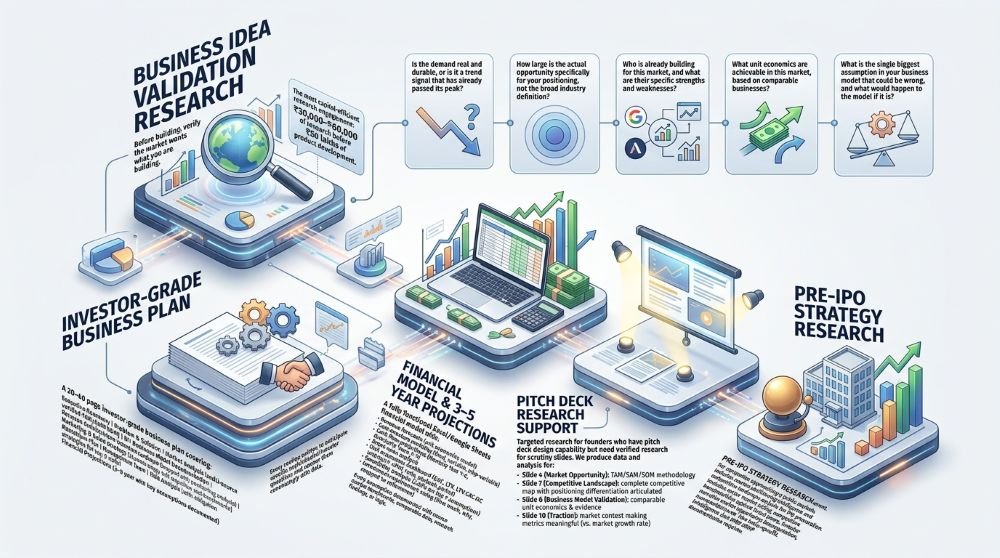
Business Idea Validation Research: Before building, verify the market wants what you are building
The most capital-efficient research engagement in our portfolio: ₹30,000–₹60,000 of research before ₹50 lakhs of product development.
This engagement answers five questions that every founder should verify before committing serious capital:
- Is the demand real and durable, or is it a trend signal that has already passed its peak?
- How large is the actual opportunity specifically for your positioning, not the broad industry definition?
- Who is already building for this market, and what are their specific strengths and weaknesses?
- What unit economics are achievable in this market, based on comparable businesses?
- What is the single biggest assumption in your business model that could be wrong, and what would happen to the model if it is?
Investor-Grade Business Plan: The complete document built to survive serious due diligence
A 20–40 page investor-grade business plan covering: Executive Summary | Problem & Solution | Market Analysis (multi-source verified TAM/SAM/SOM) | Business Model Documentation | Revenue Architecture | Competitive Landscape (mapped with positioning analysis) | Marketing & Sales Strategy (channel strategy with acquisition cost benchmarks) | Operations Plan | Management Team | Risk Analysis (with mitigation strategies for top 5 risks) | Financial Projections (3–5 year with key assumptions documented).
Every section is written to anticipate the specific questions a sophisticated investor will ask and to answer them convincingly, with data behind every assertion.
Financial Model & 3–5 Year Projections: The numbers that either close funding rounds or lose them
A fully functional Excel/Google Sheets financial model with: Revenue forecasts (unit economics model, not top-down projections) | Cost structure modeling (fixed, variable, and step-variable costs) | Cash flow projections (monthly for Year 1–2, quarterly for Years 3–5) | Break-even analysis | Unit economics dashboard (CAC, LTV, LTV:CAC ratio, payback period) | Sensitivity analysis (what happens to the model if the 3 most critical assumptions change by ±20%) | Investment requirement sizing (how much do you need to raise and why, mapped to specific milestones).
Every assumption in the financial model is documented with its source market benchmarks, comparable company data, primary research findings, or the specific logic behind management estimates. Nothing is assumed without disclosure.
Pitch Deck Research Support The specific research for the slides investors scrutinize most
A targeted research engagement for founders who have pitch deck design capability but need verified, investor-grade research for their highest-scrutiny slides. We produce the data and analysis for:
- Slide 4 (Market Opportunity): TAM/SAM/SOM with full methodology documentation
- Slide 7 (Competitive Landscape): complete competitive map with positioning differentiation clearly articulated
- Slide 8 (Business Model Validation): comparable business unit economics and market validation evidence
- Slide 10 (Traction): market context that makes your traction metrics meaningful (what does X growth rate mean against the market growth rate?)
Pre-IPO Strategy Research For companies approaching a public markets event
Market positioning intelligence and competitive landscape analysis for IPO preparation. Includes sector market sizing, competitive benchmarking against listed peers, investor narrative market opportunity documentation, and the India-specific market intelligence that SEBI DRHP documentation requires.
Startup Validation & Business Plan Pricing
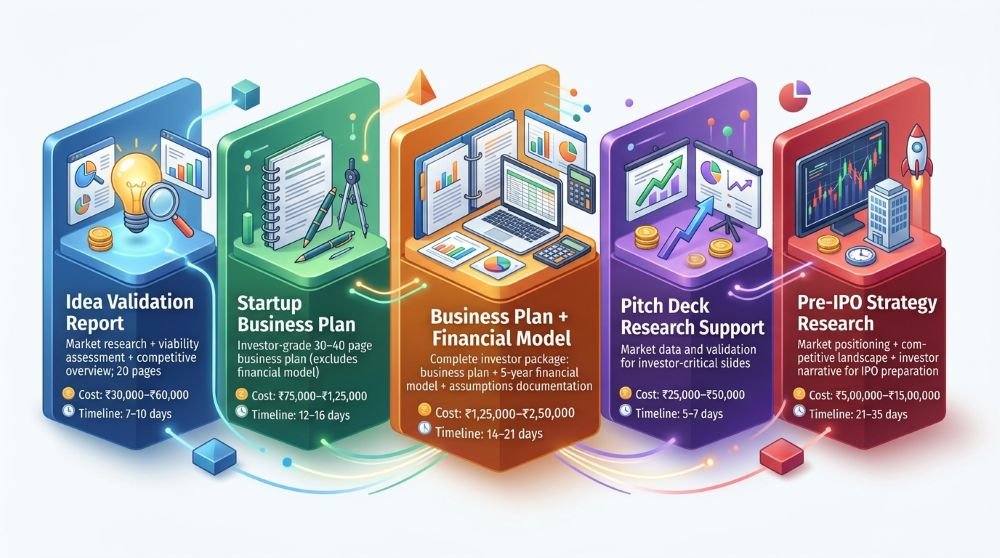
| Package | Scope | Investment | Timeline |
|---|---|---|---|
| Idea Validation Report | Market research + viability assessment + competitive overview; 20 pages | ₹30,000–₹60,000 | 7–10 days |
| Startup Business Plan | Investor-grade 30–40 page business plan (excludes financial model) | ₹75,000–₹1,25,000 | 12–16 days |
| Business Plan + Financial Model | Complete investor package: business plan + 5-year financial model + assumptions documentation | ₹1,25,000–₹2,50,000 | 14–21 days |
| Pitch Deck Research Support | Market data and validation for investor-critical slides | ₹25,000–₹50,000 | 5–7 days |
| Pre-IPO Strategy Research | Market positioning + competitive landscape + investor narrative for IPO preparation | ₹5,00,000–₹15,00,000 | 21–35 days |