A Go-To-Market Strategy That Actually Gets You Customers. Not Just a Well-Formatted Slide Deck.

Why Most GTM Strategies Fail And What We Does Differently
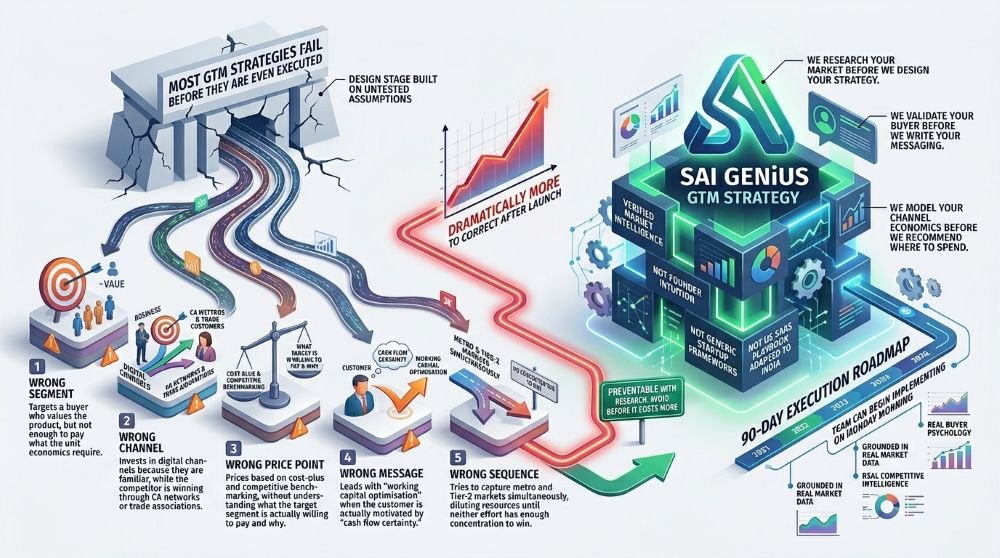
Most GTM strategies fail before they are even executed. The failure happens at the design stage when the strategy is built on untested assumptions rather than verified market intelligence.
Wrong segment: the business targets a buyer who values the product, but not enough to pay what the unit economics require. Wrong channel: the business invests in digital channels because they are familiar, while the competitor that is acquiring the most customers is winning through CA networks or trade associations. Wrong price point: the business prices based on cost-plus and competitive benchmarking, without understanding what the target segment is actually willing to pay and why. Wrong message: the business leads with “working capital optimisation” when the customer is actually motivated by “cash flow certainty.” Wrong sequence: the business tries to capture metro and Tier-2 markets simultaneously, diluting resources until neither effort has enough concentration to win.
Every one of these failures is preventable with research. And every one of them costs dramatically more to correct after launch than to avoid before it.
SAI GENiUS GTM strategy is built from verified market intelligence, not founder intuition, not generic startup frameworks, and not the GTM playbook of a US SaaS company adapted to India. We research your market before we design your strategy. We validate your buyer before we write your messaging. We model your channel economics before we recommend where to spend.
The result is a 90-day execution roadmap your team can begin implementing on Monday morning, grounded in real market data, real competitive intelligence, and real buyer psychology.
What a Full GTM Strategy Engagement Delivers
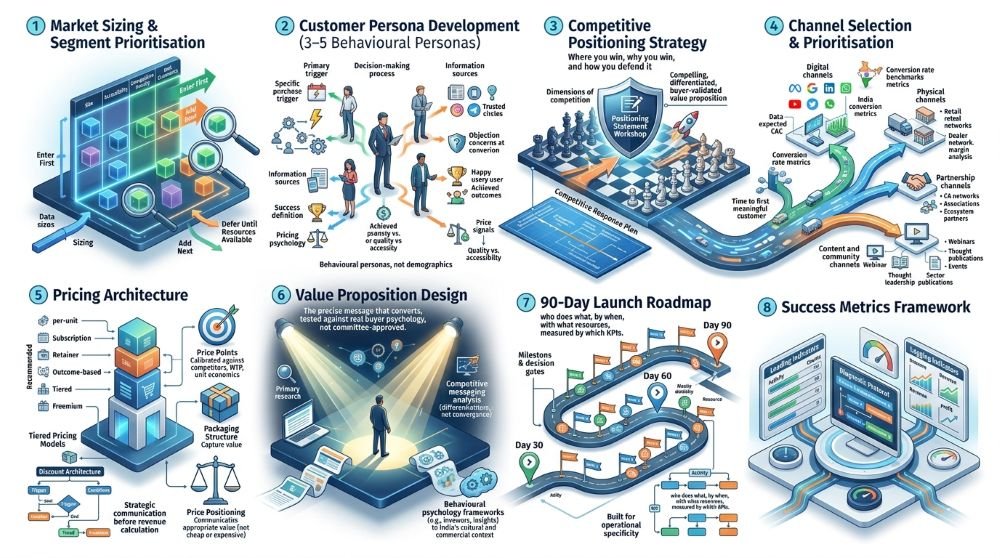
① Market Sizing & Segment Prioritisation Before you define who to target, you need to know which segment of your market is worth targeting first, balancing size, accessibility, competitive density, and unit economics. This component produces a rigorous segment prioritisation matrix: which segment do you enter first, which do you add next, and which do you defer until you have the resources to win it properly?
② Customer Persona Development (3–5 Behavioural Personas), not demographic profiles. Behavioural personas. Each persona includes:
- Primary purchase trigger (the specific event or condition that activates buying behaviour)
- Decision-making process (who is involved, how long it takes, what criteria matter at each stage)
- Information sources (where they discover solutions, who they trust for recommendations)
- Objection landscape (the specific concerns that appear most consistently at the moment of conversion)
- Success definition (what does this persona need to experience or achieve to consider your product a success)
- Pricing psychology (what price signal they use to assess quality versus accessibility)
③ Competitive Positioning Strategy: Where you win, why you win, and how you defend it when competitors respond.
This component answers which competitive dimension to lead on (price, service quality, speed, specialisation, relationship depth), how to position that dimension in language that resonates with your specific target buyer, and how to structure your competitive response plan for the most likely competitive reactions.
Includes a positioning statement workshop: a structured session producing your single most compelling, differentiated, buyer-validated value proposition — not a committee-approved tagline, but a precise message tested against real buyer psychology.
④ Channel Selection & Prioritisation: The right channels, in the right sequence, with the right budget allocation for your specific product, segment, and geography in India.
SAI GENiUS channel analysis evaluates every relevant channel for your context:
- Digital channels (Meta, Google, LinkedIn, YouTube, WhatsApp Business) with India-specific conversion benchmarks
- Physical channels (distributors, retailers, trade channels, dealer networks) with margin structure analysis
- Partnership channels (CA networks, business associations, sector trade bodies, ecosystem partners) with conversion quality comparison
- Content and community channels (webinars, LinkedIn thought leadership, sector publications, industry events)
For each channel: expected customer acquisition cost, conversion rate benchmarks from India-comparable businesses, time to first meaningful customer, and resource requirements for effective execution.
⑤ Pricing Architecture: Your pricing is a strategic communication before it is a revenue calculation. How you price signals who you are, how much you value your product, and how seriously you are competing. Getting this wrong costs you either margin (if too low) or customers (if too high in the wrong way).
This component produces:
- Recommended pricing model (per-unit, subscription, retainer, outcome-based, tiered, freemium)
- Specific price points calibrated against competitor pricing, buyer willingness to pay, and your unit economics
- Packaging structure: how to bundle your product or service to capture maximum value from different buyer segments
- Discount architecture: when to discount, how much, and what conditions should trigger a discount offer
- Price positioning: how to communicate your pricing so it reads as appropriate value rather than either cheap or expensive
⑥ Value Proposition Design: The precise message that converts with your target buyer, tested against real buyer psychology, not committee-approved.
This component is the most underrated in any GTM strategy. Every element of your go-to-market — your website headline, your sales pitch, your investor deck, your LinkedIn content runs through your value proposition. If the value proposition is wrong, every execution effort produces lower returns than it should.
SAI GENiUS value proposition design is validated against: primary research with your target buyer profile, competitive messaging analysis (ensuring differentiation, not convergence), and behavioural psychology frameworks applied to India’s specific cultural and commercial context.
⑦ 90-Day Launch Roadmap Week-by-week execution: who does what, by when, with what resources, measured by which KPIs, and with what decision gate at each 30-day milestone. Built at the level of operational specificity,y your team can actually execute from not a strategy document that requires further translation into a plan.
⑧ Success Metrics Framework: The leading indicators (activity metrics) and lagging indicators (outcome metrics) that tell you whether the GTM strategy is working before you have run out of runway to fix it if it is not. Includes a diagnostic protocol: if metric X is below benchmark by week Y, here is the most likely cause and here is the recommended adjustment.
Sub-Service Types Within GTM Strategy
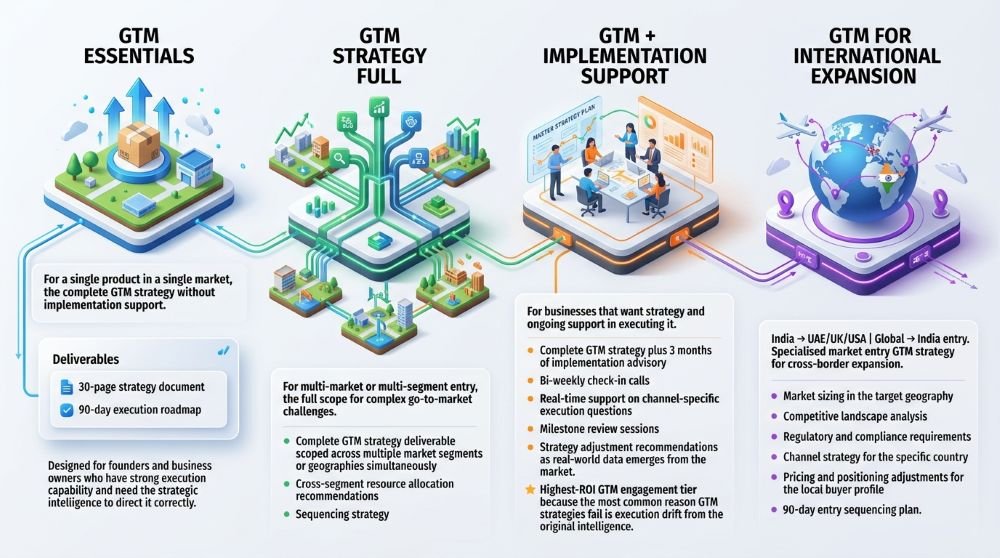
GTM Essentials: For a single product in a single market, the complete GTM strategy without implementation support
The full GTM strategy deliverable described above is scoped for one product targeting one primary market segment. 30-page strategy document + 90-day execution roadmap. Designed for founders and business owners who have strong execution capability and need the strategic intelligence to direct it correctly.
GTM Strategy Full: For multi-market or multi-segment entry, the full scope for complex go-to-market challenges
The complete GTM strategy deliverable is scoped across multiple market segments or geographies simultaneously. Includes cross-segment resource allocation recommendations and sequencing strategy.
GTM + Implementation Support: For businesses that want strategy and ongoing support in executing it
The complete GTM strategy plus 3 months of implementation advisory: bi-weekly check-in calls, real-time support on channel-specific execution questions, milestone review sessions, and strategy adjustment recommendations as real-world data emerges from the market. The highest-ROI GTM engagement tier is because the most common reason GTM strategies fail is execution drift from the original intelligence.
GTM for International Expansion: India → UAE/UK/USA | Global → India entry
Specialised market entry GTM strategy for cross-border expansion. Covers market sizing in the target geography, competitive landscape analysis, regulatory and compliance requirements, channel strategy for the specific country, pricing and positioning adjustments for the local buyer profile, and a 90-day entry sequencing plan.
GTM Strategy Pricing
| Package | Scope | Investment |
|---|---|---|
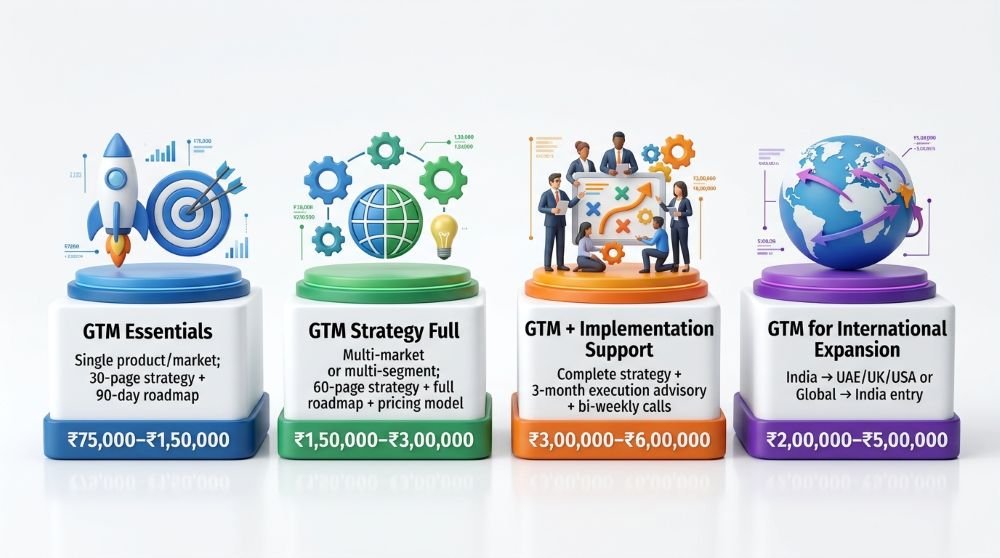
| GTM Essentials | Single product/market; 30-page strategy + 90-day roadmap | ₹75,000–₹1,50,000 |
| GTM Strategy Full | Multi-market or multi-segment; 60-page strategy + full roadmap + pricing model | ₹1,50,000–₹3,00,000 |
| GTM + Implementation Support | Complete strategy + 3-month execution advisory + bi-weekly calls | ₹3,00,000–₹6,00,000 |
| GTM for International Expansion | India → UAE/UK/USA or Global → India entry | ₹2,00,000–₹5,00,000 |
Frequently Asked Questions
- We already have some GTM ideas. Can SAI GENiUS validate and build on them rather than starting from scratch?
-
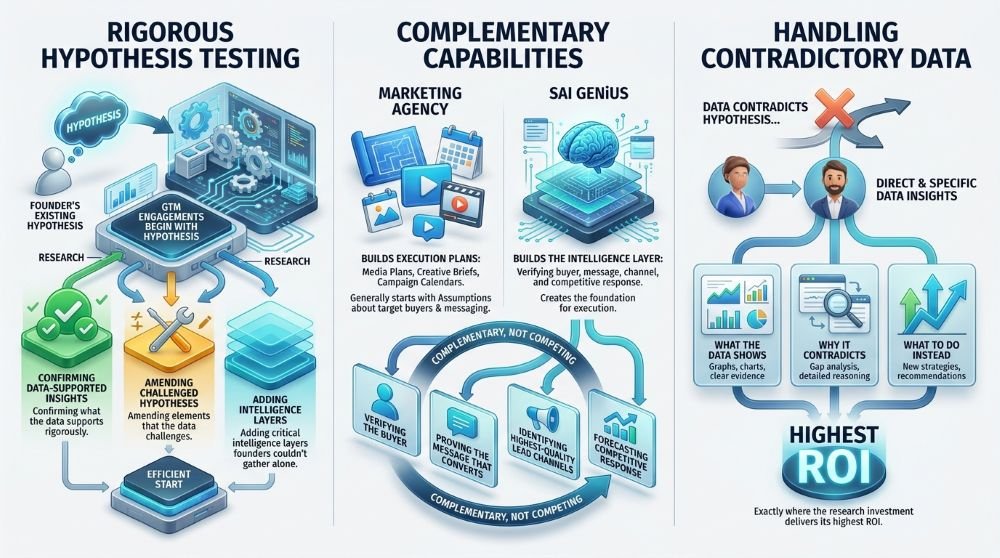
Absolutely. Many of our GTM engagements begin with a founder's existing hypothesis. We design the research specifically to test the hypothesis rigorously, confirming what the data supports, amending what it challenges, and adding the intelligence layers the founder could not have gathered without dedicated research. Starting with your hypothesis is often more efficient than starting with a blank page.
- How is a SAI GENiUS GTM strategy different from what a marketing agency would produce?
-
A marketing agency builds execution plans: media plans, creative briefs, campaign calendars. They generally begin with assumptions about who the target buyer is and what message to use. SAI GENiUS builds the intelligence layer beneath the execution plan: verifying who the buyer actually is, what message actually converts with them, which channel produces the highest-quality leads, and what the competitive response is likely to be. The two capabilities are complementary, not competing.
- What if the market research shows our GTM hypothesis is wrong?
-
Then we tell you directly and specifically what the data shows, why it contradicts the hypothesis, and what the data suggests you should do instead. This is exactly the scenario where the research investment delivers its highest ROI.