
SAI GENiUS — Strategic & Analytical Intelligence, GENerating Insights for Unlimited Success. Every word in that name is intentional. Every service we deliver is an expression of it. And every client we serve is a proof point of what becomes possible when India’s builders finally have access to the intelligence they have always deserved.
Read More THE FOUNDING STORY
WHY SAI GENiUS EXISTS: THE FOUNDING STORY
The Gap That Was So Obvious, So Large, and So Ignored It Made SAI GENiUS Inevitable.
The Three Conversations That Built This Company
Every company has an origin story. SAI GENiUS is not a single-founder epiphany moment. It is the accumulation of a specific type of conversation repeated across industries, cities, and business stages until the pattern becomes impossible to ignore.
The conversation goes like this:
A founder or business owner is facing a critical strategic decision. Which market should we enter? How do we position ourselves against this new competitor? Is this business plan credible enough for a Series A? Should we expand to Tier-2 cities or double down on metros? What is our actual TAM, not the number we put in the pitch deck, but the real number?
They know they need research. They know they need intelligence. So they look at their options.
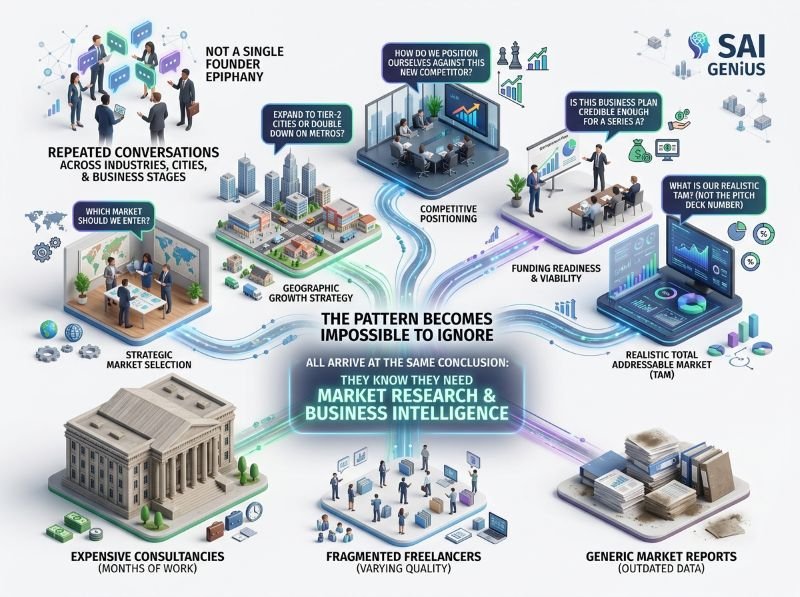
McKinsey. BCG. Bain. Deloitte. KPMG. They are brilliant. They produce world-class work. And their minimum engagement fees start at ₹15–50 lakhs. Their standard timeline is 6–12 weeks. Their India practice leads are based in Mumbai and Gurugram, and their research frameworks are largely adapted from global templates that were not built for the competitive realities of a Gujarat textile cluster, a Bengaluru D2C brand, or a Pune SaaS startup trying to figure out its first sales channel.
For India’s 5.93 crore+ registered MSMEs and 1.80 lakh DPIIT-recognised startups, the overwhelming majority of India’s most economically important businesses, the price of admission to world-class consulting intelligence is simply impossible.
Result: The decision gets made without professional intelligence. It is almost always more expensive in the long run.
Upwork. Fiverr. LinkedIn DMs. A freelancer who might be brilliant or might be good at looking brilliant while assembling a patchwork of outdated blog posts and renaming it a market research report.
The problem is not that freelancers lack talent. Many are exceptional individuals. The problem is structural. No institutional methodology. No quality framework. No accountability mechanism. No strategic interpretation layer. No India-specific market expertise that has been built and tested and refined across dozens of client engagements. No way to know, before you receive the deliverable, whether what you paid for is worth building a ₹50-lakh decision on.
Result: The output arrives. The client distrusts it. The decision still gets made without confidence.
₹40,000–₹2,00,000 for a generic PDF.
A 200-page industry report covering 18 countries, 60 companies, and a market definition so broad that it includes businesses that look nothing like yours. The data is real. The methodology is usually credible. But it was not written to answer your specific question. It was written to be sold to as many buyers as possible, which means it was written for no one in particular.
You now know that the global digital health market is valued at hundreds of billions of dollars. You still do not know whether your specific chronic disease management app for Tier-2 India is a credible ₹200Cr opportunity or a ₹20Cr niche.
Result: You bought intelligence that does not apply to your decision. You still guess.
The Indian business market, home to the world’s third-largest startup ecosystem and 5.93 crore+ registered MSMEs generating employment for over 25.18 crore individuals, has been systematically trapped between these three broken options for decades.
“Too expensive” on one end. “Too unreliable” in the middle. “Too generic”, on the other hand.
And throughout this period, AI was transforming what was possible. The same analytical depth that required a 12-person consulting team and an eight-week timeline could now be assembled with the right workflow design, the right human intelligence layer, and the right India-specific expertise in 5 to 12 days, at a fraction of the cost.
The gap was visible. The technology existed to close it. The market was enormous and verified: India’s management consulting services market size is projected to expand from USD 8.17 billion in 2025 and USD 9.36 billion in 2026 to USD 17.01 billion by 2031, registering a CAGR of 12.69% between 2026 and 2031 and the fastest-growing client segment within that market is precisely the one most systematically underserved: SMEs are the velocity engine, posting a 12.79% CAGR through 2031, a growth arc supported by venture-capital funding and modular consulting delivery that lowers cost of access for smaller budgets. SMEs gravitate toward outcome-based pricing, standardised toolkits, and remote advisory sessions that compress project timelines and costs.
SAI GENiUS was built to close this gap. Not partially. Not for a niche subset of Indian businesses. Permanently, and for every ambitious Indian founder, MSME owner, corporate strategist, and investor who has ever needed intelligence and found that their only options were unaffordable, unreliable, or irrelevant.
That is why we exist. That is the only reason we exist.