

Five Values. Non-Negotiable. Present in Every Deliverable We Produce. This Is How We Operate — and How You Will Always Experience Us.
Intellectual Honesty
The principle: We deliver what the data says — not what you hoped to hear. Not what would make the initial conversation easier. Not what would protect your feelings about a decision you have already emotionally committed to.
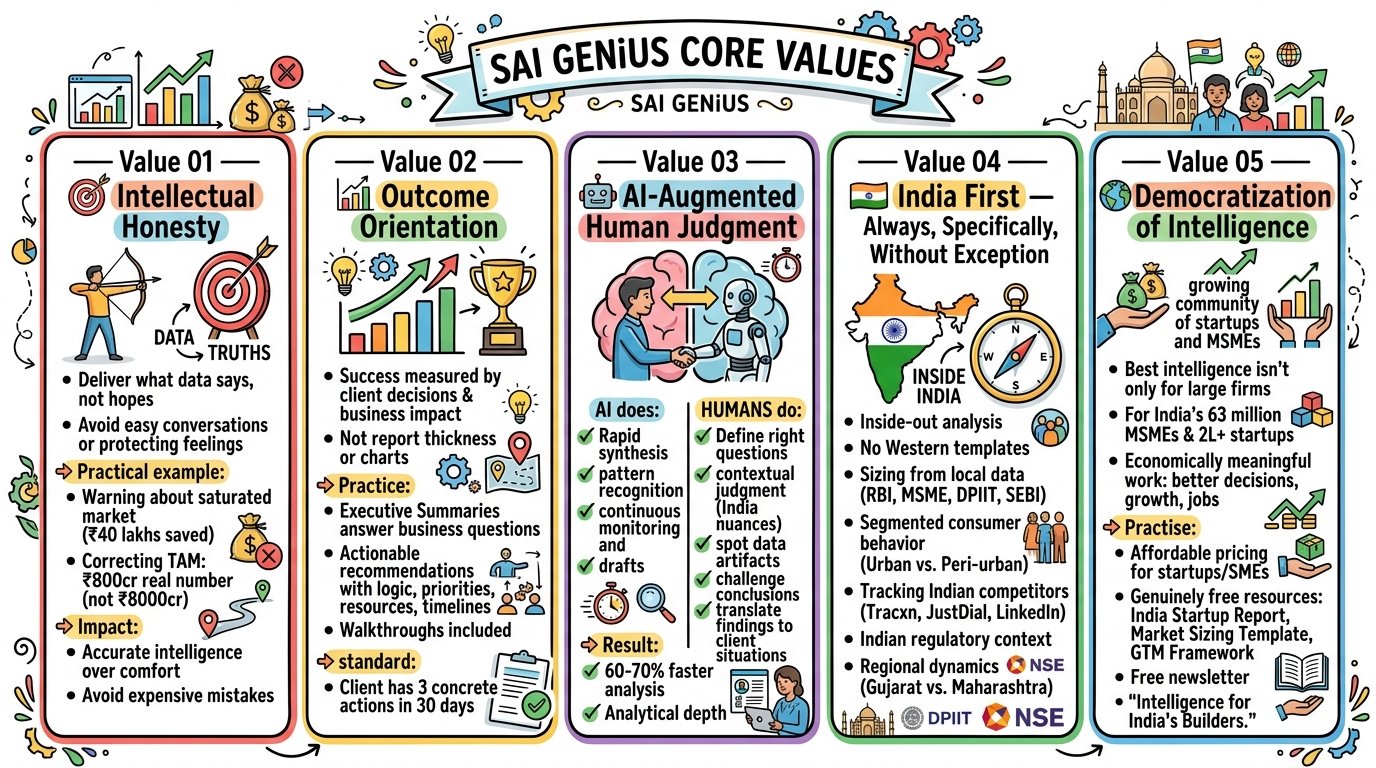
What this looks like in practice: If our market research shows that your planned metro expansion is walking into a saturated, heavily-funded competitive landscape where your customer acquisition cost will be 4x your current model, we will tell you — clearly, specifically, and before you spend ₹40 lakhs finding out the hard way.
If our competitor analysis reveals that a competitor you dismissed as small is actually gaining market share at twice your rate and is better capitalized than you assumed, that will be in your report — not softened, not buried in an appendix.
If your TAM is ₹800 crore and not the ₹8,000 crore your pitch deck currently claims, we will build you a verified model that shows the real number — and then help you understand whether ₹800 crore is still a meaningful opportunity worth pursuing.
Why this matters for you: You are not paying SAI GENiUS for comfortable intelligence. You are paying for accurate intelligence. The most expensive mistake in business is the one you made because someone told you what you wanted to hear instead of what you needed to know.
Our loyalty is to your outcomes — not your comfort.
Outcome Orientation
The principle: We do not measure our success by the quality of our reports. We do not measure it by the thickness of the document, the sophistication of the charts, or the elegance of the executive summary. We measure our success by one thing: the quality of the decisions our clients make because of our work — and what happens to their businesses as a result.
What this looks like in practice: Every SAI GENiUS deliverable is structured around decision support. The Executive Summary does not summarize the document — it answers the business question that prompted the research. The strategic recommendations section does not present options — it tells you what to do, with reasoning, with prioritization, and with explicit resource and timeline implications.
We produce intelligence designed to be used — starting the week you receive it.
What this explicitly means we do not do: We do not produce 80-page research documents designed to demonstrate how much research we conducted. We do not produce recommendations so broad and hedged that they apply equally to every possible decision. We do not deliver work and disappear — every project includes a strategic walkthrough session where we answer your questions and discuss implementation.
The standard we hold ourselves to: If a client reads a SAI GENiUS report and thinks "this is impressive research" but cannot identify three concrete actions to take in the next 30 days, we have not done our job.
AI-Augmented Human Judgment
The principle: We have thought very carefully about the correct role of AI in a research and intelligence firm — and we have arrived at a position that is more nuanced than either "AI is the future of everything" or "AI cannot be trusted with serious research."
The correct answer, based on two years of building and iterating our research system, is this: AI and human analysts are not interchangeable. They are complementary. Each does things the other cannot.
What AI does better than any human analyst:
- Synthesizes thousands of pages of secondary research across multiple languages, databases, and source types in hours rather than weeks
- Identifies non-obvious correlations across large, complex, multi-variable datasets
- Monitors hundreds of competitor websites, news sources, social channels, and regulatory databases simultaneously — continuously, without fatigue
- Generates structured, organized, well-formatted first drafts from verified data inputs
- Creates consistent, reproducible analyses across similar research categories
What human analysts do better than any AI system:
- Define the right research questions — because AI answers questions; only humans can decide which questions are worth asking
- Apply contextual judgment to India's specific market dynamics, cultural buying behaviors, regulatory nuances, and regional economic realities.
- Recognize when a finding that looks statistically significant is actually an artifact of data methodology.
- Challenge the obvious conclusion — the answer that the data seems to point to, but that misses a critical contextual variable.
- Translate findings into recommendations calibrated to the specific business situation, team capacity, and resource constraints of the individual client.
The result of combining both correctly: Intelligence that is 60–70% faster to produce than traditional research, with analytical depth that exceeds what any solo human analyst could achieve independently, because the human analyst is spending their time on interpretation, strategy, and judgment rather than on data collection and organization.
Our explicit commitment: SAI GENiUS will never produce AI-generated content that has not passed through our human quality layer. Every deliverable is reviewed, interpreted, challenged, and supplemented by a human strategist before it reaches your inbox.
🇮🇳 India First — Always, Specifically, Without Exception
The principle: We do not apply Western market analysis templates to Indian business realities. We do not take a framework designed for a US consumer market and scale it down for India. We do not cite global market projections without India-specific decomposition. We think from inside India — because we live and operate inside India.
What India-First actually means in research practice:
Market Sizing: We do not accept "India is X% of the global market" as a legitimate bottom-up market calculation. We build India-specific models from local data sources — Ministry of MSME data, DPIIT startup databases, RBI sector reports, SEBI filings, NSE/BSE listed company disclosures, CMIE economic data, and sector-specific Indian industry association publications.
Consumer Behavior: We understand that an urban Bengaluru consumer and a peri-urban Nashik consumer may both be "Indian" but respond to entirely different value propositions, distribution models, and price points. We segment India's consumer landscape with the granularity that India's actual market diversity demands.
Competitive Intelligence: We track Indian competitors through India-specific channels — Tracxn, Crunchbase India, MCA filings, GST registration data, LinkedIn India, IndiaMART, JustDial, and direct digital footprint analysis — not through global databases that have 30% India coverage and 3-month data lag.
Regulatory Context: We understand SEBI regulations, RBI guidelines, FSSAI requirements, BIS standards, DPIIT startup regulations, Startup India scheme implications, and state-level industrial policy — and we integrate regulatory intelligence into every piece of strategic analysis we produce.
Regional Reality: We understand the difference between a market entry into Gujarat (where relationship-based B2B sales, established industrial networks, and community trust dynamics dominate) versus Maharashtra (where professional networks, corporate procurement processes, and urban digital adoption patterns create a different competitive environment). Generic "India" analysis misses this. SAI GENiUS never does.
Democratization of Intelligence
The principle: The best strategic intelligence should not be a luxury available only to businesses that can write a ₹50-lakh consulting cheque. India's most consequential economic activity — the grinding, relentless, ambitious work of 63 million MSME owners and 2,00,000+ startup founders — deserves the same quality of intelligence as the largest corporations in India's economy.
The economic argument for this value: India's GDP growth trajectory over the next decade depends disproportionately on its MSME and startup ecosystems. These businesses are not peripheral to India's economy — they are its engine. An MSME that makes a better market entry decision because of good intelligence creates jobs. A startup that raises funding because its market research was investor-grade builds a product that serves Indian consumers better. The intelligence we provide is not just commercially valuable — it is economically meaningful at a national scale.
The practical commitment this value requires from us:
First, our pricing is built around what Indian startups and SMEs can actually afford — not around what the market could theoretically bear if we positioned ourselves exclusively to large corporates.
Second, our free resource library — the India Startup Intelligence Report, the Market Sizing Template, the GTM Velocity Framework, and the Research Quality Checklist — is genuinely free. No email required for the flagship report. No paywalls hide the most useful content. Free means free.
Third, our newsletter — SAI GENiUS Intelligence Weekly — delivers original market intelligence to 5,000+ Indian founders and business owners every Saturday morning. No subscription fee. No premium tier. The full product, every week, is free.
Because intelligence that serves India's builders is not charity. It is the most important investment we can make.