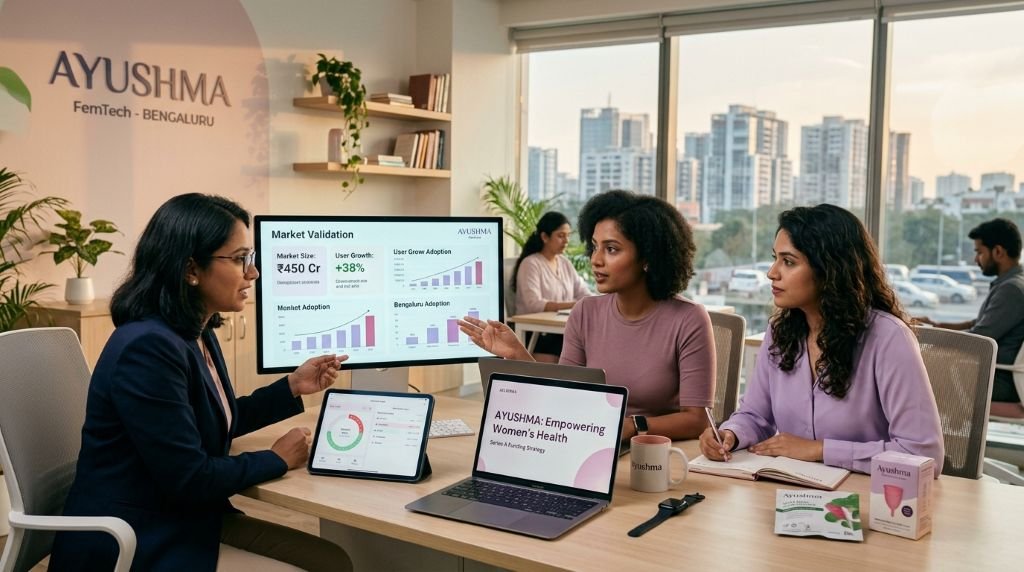
Know Your Competitors Better Than They Know Themselves. Know Them Better Than They Know Each Other.

What This Service Is And Why It Is More Powerful Than Most Businesses Realize
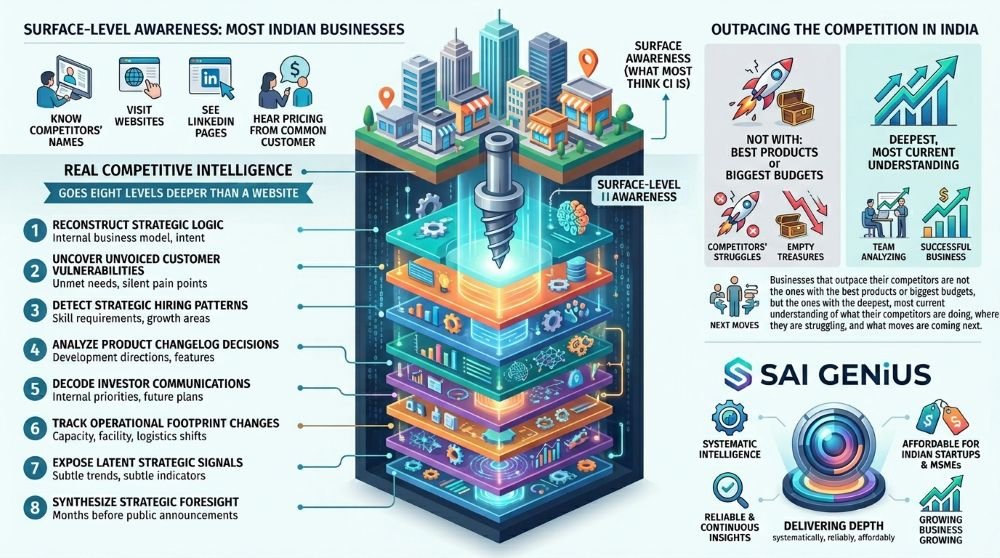
Most Indian businesses think they understand their competitive landscape. They know the names of their main competitors. They have visited their websites. They have seen their LinkedIn pages. They have heard about their pricing from a common customer.
This is not competitive intelligence. This is surface-level awareness.
Real competitor intelligence, the kind that produces strategic advantages, goes eight levels deeper than a competitor’s website. It reconstructs the strategic logic operating behind the competitor’s public face. It identifies the vulnerabilities their customers experience but rarely voice publicly. It detects the strategic direction signals buried in hiring patterns, product changelog decisions, investor communications, and operational footprint changes months before those signals become public announcements.
The businesses in India that consistently outpace their competitors are not the ones with the best products or the biggest budgets. They are the ones with the deepest, most current understanding of what their competitors are doing, where those competitors are struggling, and what moves are coming next.
SAI GENiUS delivers that depth systematically, reliably, at a price point that Indian startups and MSMEs can actually invest in.
The Five Layers of SAI GENiUS Competitor Intelligence
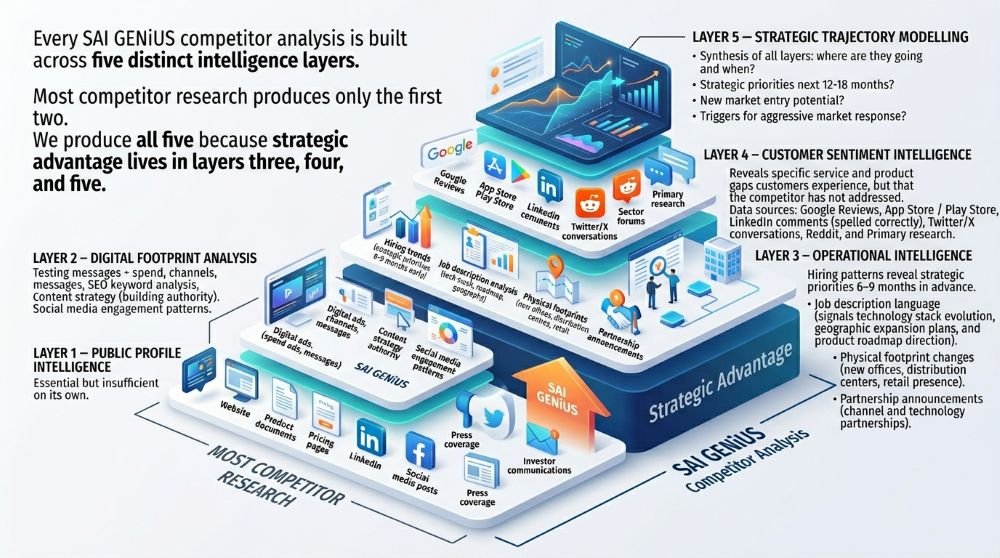
Every SAI GENiUS competitor analysis is built across five distinct intelligence layers. Most competitor research produces only the first two. We produce all five because strategic advantage lives in layers three, four, and five.
Layer 1 — Public Profile Intelligence The foundation: what every analyst builds. Website analysis, product/service documentation, pricing pages, LinkedIn presence, social media positioning, press coverage, and published investor communications. Essential but insufficient on its own.
Layer 2 — Digital Footprint Analysis Beyond the competitor’s own publications: their digital advertising strategy (what they are spending, where they are spending it, and what messages they are testing with which audiences), their SEO positioning (which keywords they are ranking for and targeting), their content strategy (what topics they are building authority on), and their social media engagement patterns (what resonates with their audience and what does not).
Layer 3 — Operational Intelligence The signals most analysts miss: hiring patterns (who they are recruiting reveals strategic priorities 6–9 months before public announcements), job description language (signals technology stack evolution, geographic expansion plans, and product roadmap direction), physical footprint changes (new offices, new distribution centres, new retail presence), and partnership announcements (which channel and technology partnerships are they building).
Layer 4 — Customer Sentiment Intelligence What their customers are actually experiencing, captured from Google Reviews, App Store and Play Store reviews, LinkedIn comments, Twitter/X conversations, Reddit threads, sector-specific forums, and structured primary research with customers who have evaluated or switched from the competitor. This layer consistently reveals the specific service and product gaps that customers experience, but that the competitor has not addressed in your most direct opportunity map.
Layer 5 — Strategic Trajectory Modelling The synthesis layer: based on all four previous layers, where is this competitor going and when are they likely to get there? What is their apparent strategic priority for the next 12–18 months? Where are they most likely to enter markets they currently do not serve? What would trigger them to respond aggressively to your market entry, and what would not provoke a response?
Sub-Service Types Within Competitor Intelligence
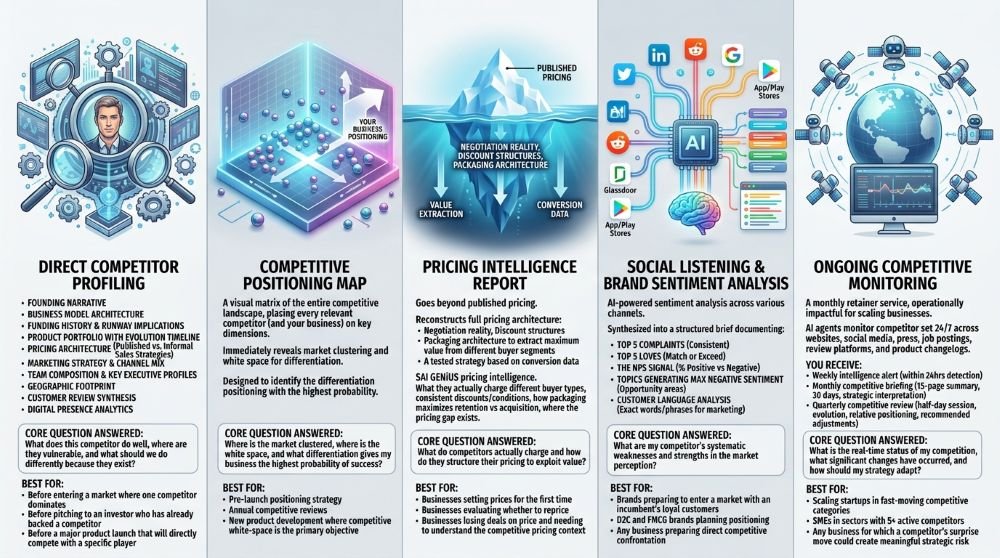
Direct Competitor Profiling A comprehensive 360° intelligence profile of a single competitor
A single-company deep dive: founding narrative, business model architecture, funding history and runway implications, product portfolio with evolution timeline, pricing architecture (including the informal pricing strategies their sales team applies that differ from their published rates), marketing strategy and channel mix, team composition and key executive profiles, geographic footprint, customer review synthesis, and digital presence analytics.
Each profile is structured to answer one core question for the client: what does this competitor do well, where are they vulnerable, and what should we do differently because they exist?
Best for: Before entering a market where one competitor dominates | Before pitching to an investor who has already backed a competitor | Before a major product launch that will directly compete with a specific player.
Competitive Positioning Map A visual matrix of the entire competitive landscape
A strategic map of your full competitive landscape, placing every relevant competitor (and your business, or your planned positioning) on the two or three dimensions that matter most to your target buyer. The map immediately reveals where the market is clustered (where everyone is competing for the same positioning) and where the white space exists (where a strong positioning is available with limited direct competition).
Every competitive positioning map is designed not just to describe the current landscape, but to identify the specific positioning that gives your business the highest probability of differentiation.
Best for: Pre-launch positioning strategy | Annual competitive reviews | New product development where competitive white-space is the primary objective.
Pricing Intelligence Report What competitors actually charge — not what their website says
Published pricing is frequently the tip of the iceberg. Behind every B2B pricing page is a negotiation reality, a discount structure, a packaging architecture that extracts maximum value from different buyer segments, and a pricing strategy that has been tested and refined based on conversion data you cannot see publicly.
SAI GENiUS pricing intelligence reconstructs the full pricing architecture of your target competitors, what they actually charge different buyer types, what discounts they consistently offer and under what conditions, how they structure their packaging to maximise retention versus acquisition, and where the pricing gap exists that your business can exploit.
Best for: Businesses setting prices for the first time | Businesses evaluating whether to reprice | Businesses losing deals on price and needing to understand the competitive pricing context.
Social Listening & Brand Sentiment Analysis Your competitor’s most consistent weaknesses systematically documented
AI-powered sentiment analysis across Twitter/X, LinkedIn, Reddit, Google Reviews, Glassdoor (for internal culture intelligence), App Store/Play Store reviews, and sector-specific forums synthesised into a structured brief that documents:
- The top 5 complaints that competitor’s customers express most consistently
- The top 5 things competitor’s customers genuinely love (what you will have to match or exceed)
- The NPS signal: what percentage of online sentiment is positive versus negative
- The topics that generate the most negative sentiment (your opportunity areas)
- Customer language analysis: the exact words and phrases your competitor’s customers use to describe their problems (invaluable for crafting your own marketing messaging)
Best for: Brands preparing to enter a market where an incumbent has loyal customers | D2C and FMCG brands planning positioning against established players | Any business preparing for a direct competitive confrontation.
Ongoing Competitive Monitoring Real-time intelligence on your competitive landscape, delivered continuously
A monthly retainer service our most operationally impactful intelligence product for scaling businesses. AI agents monitor your defined competitor set 24/7 across their website, social media, press coverage, job postings, review platforms, and product changelogs. You receive:
- Weekly intelligence alert: any significant development across your monitored competitor set, within 24 hours of detection
- Monthly competitive briefing: a structured 15-page summary of all significant competitor developments over the past 30 days, with strategic interpretation of what each development means for your business
- Quarterly competitive review: a half-day session reviewing the competitive landscape evolution, your relative positioning, and recommended strategic adjustments
Best for: Scaling startups in fast-moving competitive categories | SMEs in sectors with 5+ active competitors making regular strategic moves | Any business for which a competitor’s surprise move could create meaningful strategic risk.
Competitor Intelligence Pricing
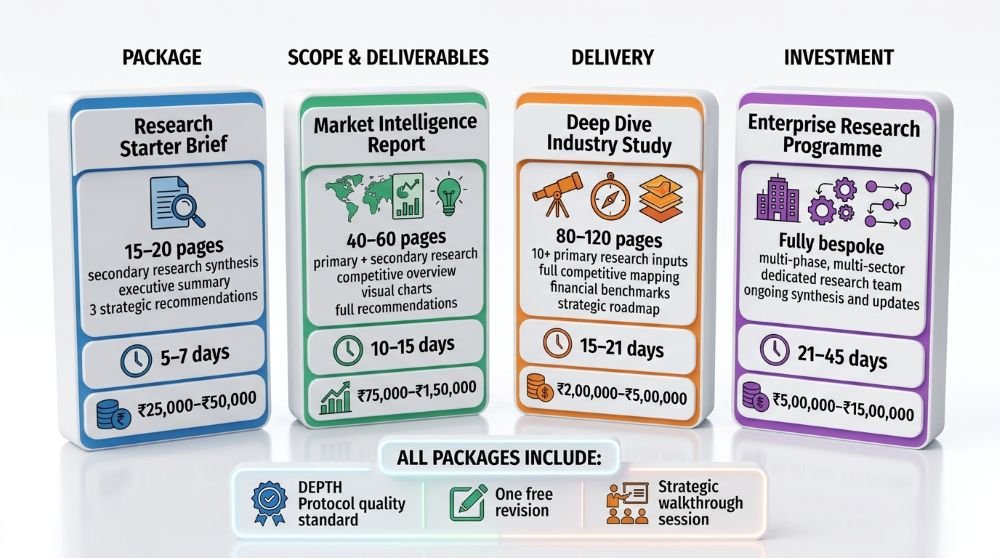
| Package | Scope & Deliverables | Delivery | Investment |
|---|---|---|---|
| Research Starter Brief | 15–20 pages; secondary research synthesis; executive summary; 3 strategic recommendations | 5–7 days | ₹25,000–₹50,000 |
| Market Intelligence Report | 40–60 pages; primary + secondary research; competitive overview; visual charts; full recommendations | 10–15 days | ₹75,000–₹1,50,000 |
| Deep Dive Industry Study | 80–120 pages; 10+ primary research inputs; full competitive mapping; financial benchmarks; strategic roadmap | 15–21 days | ₹2,00,000–₹5,00,000 |
| Enterprise Research Programme | Fully bespoke multi-phase, multi-sector; dedicated research team; ongoing synthesis and updates | 21–45 days | ₹5,00,000–₹15,00,000 |
Frequently Asked Questions
- Can you monitor competitors in very niche or specialized B2B sectors?
-
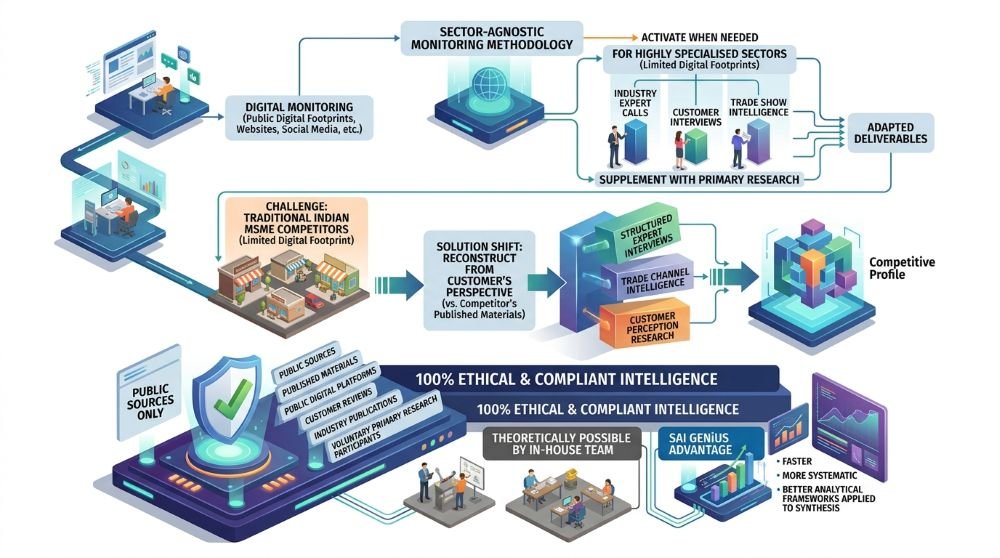
Yes. Our monitoring methodology is sector-agnostic. For highly specialised sectors where public digital footprints are limited, we supplement digital monitoring with primary research (industry expert calls, customer interviews, trade show intelligence) and adapt the deliverable accordingly.
- How do you handle competitors with very limited public digital presence?
-
This is common with traditional Indian MSME competitors. For such companies, we shift toward primary research, structured expert interviews, trade channel intelligence, and customer perception research to reconstruct the competitive profile from the customer's perspective rather than the competitor's published materials.
- Is competitive intelligence ethically conducted?
-
Completely. All SAI GENiUS competitive intelligence is gathered from public sources, published materials, public digital platforms, customer reviews, industry publications, and voluntary primary research participants. We do not engage in any practice that involves accessing private or confidential information. A sufficiently resourced in-house team could theoretically assemble everything we deliver. Realise we simply do it faster, more systematically, and with better analytical frameworks applied to the synthesis.