

SAI GENiUS — Strategic & Analytical Intelligence, GENerating Insights for Unlimited Success. Every word in that name is intentional. Every service we deliver is an expression of it. And every client we serve is a proof point of what becomes possible when India’s builders finally have access to the intelligence they have always deserved.
Read MoreTHE DEPTH RESEARCH PROTOCOL
THE SAI GENiUS RESEARCH SYSTEM: HOW EVERY ENGAGEMENT WORKS
The DEPTH Research Protocol™ SAI GENiUS 5-Layer Quality Standard
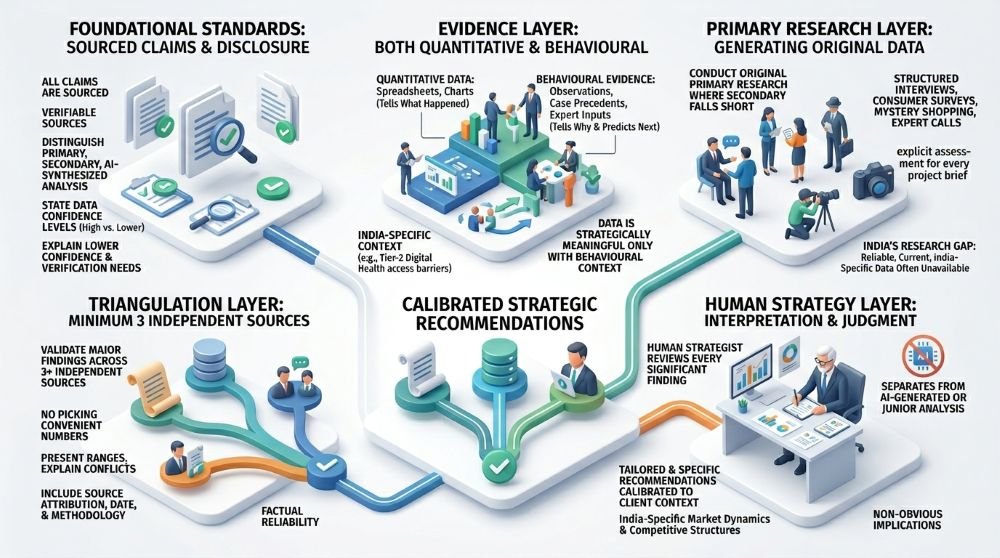
The DEPTH Research Protocol is the quality framework that every SAI GENiUS deliverable passes through before it reaches a client. It is not a checklist that gets ticked at the end of a project. It is a design principle that shapes how the research is structured, how sources are selected and verified, how findings are challenged, and how recommendations are calibrated.
It exists because “AI-generated content” has created a significant trust problem in the market research industry. Large language models can produce documents that look like research but are actually sophisticated hallucinations, confident-sounding claims that are either invented or so loosely sourced that they cannot be verified. The DEPTH Protocol is our structural response to this problem: a 5-layer quality standard that ensures every claim in a SAI GENiUS deliverable is sourced, verified, triangulated, and human-interpreted before it reaches you.
Every claim is sourced. Sources are disclosed. Confidence levels are stated.
The first and most fundamental quality standard: nothing in a SAI GENiUS deliverable is asserted without a source. Data points from primary research, secondary databases, and AI-synthesised analysis are clearly distinguished from one another. When a claim is based on a single source, we say so. When a claim is extrapolated from adjacent data, we say so. When we have high confidence in a finding, we state it directly. When confidence is lower, we say so and explain what additional verification would change the confidence level.
This creates an important distinction from most research reports, which present all findings with equivalent certainty regardless of how robust the underlying evidence is. Our clients make better decisions when they know which parts of the intelligence are highly verified versus which parts involve reasoned inference. We always tell you the difference.
What this means in practice: Every market-size figure, every competitor claim, and every consumer-behaviour finding in a SAI GENiUS report has a source citation. Those sources are verifiable. We do not cite sources we have not read.
Quantitative data alone does not tell the full story. Behavioural evidence fills the gaps that spreadsheets cannot.
Numbers tell you what happened. They rarely explain why. They rarely predict what will happen next in a specific business context.
The Evidence layer of the DEPTH Protocol requires that every major strategic finding in a SAI GENiUS deliverable is supported not just by quantitative data, but by behavioural evidence, the observable patterns, documented case precedents, expert observations, and qualitative signals that give quantitative data its strategic meaning.
This layer is where India-specific expertise becomes most critical. A market sizing figure that shows a ₹500Cr opportunity in Tier-2 digital health is only strategically useful if you also understand the behavioral context: how Tier-2 consumers currently access healthcare, what trust barriers exist for digital-first health services, how the absence of adequate referral infrastructure affects adoption timelines, and what the 3–4 behavioral changes required for product adoption look like in a Tier-2 market versus a metro.
The quantitative data is necessary. The behavioural evidence layer is what makes it actionable.
What this means in practice: Every major strategic recommendation in a SAI GENiUS deliverable is supported by both quantitative data and behavioural evidence. Where behaviourism is and where evidence is limited, we say so explicitly and recommend the specific primary research that would fill the gap.
When secondary research is insufficient, contradictory, or simply unavailable for India-specific questions, we generate the primary data ourselves.
India’s research infrastructure has a well-documented gap: reliable, current, India-specific primary data is often unavailable, outdated, or priced for only large enterprise buyers.
The Primary Research layer of the DEPTH Protocol commits SAI GENiUS to conducting original primary research, structured interviews, consumer surveys, mystery shopping exercises, expert consultation calls, and observational fieldwork wherever secondary research falls short of the intelligence quality our clients’ decisions require.
For engagements where the research question involves consumer behaviour, channel economics, pricing psychology, or expert-domain intelligence, primary research is not optional. It is designed into the project scope from the beginning, with appropriate methodology, sample definition, and quality controls applied as rigorously as they would be in a large-firm engagement.
What this means in practice: Every SAI GENiUS project brief includes an explicit assessment of where primary research is required. Where it is required and not included in the base scope, we recommend it with a methodology and cost estimate so the client can make an informed choice about depth versus budget.
Every major finding is validated across a minimum of three independent sources before it enters a deliverable. When sources conflict, we report the conflict.
The Triangulation layer is the most mechanically demanding part of the DEPTH Protocol and the most important one for ensuring the factual reliability of our deliverables.
The rule is simple: no market size figure, no competitive claim, no consumer behaviour finding, and no strategic assertion of significance enters a SAI GENiUS deliverable unless it has been corroborated by at least three independent sources that have been assessed for methodology quality and recency.
When sources contradict each other, which happens frequently in Indian market data, where sources with different methodologies and sample definitions often produce materially different figures, we do not pick the most convenient number. We present the range, explain why the sources differ, and recommend how to interpret the conflict in the context of the client’s specific decision.
This is more work. It produces better intelligence. And it is the reason our clients can present our market sizing to a sophisticated VC and not be challenged on methodology.
What this means in practice: Every market sizing figure in a SAI GENiUS report includes source attribution, publication date, and methodology notes. When ranges are presented, the reason for the range is explained. Clients always know exactly what the data uncertainty is.
The irreplaceable final layer: a human strategist who interprets findings, challenges obvious conclusions, and produces recommendations that require judgment.
This is the layer that separates a SAI GENiUS deliverable from an AI-generated research document and from a data report produced by a junior analyst who has not spent years thinking about competitive strategy in Indian markets.
The Human Strategy layer requires that a senior SAI GENiUS strategist personally review every significant finding in the context of:
- The client’s specific business model, competitive position, and strategic constraints
- The competitive dynamics of their sector in India’s specific market context
- The strategic frameworks most applicable to their decision (Porter’s Five Forces applied to Indian MSME competitive structures look meaningfully different from the textbook version)
- The non-obvious implications of the second-order effects, the timing considerations, and the sequence dependencies that raw data analysis does not surface
The output of this layer is recommendations. Specific, implementable, calibrated to the client’s situation. Not a list of findings with a “what this means for your business” heading that is generic and obvious.
What this means in practice: Every SAI GENiUS deliverable includes an Executive Recommendations section written by a human strategist, reviewed by a second senior team member, and calibrated specifically to the client’s business context. The recommendations are not generated by AI. They are written by a person who has read every word of the research, thought about the strategic implications, and made judgment calls about what matters most.
SAI GENiUS
The DEPTH Protocol in One Table
| LAYER | FUNCATION | QUALITY GATE |
|---|---|---|
| D — Data | Every claim sourced and disclosed | No unsourced assertions in any deliverable |
| E — Evidence | Behavioral evidence supports all major findings | Quantitative + qualitative for all strategic recommendations |
| P — Primary Research | Generate original data where secondary falls short | Primary research scoped into every project requiring it |
| T — Triangulation | Every major finding verified across 3+ sources | Conflicts reported; methodology documented |
| H — Human Strategy | Senior strategist interprets, challenges, recommends | All recommendations written and reviewed by human analyst |