Intelligence Designed Around Your Specific Decision, Not Someone Else's Market.

What This Service Is And What It Is Not
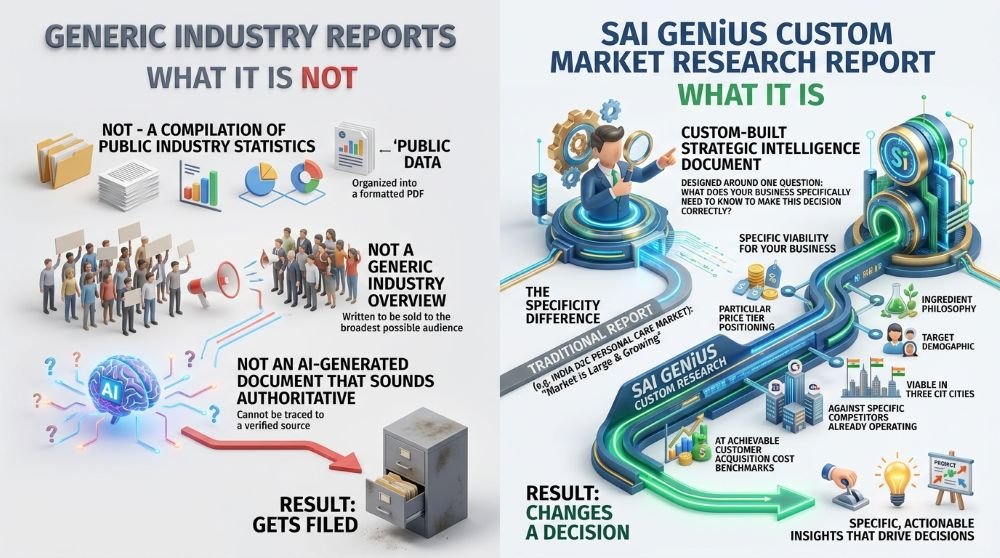
A SAI GENiUS Custom Market Research Report is not a compilation of publicly available industry statistics organised into a formatted PDF. It is not a generic industry overview written to be sold to the broadest possible audience. And it is emphatically not an AI-generated document that sounds authoritative but cannot be traced to a verified source.
It is a custom-built strategic intelligence document designed from the ground up around one question: what does your business specifically need to know to make this decision correctly?
The difference matters more than it sounds. A generic industry report about India’s D2C personal care market tells you the market is large and growing. A SAI GENiUS custom research report tells you specifically whether the particular positioning of your price tier, your ingredient philosophy, and your target demographic is viable in the three cities you are considering entering, against the specific competitors already operating in each of those cities, at the customer acquisition cost benchmarks achievable in each.
That specificity is the difference between a document that gets filed and a document that changes a decision.
Who This Service Is For
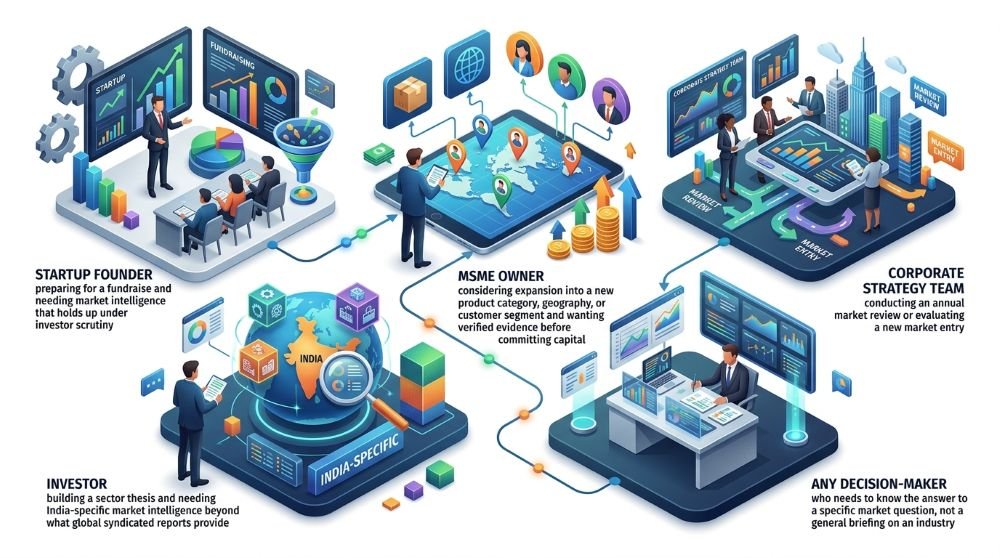
This service is the right fit if you are:
- A startup founder preparing for a fundraise and needing market intelligence that holds up under investor scrutiny
- An MSME owner considering expansion into a new product category, geography, or customer segment and wanting verified evidence before committing capital
- A corporate strategy team conducting an annual market review or evaluating a new market entry
- An investor building a sector thesis and needing India-specific market intelligence beyond what global syndicated reports provide
- Any decision-maker who needs to know the answer to a specific market question, not a general briefing on an industry
What Every SAI GENiUS Market Research Report Includes
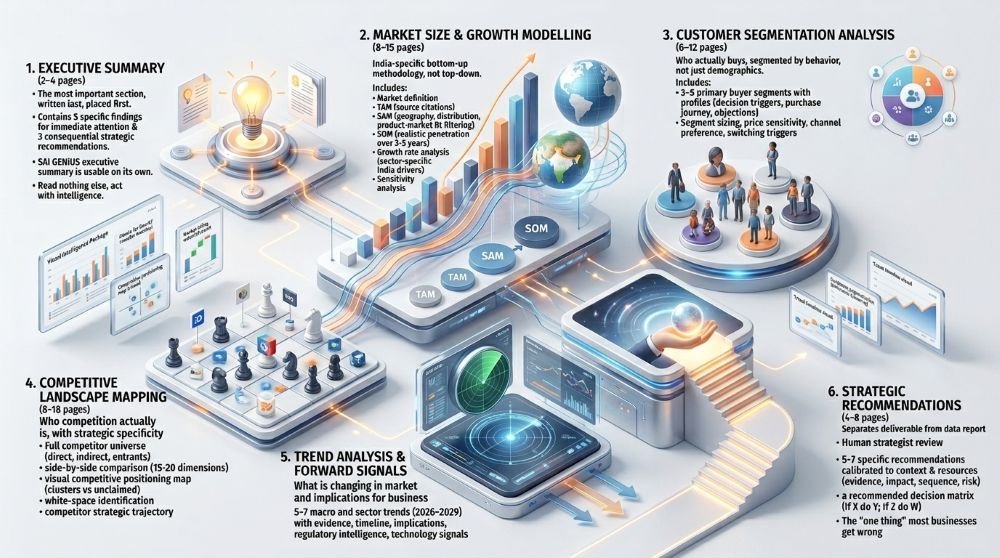
Every market research report, regardless of scope tier, passes through the DEPTH Research Protocol and includes the following foundational components. Scope and depth vary by engagement level; core structure is consistent.
Executive Summary (2–4 pages): The most important section of any research report, written last, is placed first. Contains the 5 specific findings that require immediate attention and the 3 most consequential strategic recommendations for your business. An SAI GENiUS executive summary is written to be usable on its own. If you read nothing else, you have the intelligence you need to act.
Market Size & Growth Modelling (8–15 pages) TAM, SAM, and SOM calculated using bottom-up India-specific methodology, not top-down extrapolations from global databases. Includes:
- Market definition (who is and is not included, and why)
- Total Addressable Market (TAM) with source citations and methodology documentation
- Serviceable Addressable Market (SAM) filtered by geography, distribution capability, and product-market fit
- Serviceable Obtainable Market (SOM) modelled against realistic market penetration assumptions over 3–5 years
- Growth rate analysis with sector-specific India drivers (regulatory, demographic, behavioural)
- Sensitivity analysis: what changes the TAM significantly and in which direction
Customer Segmentation Analysis (6–12 pages): Who actually buys in this market, segmented by behaviour, not just demographics. Includes:
- 3–5 primary buyer segments with behavioural profiles (decision triggers, purchase journey, objection patterns)
- Segment sizing: which segments are largest, fastest-growing, and most accessible
- Segment-specific price sensitivity and willingness to pay
- Channel preference by segment: where each segment discovers and purchases
- Switching triggers: what makes each segment change providers or brands
Competitive Landscape Mapping (8–18 pages): Who your competition actually is, mapped with the specificity that strategic positioning requires. Includes:
- Full competitor universe: direct, indirect, and potential new entrants
- Side-by-side comparison matrix across 15–20 competitive dimensions
- Visual competitive positioning map: where the market clusters and where it is unclaimed
- White-space identification: the specific positioning, segment, or geography that no existing competitor is serving well
- Competitor strategic trajectory: where each major competitor appears to be heading based on observable signals
Trend Analysis & Forward Signals (4–8 pages): What is changing in your market and what it means specifically for your business. Includes:
- 5–7 macro and sector-specific trends shaping the competitive landscape over 2026–2029
- For each trend: the evidence it is real, the timeline of impact, and the specific strategic implications for your business
- Regulatory intelligence: upcoming policy changes that could reshape competitive dynamics
- Technology signals: emerging capabilities that could disrupt your category or create new opportunities
Strategic Recommendations (4–8 pages): This is the section that separates an SAI GENiUS deliverable from a data report. Written by a human strategist after reading every word of the research. Includes:
- 5–7 specific recommendations calibrated to your business context, your team, and your resource constraints
- For each recommendation: the evidence base, the expected impact, the implementation sequence, and the risk factors
- A recommended decision matrix: if X is true, do Y; if Z is true, reconsider Y and do W instead
- The one thing most businesses in your market are getting wrong and how to not make the same mistake
Visual Intelligence Package
- Charts and infographics built for board presentations and investor meetings
- Competitive positioning map (visual)
- Market sizing waterfall chart (TAM → SAM → SOM)
- Customer segmentation visual (behavioural clustering)
- Trend timeline visual (when each major trend is expected to peak in impact)
Sub-Service Types Within Market Research
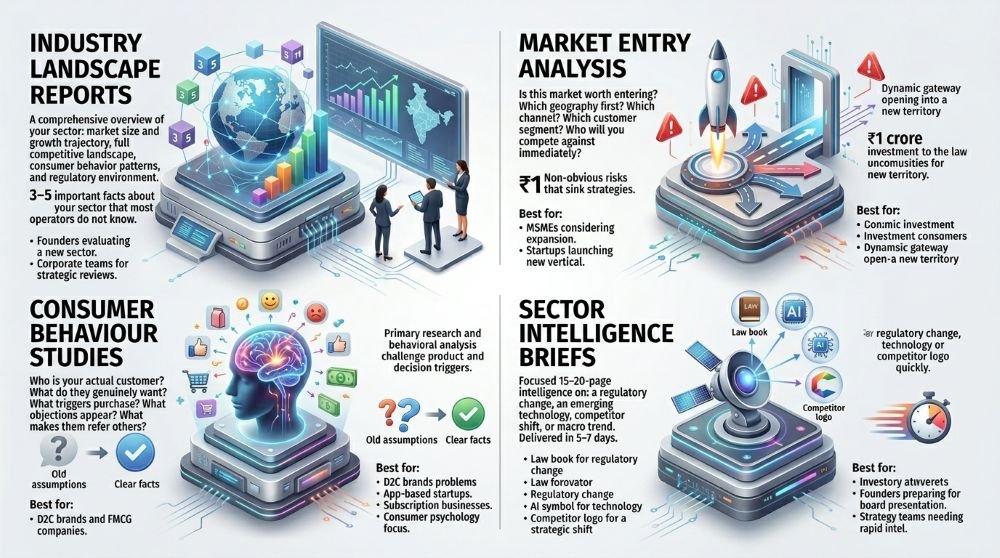
Industry Landscape Reports: The broadest scope, ideal for sector orientation and strategic reviews
A comprehensive overview of your sector: market size and growth trajectory, the full competitive landscape, the consumer behaviour patterns that drive demand, the regulatory environment and its strategic implications, and the 3–5 most important strategic facts about your sector that most operators either do not know or are not acting on.
Best for: Founders evaluating a new sector before committing to build in it | Corporate teams conducting annual strategic reviews | Investors building a sector thesis from scratch | Anyone who needs to get smart about a new market quickly and reliably.
Market Entry Analysis: For the most consequential single decision most businesses make
Is this market worth entering? Which geography to enter first? Which channel to launch through? Which customer segment to target first? Who will you compete against immediately, and what are their specific vulnerabilities? What are the non-obvious risks that sink most market entry strategies?
A market entry analysis answers all of these questions before you invest ₹1 crore, avoiding the hard way. The ROI on getting this right is almost always significantly larger than the research investment.
Best for: MSMEs considering geographic expansion | Startups launching into a new vertical or segment | Corporates evaluating a new India market entry | Businesses moving from metro to Tier-2 strategy or vice versa.
Consumer Behaviour Studies: For businesses where the quality of customer understanding directly determines conversion and margin
Who is your actual customer, not your assumed customer? What do they genuinely want versus what they say they want in a generic survey? What triggers the purchase decision? What objections appear consistently at the moment of conversion? What would make them switch to a competitor? What would make them refer others?
Primary research combined with behavioural analysis is designed to challenge your assumptions about your own customer, not confirm them.
Best for: D2C brands | FMCG companies | App-based startups | Subscription businesses | Any business where consumer psychology is the primary driver of customer acquisition and retention.
Sector Intelligence Briefs: For fast orientation on a specific trend, shift, or development
A sharp, focused 15–20 page intelligence brief on one specific topic: a regulatory change, an emerging technology, a competitor strategic shift, a new market entrant, or a macro trend with sector-specific implications. Designed for rapid orientation delivered in 5–7 days.
Best for: Investors preparing for a sector meeting | Founders preparing for a board presentation | Strategy teams that need to get smart quickly on a specific topic | Anyone who needs reliable intelligence fast without a full research engagement.
Market Research Pricing
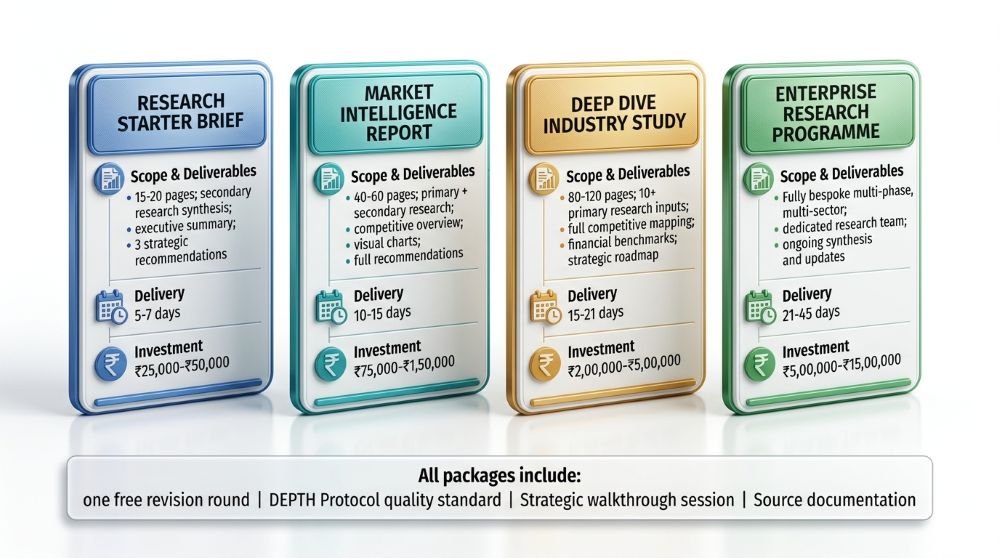
| Package | Scope & Deliverables | Delivery | Investment |
|---|---|---|---|
| Research Starter Brief | 15–20 pages; secondary research synthesis; executive summary; 3 strategic recommendations | 5–7 days | ₹25,000–₹50,000 |
| Market Intelligence Report | 40–60 pages; primary + secondary research; competitive overview; visual charts; full recommendations | 10–15 days | ₹75,000–₹1,50,000 |
| Deep Dive Industry Study | 80–120 pages; 10+ primary research inputs; full competitive mapping; financial benchmarks; strategic roadmap | 15–21 days | ₹2,00,000–₹5,00,000 |
| Enterprise Research Programme | Fully bespoke multi-phase, multi-sector; dedicated research team; ongoing synthesis and updates | 21–45 days | ₹5,00,000–₹15,00,000 |
What a Market Research Engagement Looks Like in Practice
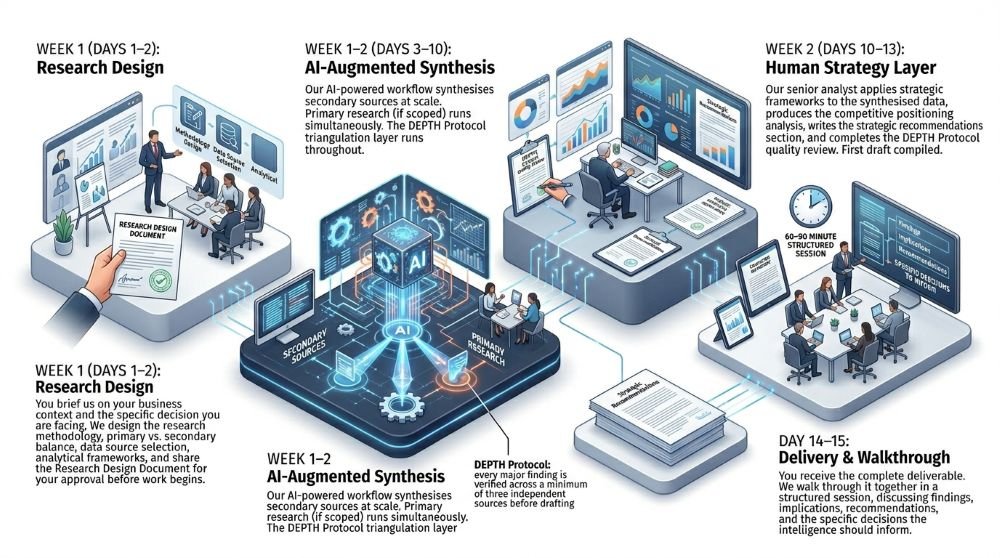
Week 1 (Days 1–2): Research Design You brief us on your business context and the specific decision you are facing. We design the research methodology, primary vs. secondary balance, data source selection, analytical frameworks, and share the Research Design Document for your approval before work begins.
Week 1–2 (Days 3–10): AI-Augmented Synthesis Our AI-powered workflow synthesises secondary sources at scale. Primary research (if scoped) runs simultaneously. The DEPTH Protocol triangulation layer runs throughout: every major finding is verified across a minimum of three independent sources before it progresses to the drafting phase.
Week 2 (Days 10–13): Human Strategy Layer Our senior analyst applies strategic frameworks to the synthesised data, produces the competitive positioning analysis, writes the strategic recommendations section, and completes the DEPTH Protocol quality review. First draft compiled.
Day 14–15: Delivery & Walkthrough: You receive the complete deliverable. We walk through it together in a 60–90-minute structured session, discussing findings, implications, recommendations, and the specific decisions the intelligence should inform.
Frequently Asked Questions
- What makes SAI GENiUS research different from buying a syndicated report?
-
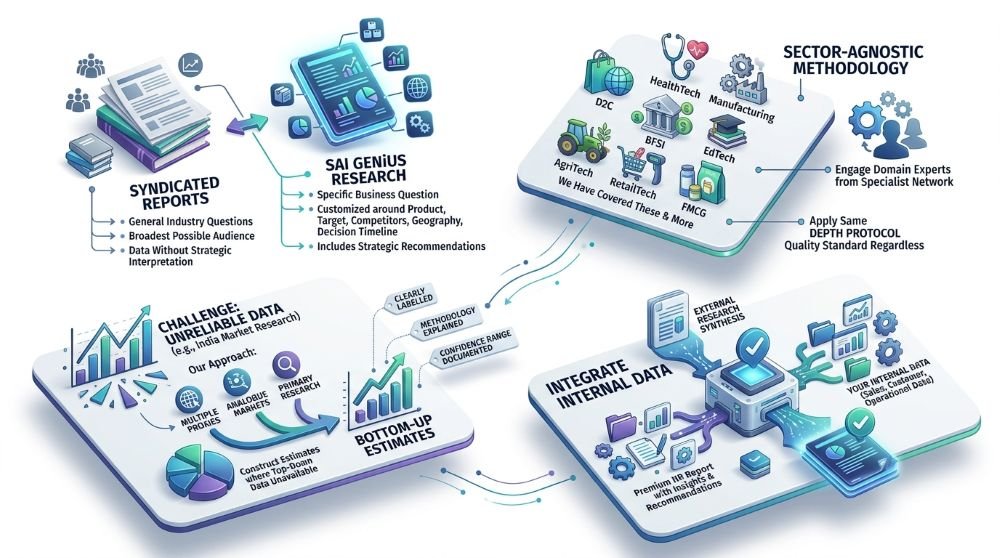
Syndicated reports answer general industry questions for the broadest possible audience. SAI GENiUS research answers your specific business question designed around your product, your target segment, your competitive situation, your geography, and your decision timeline. We also include strategic recommendations; syndicated reports provide data without strategic interpretation.
- Can you research sectors you have not previously covered?
-
Yes. Our research methodology is sector-agnostic. We have covered D2C, HealthTech, Manufacturing, BFSI, EdTech, AgriTech, RetailTech, FMCG, and more. When a new sector is required, we engage relevant domain experts from our specialist network and apply the same DEPTH Protocol quality standard regardless.
- How do you handle markets where reliable India-specific data is scarce?
-
This is one of the most common challenges in India market research. Our approach: we use multiple proxies, analogue markets, and primary research to construct bottom-up estimates where top-down data is unavailable or unreliable. Every estimate built from proxies is clearly labelled as such, with the methodology explained and the confidence range documented.
- Can you work with our existing internal data?
-
Yes. If you have internal sales data, customer data, or operational data you want incorporated into the research, we can design the engagement to integrate your data with our external research synthesis.