Chapter-1
The Situation
Three Years of Plateau and a Business Owner Considering an Exit

The owner-director of a 14-year-old Surat textile machinery manufacturing company had built a respected business supplying specialized weaving equipment and spare parts to Gujarat's textile cluster. At its peak, the business had grown steadily for a decade. Then it stopped.
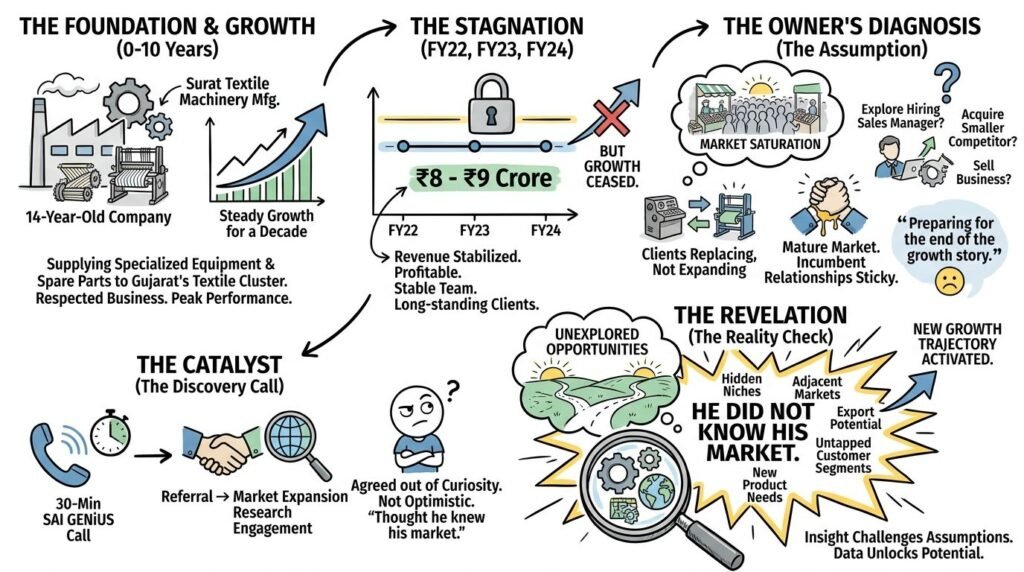
For three consecutive years — FY22, FY23, FY24 — annual revenue had stabilized between ₹8 and ₹9 crore. The business was profitable. The team was stable. The client relationships were long-standing. But growth had ceased.

The owner's diagnosis: market saturation. The Surat textile machinery market, he believed, had reached a steady state. His existing clients were not buying more machinery — they were replacing, not expanding. New clients were difficult to find because the market was mature and incumbent relationships were sticky. He had explored hiring a new sales manager, considered acquiring a smaller competitor, and had tentative conversations with two potential acquirers who were interested in buying his business.

He was, in his own words, "preparing for the end of the growth story."

A referral from a mutual contact in Gujarat's MSME community led to a 30-minute SAI GENiUS discovery call. The owner agreed to a market expansion research engagement largely out of curiosity — he was not optimistic about what it might reveal. He thought he knew his market.

He did not know his market.

Chapter-2
The Intelligence
Three Growth Levers Hidden in Plain Sight

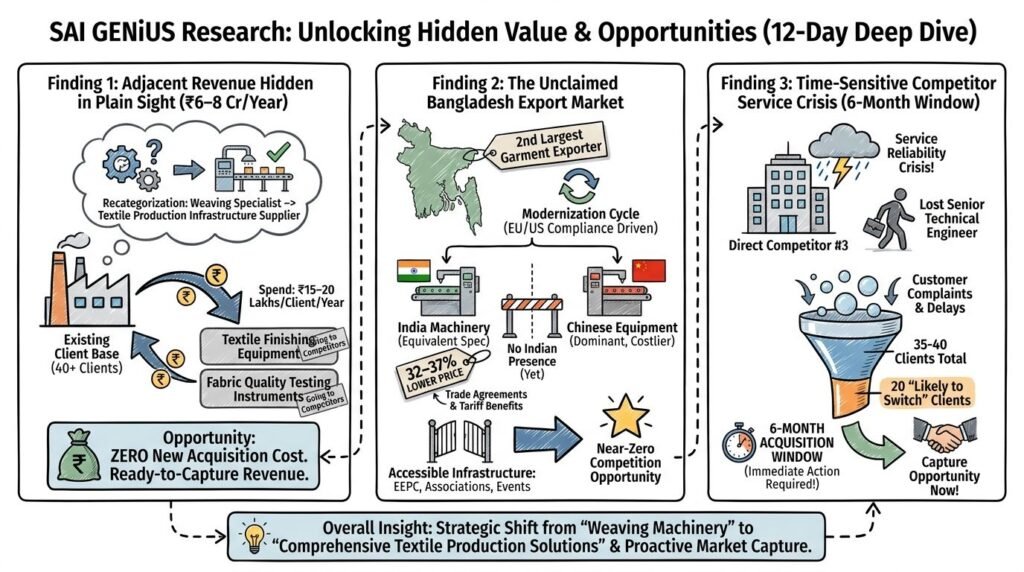
The SAI GENiUS research team spent 12 days mapping the owner's competitive landscape, analyzing adjacent product categories, assessing international export opportunities, and — crucially — investigating recent developments among his direct competitors. The research combined secondary market analysis with primary data gathered through structured interviews with 6 industry experts and distribution channel contacts in Gujarat's textile cluster.
₹15–20 Lakhs Per Client Per Year, Sitting in Adjacent Categories, Going to Competitors

The research team analysed the purchasing patterns of the owner’s existing client base — specifically what those clients were buying from other suppliers in adjacent product categories. The methodology: a combination of trade data analysis, distributor conversations, and structured interviews with 3 of the owner’s own long-standing clients (conducted as industry research, not as sales conversations).

The finding was stark: the owner’s 40+ existing clients were collectively spending an estimated ₹15–20 lakhs per client per year — totalling ₹6–8 crore annually — on textile finishing equipment and fabric quality testing instruments from other suppliers. These were product categories that the owner’s manufacturing capability could address with minimal retooling, that shared supply chain infrastructure with his existing product line, and that his existing clients already trusted him to supply — they simply did not know he could.

The owner had never sold textile finishing equipment. He had never considered it. He was a weaving machinery specialist — that was his identity and his expertise. The research team’s findings forced a recategorization: he was not a weaving machinery specialist. He was a textile production infrastructure supplier. The distinction carried ₹6–8 crore of annual revenue opportunity inside his existing client base, requiring zero new customer acquisition.

A Bangladesh Export Opportunity That No Competitor Had Captured

The research team’s international market analysis identified a specific opportunity the owner had never considered: Bangladesh’s textile manufacturing sector — the world’s second-largest garment exporter after China — was in the middle of a machinery modernization cycle, driven by compliance requirements from European and American buyers who increasingly mandated production efficiency and quality standards from their Bangladeshi suppliers.

The price comparison data the research team assembled was significant: India-manufactured textile machinery of equivalent specification to the owner’s product range was priced 32–37% below comparable Chinese equipment in the Bangladesh market — and Chinese equipment dominated the Bangladeshi import supply chain primarily because no Indian supplier had established the relationships, logistics infrastructure, or marketing presence to compete for Bangladeshi market share.

The regulatory environment was favorable: India-Bangladesh trade agreements (including preferential tariff treatment) made Indian machinery cost-competitive even after logistics and duty considerations. The relationship infrastructure required to enter the Bangladeshi market — industry associations, EEPC India support, Bangladeshi textile industry events — was accessible and well-documented.

This was an export market with structural price advantage, active demand, and near-zero competition from Indian suppliers. It had existed for years. No competitor had gone after it. The owner had never thought to look.

A Competitor Service Crisis Creating a 6-Month Acquisition Window

The competitive landscape analysis — specifically, a structured investigation of the owner’s three nearest direct competitors — surfaced a time-sensitive finding: the owner’s third-largest competitor had recently lost their senior technical engineer (confirmed through LinkedIn analysis and corroborated by a distribution channel conversation) and was experiencing a documented service reliability crisis. Customer complaints on textile industry forums and a sudden uptick in service delays indicated that the competitor was unable to maintain their standard service quality commitments.

The research team estimated that this competitor served approximately 35–40 clients in the owner’s geographic footprint, with an estimated 20 of those clients classified as likely to consider switching suppliers if service quality did not recover within 60–90 days. The window — from the time the service crisis became visible to the time the competitor either resolved it or lost clients permanently — was estimated at 6 months.

This was not a market trend. It was a time-sensitive competitive opportunity that required immediate action to capture.

Chapter-3
The Decision
Three Simultaneous Growth Moves, Launched Within 45 Days

The owner received the SAI GENiUS research on day 12. His response — by his own account — was a combination of relief and urgency. Relief that the market saturation diagnosis was wrong. Urgency because the competitor window was actively closing.

Move 1 — Adjacent Product Launch (Month 1–3): The owner immediately initiated conversations with two existing manufacturers of textile finishing equipment about a distribution or white-label agreement that would allow him to supply these products to his existing clients under his own brand and warranty. Within 45 days, a distribution agreement was signed with one manufacturer, giving the owner a textile finishing equipment product line to sell to his existing clients. The product line was introduced to his top 25 clients in a targeted personal outreach campaign framed as a service expansion.

Move 2 — Bangladesh Export Initiative (Month 1–6): The owner connected with EEPC India's regional chapter and identified two Bangladeshi textile industry events scheduled in the following quarter. He attended both — the first time he had represented his business at an international industry event. Export licensing applications were initiated. A Bangladeshi distributor contact was established through one of the industry events, leading to an initial sample export of 3 units in month 4. The Bangladesh pilot generated ₹1.2Cr in its first year of operation.

Move 3 — Competitor Client Acquisition Campaign (Immediate): Within 2 weeks of receiving the research, the owner's sales team deployed a targeted direct outreach campaign to the estimated 20 clients of the struggling competitor who matched the profile of likely switchers. The message was simple: same product category, guaranteed service level agreements, local Surat presence, and a 3-month free service contract for any client willing to evaluate a switch. Eleven of the 20 contacted clients took a meeting. Four converted within 90 days.

Chapter-4
The Outcome
61% Revenue Growth in 14 Months, and a Business With Three New Growth Engines

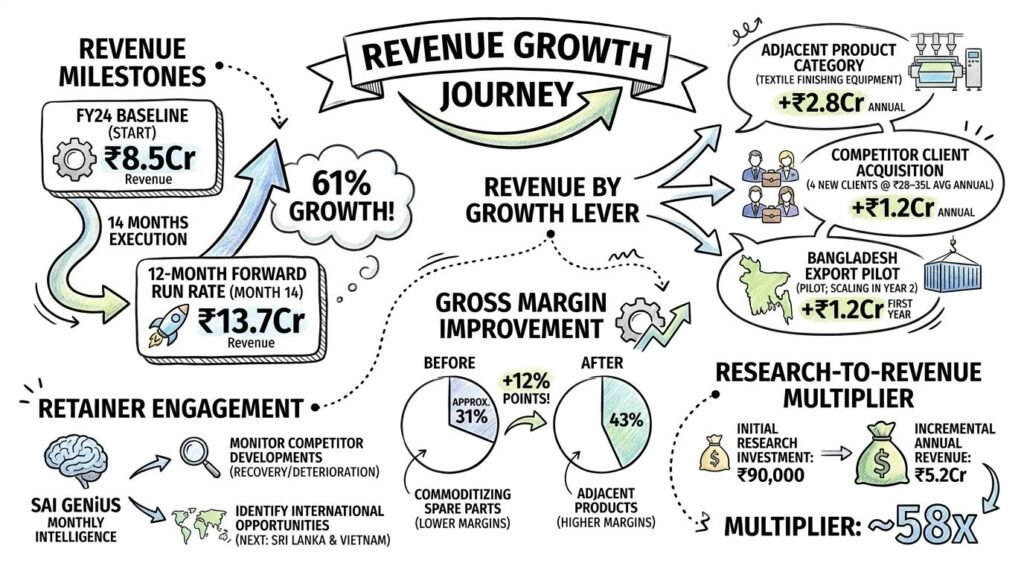
Revenue: ₹8.5Cr (FY24 baseline) → ₹13.7Cr (12-month forward run rate by month 14 of execution). Revenue growth of 61% in 14 months.
Revenue by Growth Lever:

    • Adjacent product category (textile finishing equipment): +₹2.8Cr annual
    • Competitor client acquisition: +₹1.2Cr annual (4 new clients at ₹28–35L average annual value)
    • Bangladesh export pilot: +₹1.2Cr first year (pilot; scaling in Year 2)

Gross Margin: Improved by 12 percentage points — from approximately 31% to 43% — primarily because the adjacent product categories (finishing equipment and testing instruments) carried structurally higher margins than the commoditizing spare parts segment that had dominated the client mix during the plateau period.

Retainer Engagement: The owner engaged a SAI GENiUS monthly intelligence retainer following the initial research, specifically to monitor competitor developments (particularly the struggling competitor's recovery or further deterioration) and identify the next round of international market opportunities. Sri Lanka and Vietnam are the next export markets being assessed.

Research-to-Revenue Multiplier: Initial research investment: ₹90,000. Incremental annual revenue generated by decisions made from the research: ₹5.2Cr. Multiplier: ~58x.

---------- CASE STUDY

INDUSTRY

Textile Machinery Manufacturing

LOCATION

Surat, Gujarat

Business Stage

Established SME (₹8–9Cr annual revenue; operating for 14 years)

Services Used

Market Expansion Research + Ongoing Monthly Intelligence Retainer

Project Investment

₹90,000 (initial research) + ₹35,000/month (retainer, ongoing)

Delivery Timeline

12 days (initial research)

Primary Decision

Adjacent product expansion + Bangladesh export launch + competitor client acquisition campaign

Outcome

Revenue ₹8.5Cr → ₹13.7Cr in 14 months (+61%); gross margin +12 percentage points

Research-to-Revenue Multiplier

~58x (₹5.2Cr new annual revenue / ₹90,000 research investment)

our

CLIENT VOICE

"We walked into that investor meeting knowing our market better than our investor did. For a pre-Series A founder, that is not a typical feeling. The research gave us a level of evidentiary confidence that I believe is what converted conditional interest into a signed term sheet. And the chronic disease management insight — something we had not seen — is now a core business line. The research did not just support our fundraise. It changed our product roadmap."

— Co-Founder (Clinical), HealthTech Platform, Hyderabad (Identity anonymized with permission)