A personal care brand built on the principle of ingredient transparency and natural formulations had spent 14 months developing a product line of eight SKUs — face care, hair care, and body care — targeted at urban Indian women aged 25–40 who were increasingly sceptical of synthetic ingredient labels.
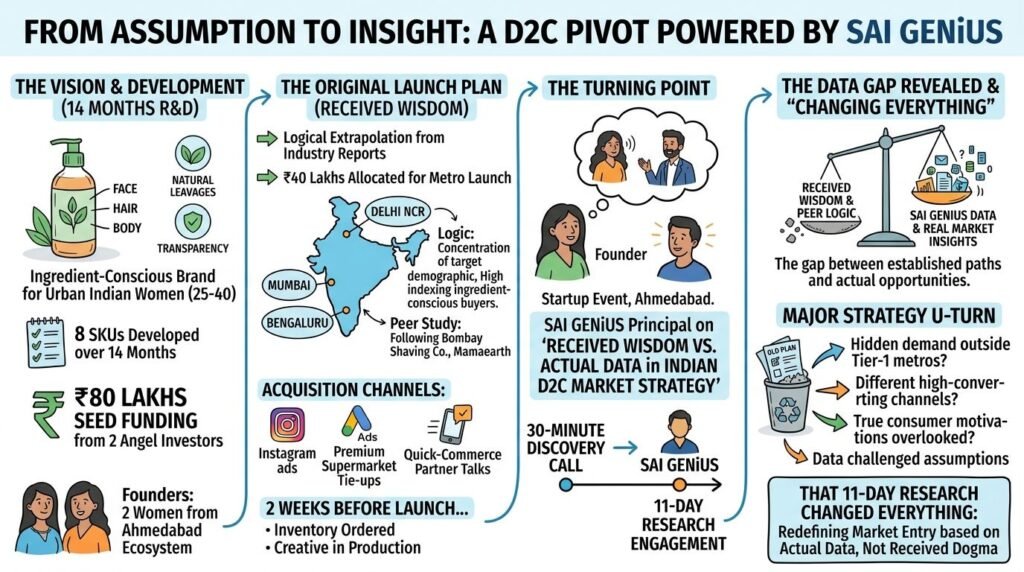
The brand had raised ₹80 lakhs in seed funding from two angel investors. The founding team — two women from Ahmedabad's startup ecosystem — had done what most Indian startup founders do before a launch: read industry reports about the Indian D2C market, studied successful peers from Bombay Shaving Company to Mamaearth, and built their launch plan on logical extrapolation from what they observed.
Their plan: ₹40 lakhs allocated to a metro launch across Mumbai, Delhi NCR, and Bengaluru. Instagram and Google advertising are the primary acquisition channels. Modern trade tie-ups in premium supermarkets. A launch partner conversation is underway with one national quick-commerce platform.
The logic was sound — on the surface. India's Tier-1 cities had the largest concentration of their target demographic. Ingredient-conscious buyers indexed highest in metro areas. Their three most admired competitor brands had all launched in metros first.
The funding was allocated. The inventory was ordered. The campaign creative was in production.
Two weeks before the campaign launch date, one of the founders attended a startup event in Ahmedabad where a SAI GENiUS principal was speaking about the gap between received wisdom and actual data in the Indian D2C market strategy. The conversation that followed led to a 30-minute discovery call. That 30-minute call led to an 11-day research engagement. That 11-day research engagement changed everything.
The SAI GENiUS research engagement combined secondary market research synthesis with competitive intelligence analysis covering 18 direct and indirect competitors. The team specifically investigated the Tier-1 D2C personal care competitive landscape and tested the assumption — held as received wisdom in the founding team — that metro markets were the correct launch geography for an ingredient-transparent natural personal care brand.
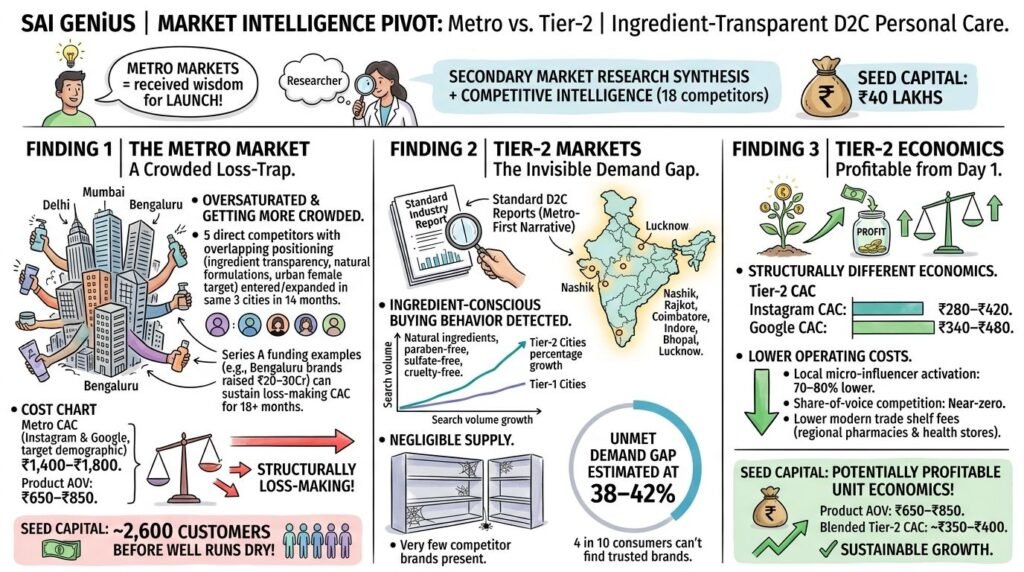
Three findings emerged that the founding team had not seen, could not have seen from standard industry reports, and would have discovered only after spending ₹40 lakhs of irreplaceable seed capital.
The founding team received the SAI GENiUS research report on day 11 of the project. The strategy walkthrough call lasted two hours — far longer than the standard 30-minute debrief — because the founders spent most of the call processing the implications.
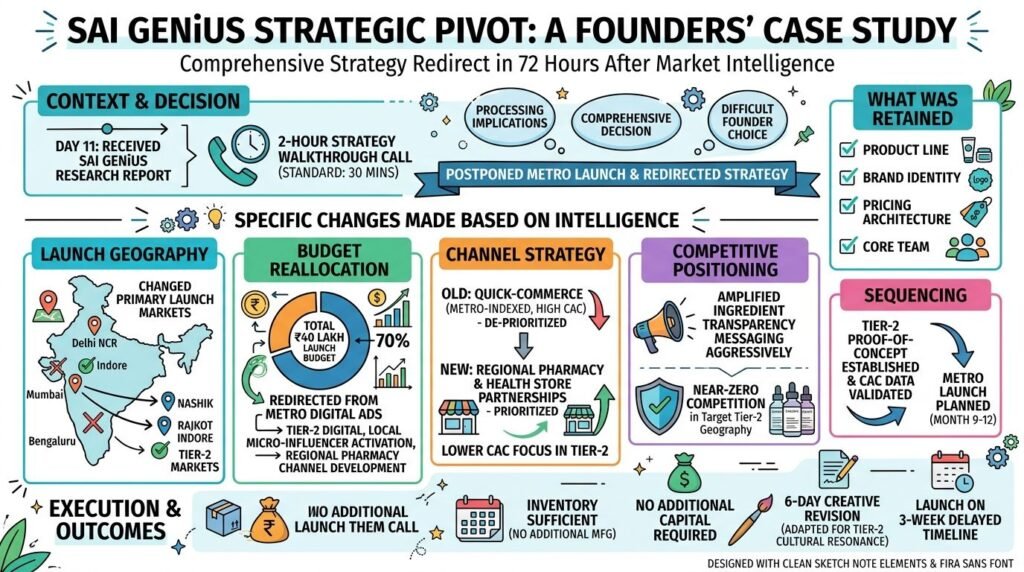
The decision they made in the following 72 hours was comprehensive and, by their own account, one of the most difficult decisions they had made as founders: they postponed the planned metro launch entirely and redirected the strategy.
Specific changes made based on the intelligence:
- Launch geography: Changed from Mumbai/Delhi NCR/Bengaluru to Nashik, Rajkot, and Indore as the three primary launch markets
- Budget reallocation: 70% of the ₹40 lakh launch budget redirected from metro digital advertising to Tier-2 digital, local micro-influencer activation, and regional pharmacy channel development
- Channel strategy: Quick-commerce de-prioritized (metro-indexed, higher CAC); regional pharmacy and health store partnerships prioritized
- Competitive positioning: Amplified ingredient transparency messaging more aggressively, recognizing near-zero competition in the target Tier-2 geography
- Sequencing: Metro launch planned for Month 9–12, after Tier-2 proof-of-concept established and CAC data validated
- Retained: Product line, brand identity, pricing architecture, and core team remained unchanged
The inventory already manufactured was sufficient for all three Tier-2 markets. No additional capital was required to execute the pivot. The campaign creative was adapted for Tier-2 cultural resonance — a 6-day creative revision —, and the launch proceeded on a 3-week delayed timeline.
Eight months after the Tier-2 launch, the metrics told a story that the original metro strategy could not have produced at the same capital investment:
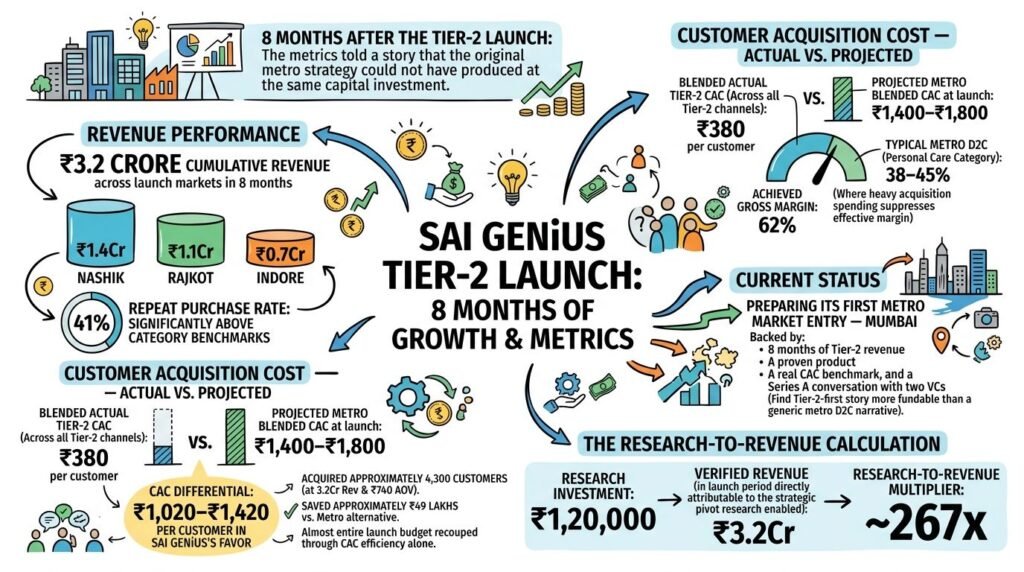
Revenue Performance: ₹3.2 crore in cumulative revenue across the three launch markets in 8 months. Nashik generated ₹1.4Cr, Rajkot ₹1.1Cr, and Indore ₹0.7Cr in the launch period. Repeat purchase rate: 41% (significantly above category benchmarks).
Customer Acquisition Cost — Actual vs. Projected: Blended actual CAC across all Tier-2 channels: ₹380 per customer. Projected metro blended CAC at launch: ₹1,400–₹1,800. CAC differential: ₹1,020–₹1,420 per customer in SAI GENiUS's favor. At 3.2Cr revenue and a blended AOV of ₹740, the brand acquired approximately 4,300 customers. At ₹380 vs. ₹1,500 CAC, the brand saved approximately ₹49 lakhs in customer acquisition costs versus the metro alternative — almost the entire launch budget recouped through CAC efficiency alone.
Gross Margin: Achieved: 62% — above the 38–45% typical for metro D2C in the personal care category (where heavy acquisition spending suppresses effective margin).
Current Status: The brand is preparing its first metro market entry — Mumbai — backed by 8 months of Tier-2 revenue, a proven product, a real CAC benchmark, and a Series A conversation with two VCs who found the Tier-2-first story more fundable than a generic metro D2C narrative.
The Research-to-Revenue Calculation: Research investment: ₹1,20,000. Verified revenue generated in the launch period directly attributable to the strategic pivot the research enabled: ₹3.2Cr. Research-to-Revenue Multiplier: ~267x.