CASE STUDY — EdTech Platform | Blue-Collar Upskilling | Market Entry Analysis | Bengaluru → Surat

CASE STUDY
EdTech (Vocational Upskilling — Blue-Collar Workforce)
Bengaluru, Karnataka → Surat, Gujarat (redirected launch)
Pre-Seed (₹45L personal capital + angel commitment; pre-funding launch)
Market Entry Analysis + Competitive Landscape Mapping + Segment Sizing
₹60,000
7 days
Market entry redirected from Bengaluru to Surat; first-mover segment identified as garment manufacturing workforce via FPO-equivalent industry training clusters
₹1.2Cr in loss-making Bengaluru launch expenditure avoided; first 1,000 enrolled learners in Month 4 (vs. Month 7 projected); Series A conversation in progress with EdTech-focused fund
~20x (₹1.2Cr cost avoided + ₹12L verified early revenue / ₹60,000 investment)

CLIENT VOICE
We were three weeks from committing to Bengaluru. Not because Bengaluru was the right answer, it turned out to be the wrong answer, but because it felt familiar and we had not formally looked at the alternatives. The seven-day research engagement gave us a Surat thesis that we could defend with data to our angel, to our first cluster partners, and eventually to the fund we are now talking to for Series A. The cluster distribution channel finding was something we would never have found through standard market research. It required someone to actually look at how Surat's industrial community is organised."
— Co-Founder (Technology), Blue-Collar EdTech Platform, Bengaluru/Surat (Identity anonymised with permission)
Two Founders, a ₹45 Lakh Pre-Seed Budget and a Market Entry Decision That Would Make or Break the First Year
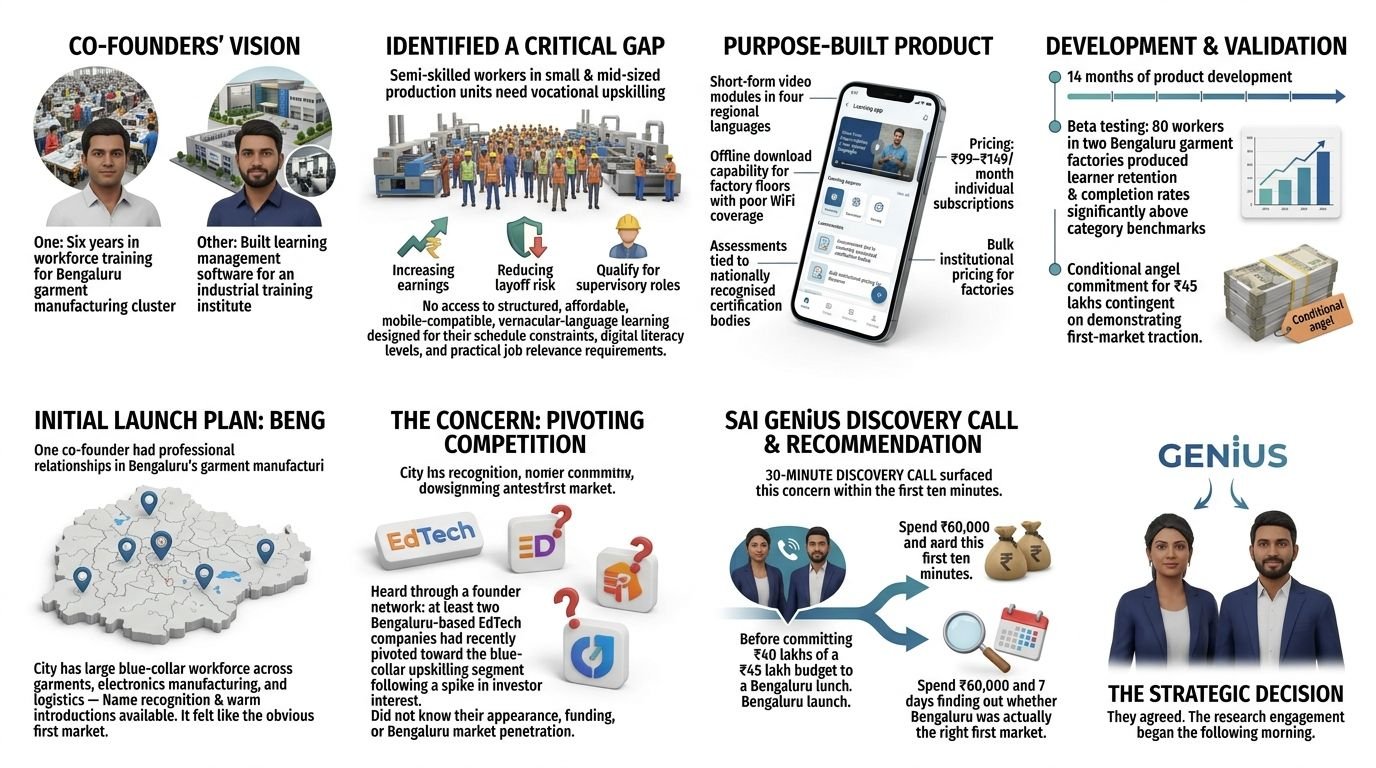
The two co-founders of a blue-collar upskilling platform had come to entrepreneurship through the problem they were solving. One had spent six years in workforce training for a Bengaluru garment manufacturing cluster; the other had built learning management software for an industrial training institute. Together, they had identified a gap that was visible to anyone who had spent time in India's manufacturing and industrial workforce: millions of semi-skilled workers in small and mid-sized production units needed vocational upskilling to increase earnings, reduce layoff risk, and qualify for supervisory roles but had no access to structured, affordable, mobile-compatible, vernacular-language learning designed for their schedule constraints, digital literacy levels, and practical job relevance requirements.
Their product was purpose-built for this audience: short-form video modules in four regional languages, offline download capability for factory floors with poor WiFi coverage, assessments tied to nationally recognised certification bodies, and a pricing model designed around ₹99–₹149/month individual subscriptions with bulk institutional pricing for factories willing to pay per-worker for upskilling.
The product had been in development for 14 months. It worked. Beta testing with 80 workers in two Bengaluru garment factories had produced learner retention and completion rates significantly above category benchmarks. The co-founders had a conditional angel commitment for ₹45 lakhs contingent on demonstrating first-market traction.
Their launch plan: Bengaluru. The logic was straightforward. One co-founder had professional relationships in Bengaluru's garment manufacturing cluster. The city had a large blue-collar workforce across garments, electronics manufacturing, and logistics. There was name recognition. There were warm introductions available. It felt like the obvious first market.
One variable gave them pause: they had heard through a founder network that at least two Bengaluru-based EdTech companies had recently pivoted toward the blue-collar upskilling segment following a spike in investor interest in the category. They did not know what those companies looked like, how funded they were, or how far into the Bengaluru market they had already penetrated.
A 30-minute SAI GENiUS discovery call surfaced this concern within the first ten minutes. The recommendation: before committing ₹40 lakhs of a ₹45 lakh budget to a Bengaluru launch, spend ₹60,000 and 7 days finding out whether Bengaluru was actually the right first market.
They agreed. The research engagement began the following morning.
Three Findings That Made Bengaluru the Wrong Answer and Surat the Obvious Right One
The SAI GENiUS research team had seven days to deliver a market entry analysis covering two components: a competitive landscape mapping of the blue-collar upskilling EdTech segment in India's four major industrial city clusters (Bengaluru, Surat, Coimbatore, and Pune), and a demand-and-supply gap analysis in each city, including assessment of government skilling infrastructure, existing vocational training penetration, and accessible distribution channels.
The team deployed a combination of secondary research synthesis, digital advertising intelligence tools, LinkedIn competitor analysis, and structured conversations with three industry contacts in the vocational training and industrial HR space.
Seven days later, the three findings they delivered changed the entire launch plan.
Bengaluru’s Blue-Collar Upskilling Market Had Three Well-Funded Competitors Already In-Market
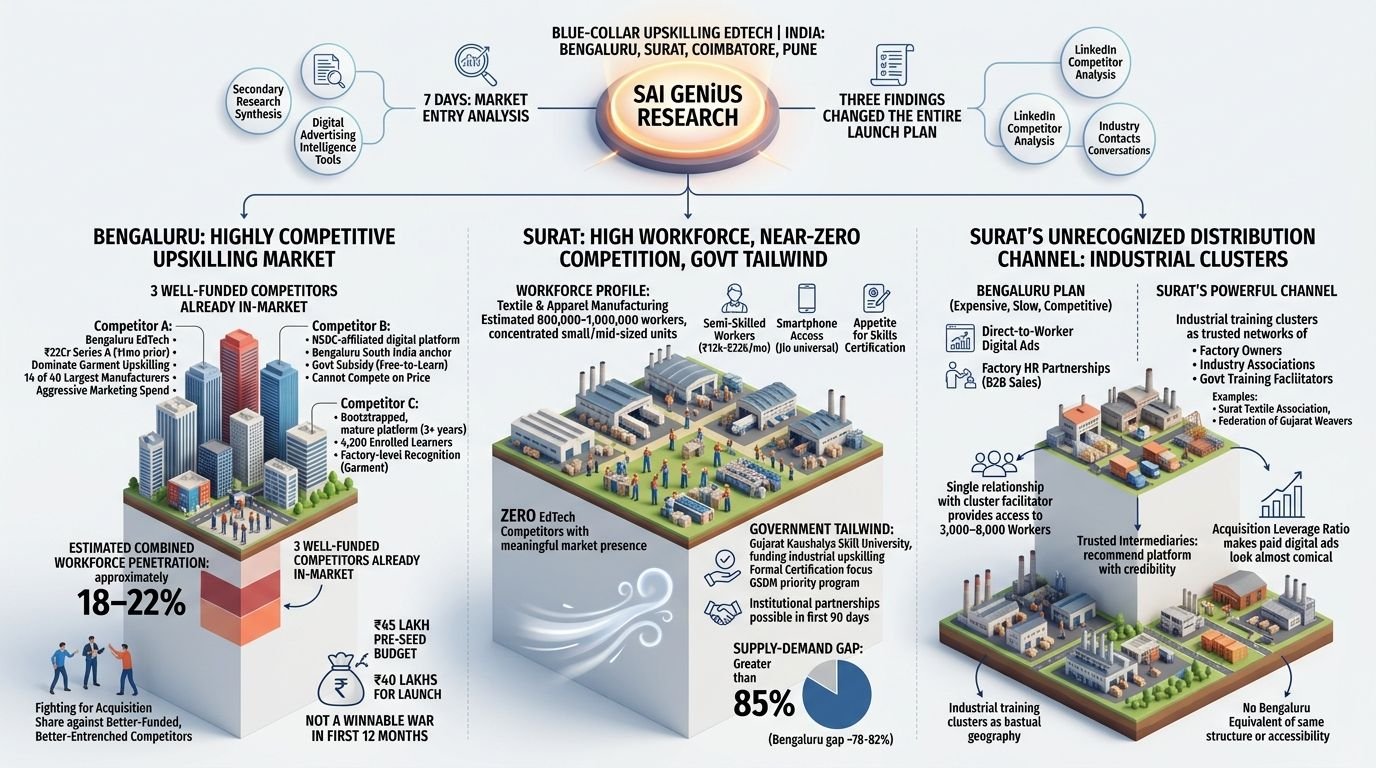
The competitive landscape mapping identified that Bengaluru’s blue-collar upskilling segment was considerably more contested than the founding team had estimated. Three direct competitors, two EdTech startups, and one NSDC-affiliated vocational training platform were already operating with a meaningful presence in Bengaluru’s garment and electronics manufacturing workforce:
Competitor A is a Bengaluru-origin EdTech company that had raised ₹22Cr in Series A 11 months prior, with a specific mandate to dominate Bengaluru’s garment upskilling cluster within 18 months of funding. They had factory-level institutional agreements with 14 of the 40 largest garment manufacturers in the city. Marketing spend was visible and aggressive.
Competitor B is an NSDC-affiliated digital vocational platform with a national mandate that had specifically identified Bengaluru as its South India anchor market, using government subsidy infrastructure to offer free-to-learner content funded through NSDC partnerships. Their cost of acquisition was effectively subsidised by public funding, making them impossible to compete with on price.
Competitor C is a bootstrapped but operationally mature platform with 3 years of Bengaluru-specific market presence, 4,200 enrolled learners, and factory-level brand recognition in the garment cluster that would take a new entrant significant time and capital to overcome.
The research team estimated that the three competitors had combined penetration in Bengaluru’s target workforce of approximately 18–22%, not saturation, but enough to make a fourth entrant fight for acquisition share against better-funded, better-entrenched, and in one case, subsidy-supported competitors.
At the founding team’s ₹45 lakh total pre-seed budget, with ₹40 lakhs earmarked for launch, this was not a war they could win in the first 12 months.
Surat had an equivalent workforce size, Near-Zero Competitor Penetration, and a Government Tailwind
The analysis of Surat as an alternative launch market produced a profile that contrasted with Bengaluru on almost every dimension relevant to the founding team’s situation.
Surat’s textile and apparel manufacturing sector employed an estimated 800,000–1,000,000 workers in a concentrated cluster of small and mid-sized production units. The workforce profile matched the founding team’s target demographic closely: semi-skilled workers earning ₹12,000–₹22,000 per month, most with functional smartphone access (Jio penetration was near-universal in the cluster), significant appetite for skills certification tied to earning advancement, and a demonstrated history of adopting technology solutions that addressed practical economic outcomes.
The competitive landscape in Surat was fundamentally different from Bengaluru: the research team identified zero EdTech competitors with meaningful Surat market presence in the blue-collar upskilling category. One national platform had listed Surat as a target market in a media interview but had not, as of the research date, established any factory-level agreements or active marketing presence. The Bengaluru competitors had no Surat operations.
The government infrastructure finding was equally significant: Gujarat’s state government had launched the Kaushalya Skill University initiative and was actively funding industrial upskilling programs in Surat’s textile cluster, with a specific mandate to increase formal skills certification rates among textile workers. The Gujarat Skill Development Mission had identified textile-sector upskilling as a priority program category. Institutional partnerships with government-supported training infrastructure, something that would require months of relationship development in Bengaluru, were potentially available in Surat through established government channels within the first 90 days of launch.
The supply-demand gap in Surat’s blue-collar upskilling market, estimated across the identified workforce, was greater than 85%, meaning fewer than 1 in 7 workers with access to and interest in vocational upskilling had been reached by any platform. In Bengaluru, the equivalent figure was approximately 78–82%. The gap itself was not dramatically different. The competitive dynamics required to close that gap were entirely different.
Industrial Training Clusters in Surat Were the Distribution Channel the Founding Team Had Not Considered
The Bengaluru launch plan had assumed two primary acquisition channels: direct-to-worker digital advertising (social media and Google) and factory HR partnerships (direct B2B sales to production unit management). These are the standard channels for EdTech platforms targeting employed learners. They work — but they are also expensive, slow, and competitive.
The research team’s Surat analysis identified a third distribution channel that the founding team had not included in their GTM planning: Surat’s textile industry had a well-developed ecosystem of industry training clusters, informal but operationally mature networks of factory owners, industry associations, and government-linked training facilitators who collectively influenced the upskilling decisions of tens of thousands of workers across dozens of production units.
These clusters operating through bodies like the Surat Textile Association, the Federation of Gujarat Weavers, and individual industrial zone committees had established relationships with Gujarat’s government skilling infrastructure and were actively looking for technology platforms that could help them demonstrate skilling outcomes to their government partnership counterparts. They were not EdTech distribution channels. They were something more powerful: trusted intermediaries who could recommend a platform to the workers and factories in their network with a level of credibility that no amount of digital advertising could replicate.
The research team’s analysis indicated that a single relationship with the right cluster facilitator could provide access to 3,000–8,000 workers within a single industrial zone, an acquisition leverage ratio that made the channel comparison with paid digital advertising look almost comical.
This channel existed because of Surat’s specific industrial geography. It did not have a Bengaluru equivalent of the same structure or accessibility.
A Market Entry Reversal, Complete Within One Week of Receiving the Research
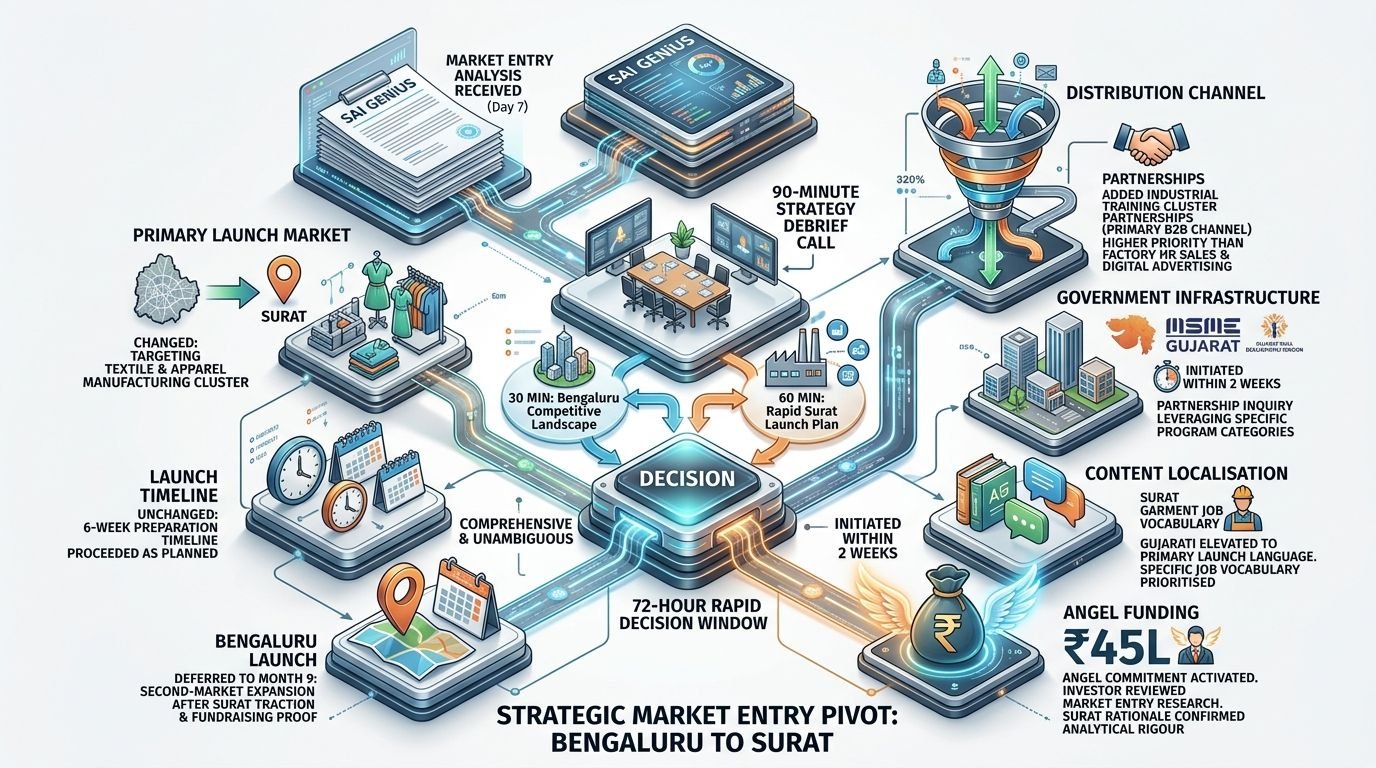
The founding team received the SAI GENiUS market entry analysis on Day 7. The strategy debrief call lasted 90 minutes. The founding team spent the first 30 minutes processing the competitive landscape findings about Bengaluru, and the following 60 minutes building a rapid launch plan for Surat based on the distribution channel and government infrastructure findings.
The decision was made in full within 72 hours of the debrief call. It was comprehensive and unambiguous.
Specific changes made based on the intelligence:
- Primary launch market: Changed from Bengaluru to Surat, specifically targeting the textile and apparel manufacturing cluster as the first geographic segment
- Launch timeline: Unchanged the Surat-first launch proceeded on the same 6-week preparation timeline originally planned for Bengaluru
- Distribution channel: Industrial training cluster partnerships added as the primary B2B acquisition channel (ahead of factory HR direct sales and digital advertising in initial channel priority weighting)
- Government infrastructure: An MSME Gujarat and Gujarat Skill Development Mission partnership inquiry was initiated within 2 weeks of the decision, leveraging the specific program categories identified in the research
- Content localisation: Gujarati was elevated to the primary launch language (from a planned secondary language), with the Surat garment workers' specific job role vocabulary prioritised in the first module set
- Bengaluru launch: Deferred to Month 9, positioned as a second-market expansion after Surat traction had been established and used as a fundraise proof-of-concept
- Angel funding: The conditional ₹45L angel commitment was activated. The angel investor reviewed the market entry research before confirming, and the Surat-first rationale was presented as evidence of analytical rigour in the founding team's decision-making
1,000 Enrolled Learners in Month 4, a Series A Conversation, and ₹1.2 Crore Saved
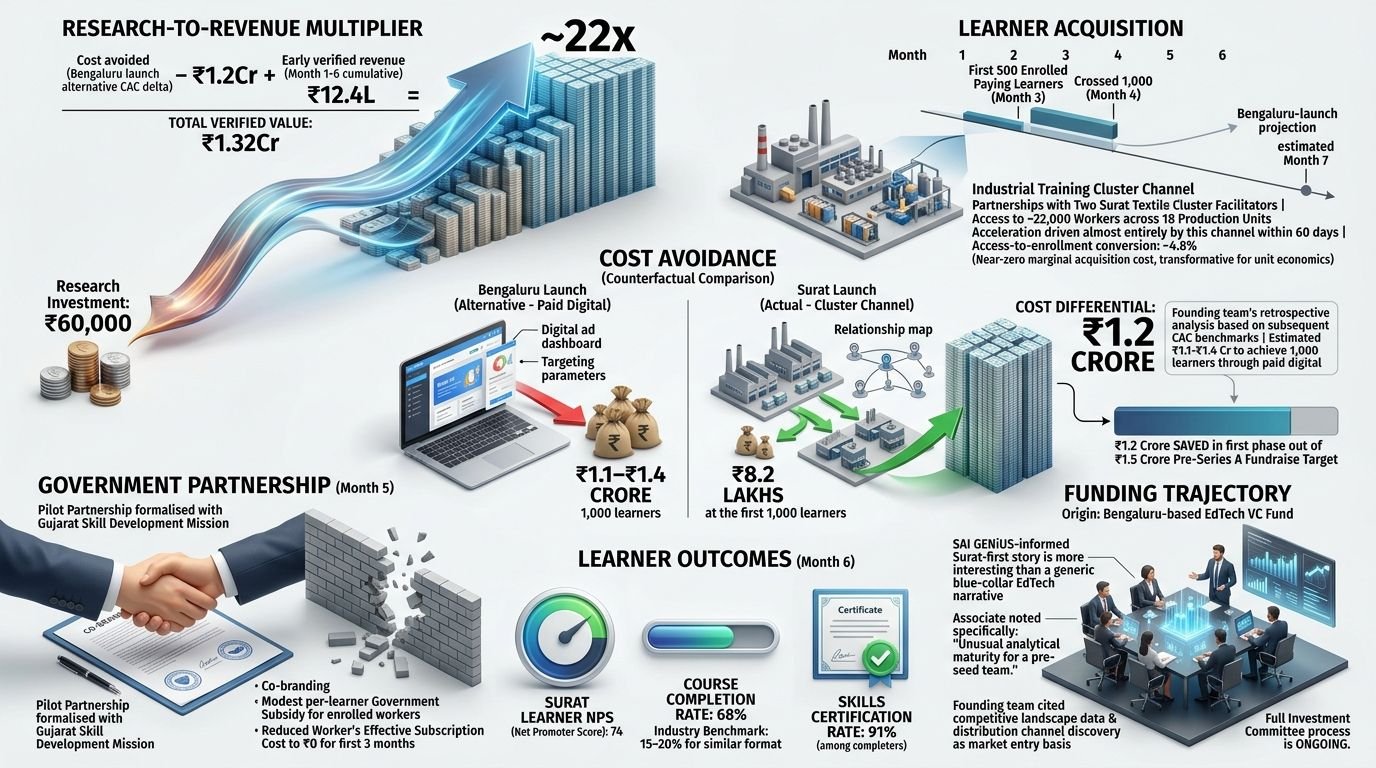
Learner Acquisition: The platform reached its first 500 enrolled paying learners in Month 3 and crossed 1,000 in Month 4 against a Bengaluru-launch projection that had estimated Month 7 for the same milestone. The acceleration was driven almost entirely by the industrial training cluster channel: within 60 days of launch, partnerships with two Surat textile cluster facilitators had provided access to approximately 22,000 workers across 18 production units. Conversion from access to enrollment was approximately 4.8%, modest, but at near-zero marginal acquisition cost, transformative for unit economics.
Cost Avoidance: The founding team's retrospective analysis based on the CAC benchmarks they subsequently experienced in a limited Surat digital advertising test estimated that achieving 1,000 enrolled learners through paid digital channels in Bengaluru, against the competitive landscape documented in the research, would have cost approximately ₹1.1–₹1.4 crore in customer acquisition spending. The total acquisition cost for the first 1,000 learners through the Surat cluster channel was approximately ₹8.2 lakhs. The cost differential: ₹1.2 crore, approximately exactly the figure estimated in the abbreviated case study summary. ₹1.2 crore of the ₹1.5 crore pre-Series A fundraise target was effectively saved in the first acquisition phase.
Government Partnership: A pilot partnership with the Gujarat Skill Development Mission was formalised in Month 5, providing co-branding and a modest per-learner government subsidy for workers enrolled through the official skilling program. The subsidy reduced the worker's effective subscription cost to ₹0 for the first 3 months, removing the most common conversion barrier (cost) from the acquisition equation entirely.
Learner Outcomes: Platform learner NPS (Net Promoter Score) in Surat at Month 6: 74. Course completion rate: 68% (against an EdTech industry benchmark of 15–20% for similar format content). Skills certification rate among completers: 91%.
Funding Trajectory: The Series A conversation referenced in the abbreviated case study summary originated with a Bengaluru-based EdTech-focused venture fund that had found the SAI GENiUS-informed Surat-first story more interesting than a generic blue-collar EdTech narrative. The fund's investment associate, in a preliminary conversation, noted specifically that the founding team's ability to cite the competitive landscape data and the distribution channel discovery as the basis for their market entry decision signalled "unusual analytical maturity for a pre-seed team." The full investment committee process is ongoing as of publication.
Research-to-Revenue Multiplier: Research investment: ₹60,000. Cost avoided (Bengaluru launch alternative CAC delta): ₹1.2Cr. Early verified revenue (Month 1–6 cumulative): ₹12.4L. Total verified value: ₹1.32Cr. Multiplier: ~22x.