
CASE STUDY — SaaS Platform | HR Technology | Market Sizing + Competitive Intelligence | Bengaluru

CASE STUDY
B2B SaaS (HR Technology — SME Payroll & Compliance)
Bengaluru, Karnataka
Seed (₹2.1Cr seed raised; 40 paying customers; targeting Series A in 12 months)
Market Sizing Research + Competitive Intelligence + ICP Refinement Analysis
₹1,50,000
10 days
ICP narrowed from "any Indian SME with 10–500 employees" to "manufacturing SMEs with 50–200 employees in Gujarat, Maharashtra, and Tamil Nadu with active ESI/PF compliance burden" — an ICP refinement that tripled conversion rate
Sales conversion rate 8% → 26%; ACV (Annual Contract Value) ₹24,000 → ₹58,000; MRR ₹80,000 → ₹3.4L in 6 months
~22x (annualised MRR uplift/research investment)

CLIENT VOICE
We had been selling to everyone and closing no one. The research showed us that we had already found our best customer — we had 10 of them in our existing base — but we had never formally described who they were or why they were buying. The manufacturing SME ESI/PF compliance framing was not something we invented. Our customers had been telling us that was their problem. We had just not been listening at a pattern level. The ICP refinement took us from an 8% conversion rate to 26% in one quarter. That is not a marginal improvement. That is a different business."
— Co-Founder (Product), B2B HR SaaS Platform, Bengaluru (Identity anonymized with permission)
40 Customers, a Functional Product and a Sales Cycle That Made No Economic Sense
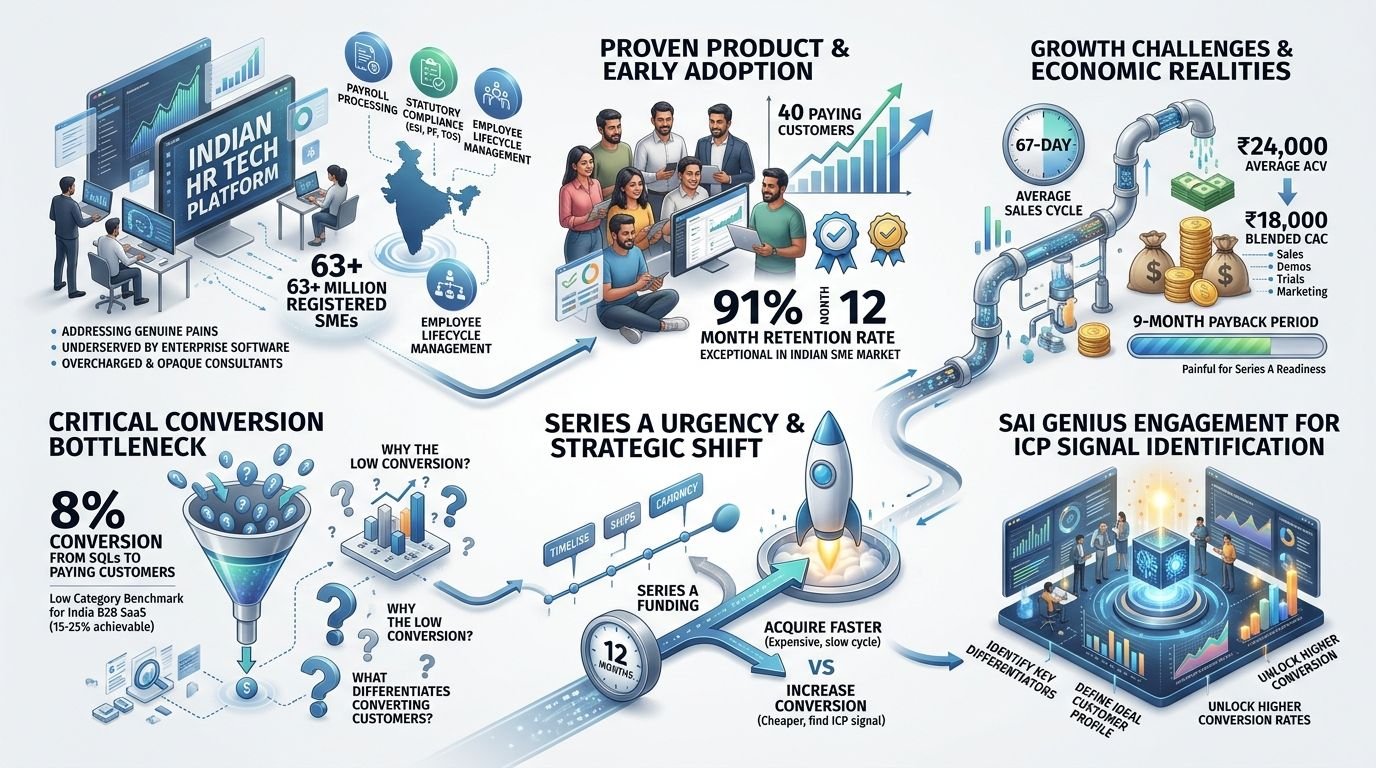
The two co-founders of an HR technology SaaS platform had built a product addressing a genuinely painful problem: payroll processing, statutory compliance (ESI, PF, professional tax, TDS), and employee lifecycle management for Indian SMEs a market of 63+ million registered businesses that was simultaneously underserved by enterprise HR software (too expensive, too complex) and overcharged by payroll consultants (too slow, too relationship-dependent, and operationally opaque).
Their product worked. Forty paying customers confirmed it. The team had navigated the hardest part of early B2B SaaS in India, getting paying customers, and the retention rate at Month 12 was 91%, which in the Indian SME software market is exceptional.
The problem was economics. The average sales cycle was 67 days from first contact to signed contract. The average ACV (Annual Contract Value) was ₹24,000. The blended cost of acquiring a single customer, including the sales team's time, demo costs, trial period support, and marketing attribution, was approximately ₹18,000. At ₹24,000 ACV and ₹18,000 CAC, the payback period was 9 months, acceptable in theory, painful in practice when the founding team was trying to demonstrate Series A readiness within 12 months.
The more fundamental problem was conversion rate: 8% of sales-qualified leads were converting to paying customers. The founding team knew this was a low-category benchmark for B2B SaaS in India, suggesting that 15–25% was achievable for a product with their retention and satisfaction profiles. They did not know why their conversion rate was low, because they had not formally analysed what differentiated converting customers from non-converting ones.
The Series A timeline created urgency: to demonstrate the MRR growth required for a credible Series A narrative in 12 months, the team needed to either acquire customers faster (expensive, given the sales cycle length) or increase conversion on existing lead flow (cheaper, if the right ICP signal could be identified). SAI GENiUS was engaged to identify the ICP signal.
The Customer They Already Had Was Not the Customer They Were Selling To
The Top Quartile Customers Had a Specific Profile That Was Not in the Founding Team’s ICP
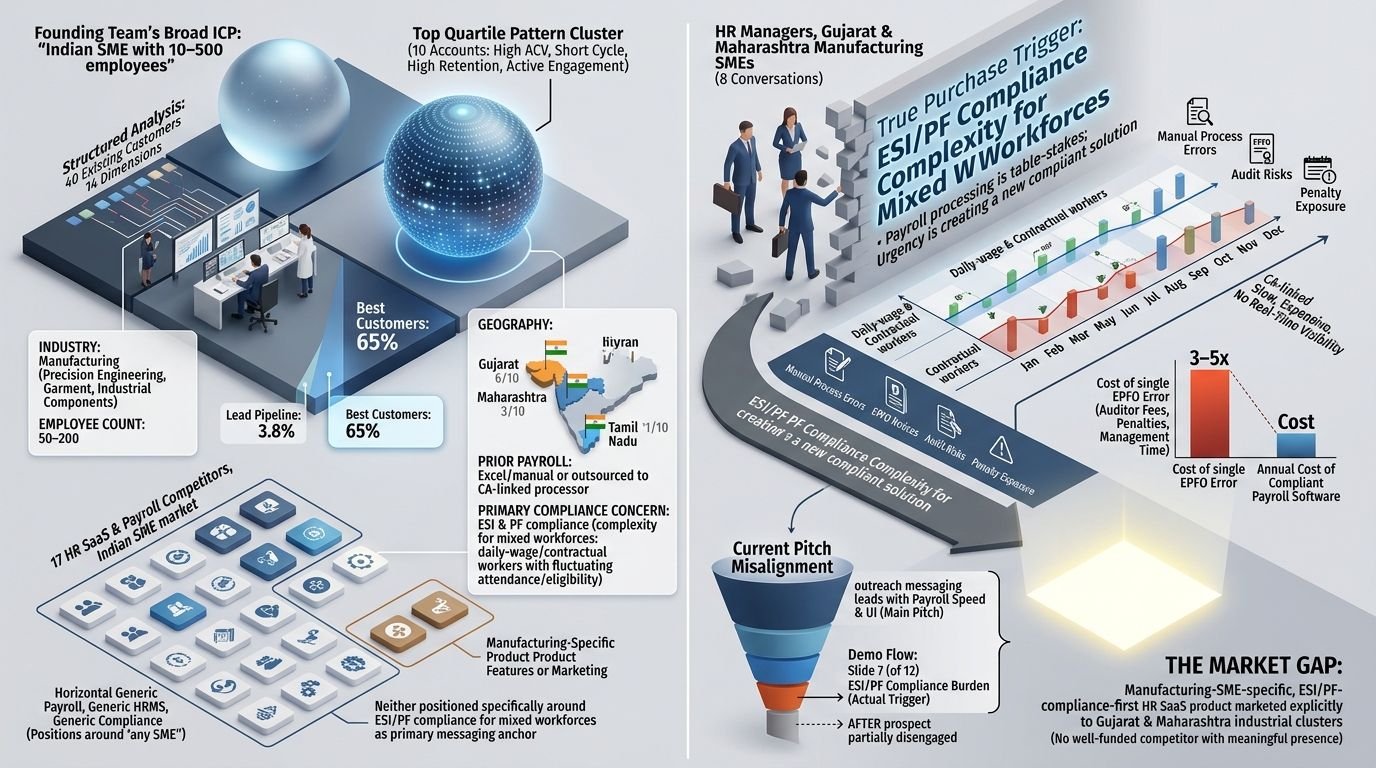
The research team’s first task was a structured analysis of the 40 existing customers mapping each across 14 dimensions, including industry, employee count band, founding year, geographic location, prior payroll management method, primary compliance concern, and ACV. The analysis was designed to identify pattern clusters that the founding team’s broad ICP (“Indian SME with 10–500 employees”) had obscured.
The pattern was unambiguous. The top quartile of customers the 10 accounts with the highest ACV, shortest sales cycles, highest retention scores, and most active product engagement shared a profile that was specific enough to constitute a true ICP:
- Industry: Manufacturing (specifically: precision engineering, garment manufacturing, and industrial components)
- Employee count: 50–200 employees
- Geography: Gujarat (6 of 10), Maharashtra (3 of 10), Tamil Nadu (1 of 10)
- Prior payroll method: Excel/manual or outsourced to a CA-linked payroll processor
- Primary compliance concern: ESI and PF compliance, specifically the complexity of managing ESI contributions for a large number of daily-wage and contractual workers whose attendance and eligibility changed month-to-month
- Secondary driver: TDS management for white-collar employees combined with ESI for blue-collar workforce, a mixed workforce compliance burden that generic payroll software handled poorly
This profile of manufacturing SMEs in Gujarat and Maharashtra, with 50–200 employees and a mixed workforce compliance burden, represented approximately 3.8% of the founding team’s current lead pipeline. It represented 65% of their best customers.
The ESI/PF Compliance Burden Was the Real Purchase Trigger, Not Payroll Processing
The research team’s primary research component, structured conversations with 8 manufacturing SME HR managers and payroll administrators in Gujarat and Maharashtra, produced a finding that reframed the product’s value proposition:
Every manufacturing SME HR contact described payroll processing as table-stakes; they had existing processes for it, however painful. The purchase that triggered the problem that created genuine urgency to buy a new solution was ESI/PF compliance complexity for mixed workforces.
The specific pain: manufacturing SMEs with daily-wage and contractual workers needed to recalculate ESI eligibility every month as worker attendance and wage rates fluctuated. Manual processes generated compliance errors that resulted in EPFO notices, audit risks, and penalty exposure. CA-linked payroll processors were slow, expensive, and provided no real-time visibility into compliance status. The cost of a single EPFO compliance error in auditor fees, penalty payments, and management time was typically 3–5x the annual cost of a compliant payroll software solution.
The founding team’s product handled this use case well, but their sales materials, demo flow, and outreach messaging did not lead with it. The pitch led with payroll processing speed and user interface. The ESI/PF compliance burden, the actual purchase trigger for the highest-value customer segment, appeared in slide 7 of a 12-slide demo, after the prospect had already partially disengaged.
The Competitive Landscape Had a Specific Gap in the Manufacturing SME Segment
The competitive analysis mapped 17 HR SaaS and payroll software competitors across the Indian SME market. The mapping found that 14 of the 17 positioned their primary GTM around the “any SME” horizontal generic payroll, generic HRMS, and generic compliance. Only 2 had any manufacturing-specific product features or marketing. Neither had positioned specifically around ESI/PF compliance for mixed workforces as a primary messaging anchor.
The market gap, a manufacturing-SME-specific, ESI/PF-compliance-first HR SaaS product marketed explicitly to Gujarat and Maharashtra industrial clusters, was unoccupied by any well-funded competitor with meaningful market presence in those geographies.
ICP Refinement, Messaging Overhaul, and a Channel Pivot to Industrial Associations
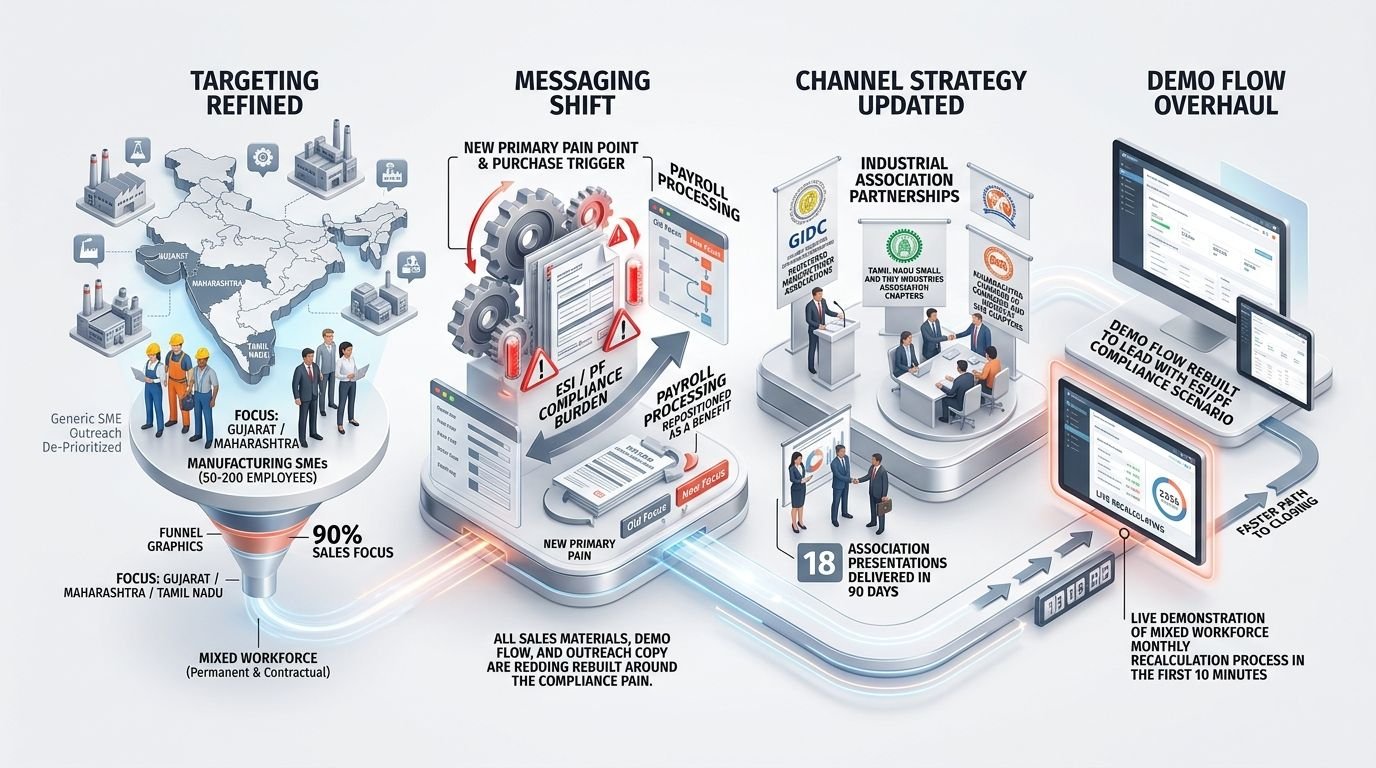
ICP change: Formally narrowed to manufacturing SMEs (50–200 employees, Gujarat / Maharashtra / Tamil Nadu, mixed workforce) as 90% of sales focus. Generic SME outreach de-prioritised.
Messaging change: All sales materials, demo flow, and outreach copy rebuilt around the ESI/PF compliance burden as the primary pain point and purchase trigger. Payroll processing is repositioned as a benefit, not the headline value proposition.
Channel change: Industrial association partnerships added as a primary acquisition channel, specifically, GIDC (Gujarat Industrial Development Corporation) registered manufacturer associations, Tamil Nadu Small and Tiny Industries Association chapters, and Maharashtra Chamber of Commerce and Industry SME chapters. 18 association presentations delivered in 90 days.
Demo restructure: Demo flow rebuilt to lead with the ESI/PF compliance scenario, specifically, a live demonstration of the mixed workforce monthly recalculation process in the first 10 minutes of every demo.
Triple the Conversion Rate, 4x the ACV, and a Series A Pipeline
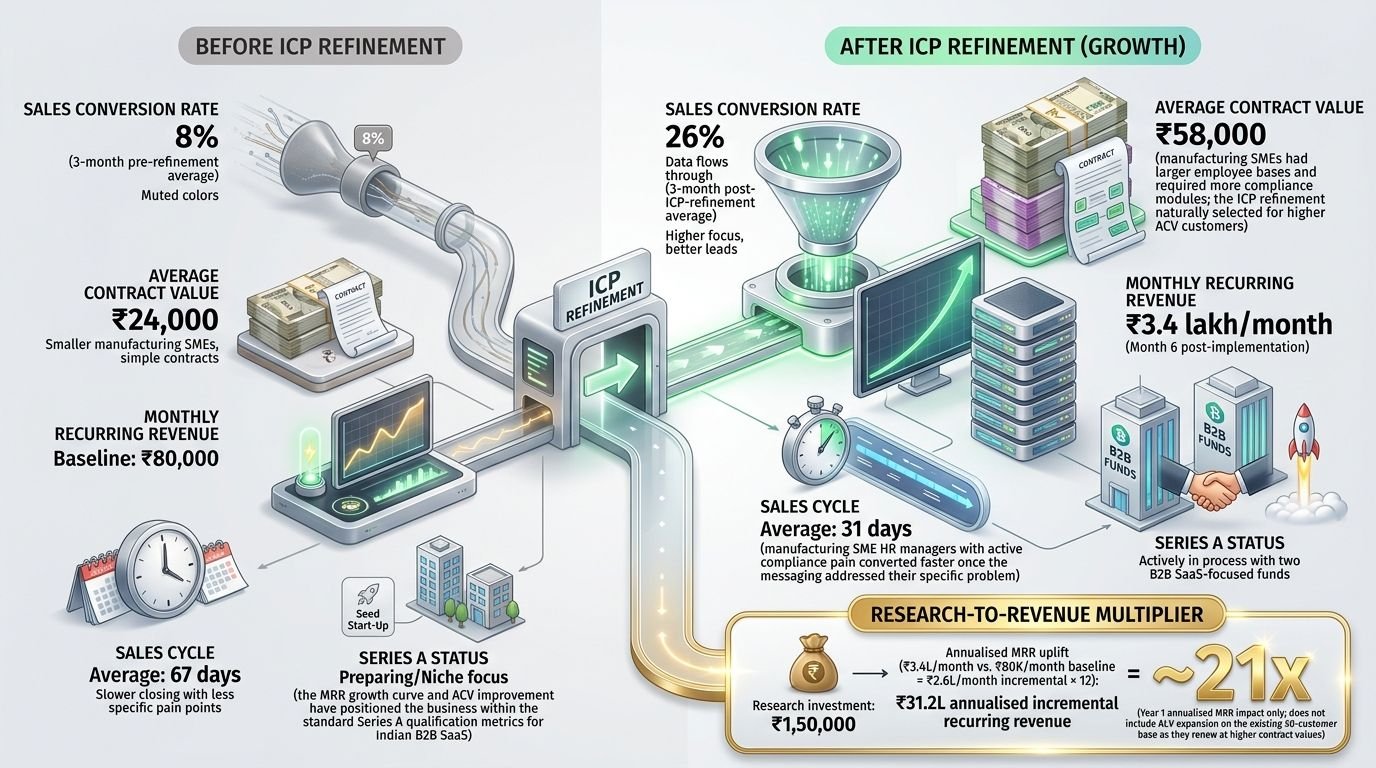
Sales Conversion Rate: 8% → 26% (3-month post-ICP-refinement average)
Average Contract Value: ₹24,000 → ₹58,000 (manufacturing SMEs had larger employee bases and required more compliance modules; the ICP refinement naturally selected for higher ACV customers)
Monthly Recurring Revenue: ₹80,000 (baseline) → ₹3.4 lakh/month (Month 6 post-implementation)
Sales Cycle: Reduced from 67 days to 31 days on average, manufacturing SME HR managers with active compliance pain converted faster once the messaging addressed their specific problem
Series A Status: Actively in process with two B2B SaaS-focused funds; the MRR growth curve and ACV improvement have positioned the business within the standard Series A qualification metrics for Indian B2B SaaS
Research-to-Revenue Multiplier: Research investment: ₹1,50,000. Annualised MRR uplift (₹3.4L/month vs. ₹80K/month baseline = ₹2.6L/month incremental × 12): ₹31.2L annualised incremental recurring revenue. Multiplier: ~21x (Year 1 annualised MRR impact only; does not include ACV expansion on the existing 40-customer base as they renew at higher contract values).