
SAI GENiUS — Strategic & Analytical Intelligence, GENerating Insights for Unlimited Success. Every word in that name is intentional. Every service we deliver is an expression of it. And every client we serve is a proof point of what becomes possible when India’s builders finally have access to the intelligence they have always deserved.
Read MoreTHE FIVE VALUES
WHAT WE ACTUALLY STAND FOR: THE FIVE VALUES WE BUILD EVERY PROJECT AROUND
These Are Not Wall Posters. They Are the Operating Principles That Every Single Deliverable Is Held To.
Every consulting firm has values written somewhere. Most of them are written for an investor deck or a website visitor, not for the people doing the actual work. Our values were written backwards: we started with the behaviours we refuse to compromise on in a live client engagement, and then we named them.
We tell you what the data says, not what you hoped it would say.
This is the most important value we hold and the one that creates the most tension in any research relationship.
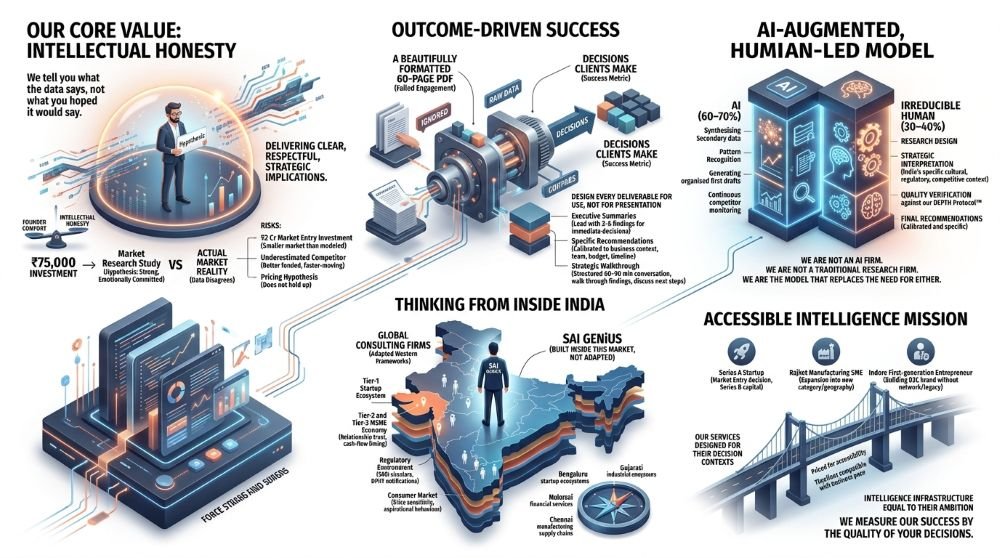
When a founder spends ₹75,000 on a market research study, they usually have a hypothesis. Often a strong one. Sometimes an emotionally committed one. They have told their co-founder, their family, and maybe an early investor that this market is worth pursuing.
And sometimes, the data disagrees.
Our job in that moment is not to protect the founder’s hypothesis. It is not to find a creative way to make the numbers work. It is not to produce a report that validates what the client hoped was true.
Our job is to deliver what the research actually shows clearly, respectfully, and with the specific strategic implications clearly explained.
If the market is significantly smaller than modelled, you need to know before you invest ₹2 crore, not after. If a competitor you underestimated is actually better funded and faster-moving than you assumed, you need to know before you enter their territory, not after six months of declining conversion rates. If your pricing hypothesis does not hold up under consumer research, you need to know before you build your entire go-to-market model around it.
Intellectual honesty is not comfortable in the short term. It is consistently the most valuable thing a research partner can deliver.
Our loyalty is to your outcomes. Not to your comfort. Not to a repeat engagement that feels pleasant but produces nothing.
We do not measure our success by the quality of our reports. We measure it by the quality of the decisions our clients make because of them.
A beautifully formatted 60-page PDF that sits in a Google Drive folder and influences no decisions is a failed engagement, regardless of how impressive the table of contents is.
This means we design every deliverable for use, not for presentation. Our executive summaries lead with the 3–5 findings that require immediate decisions, not with background context and methodology documentation. Our recommendations are specific to your business context, your team size, your budget, and your timeline, not generic strategic advice about your industry that applies equally to every player in the market.
It also means we build a strategic walkthrough into every engagement. Not a “here is your file, let us know if you have questions” handover. A structured conversation usually lasts 60–90 minutes during which we walk through the findings, explain what they mean for your specific situation, and discuss what to do with the intelligence you now have.
We are not trying to create dependency. We are trying to maximise the return on your research investment, and the return is only realised when the intelligence is applied to a real decision.
Your decision quality is our success metric. That is the only one that matters.
We use AI for everything it does better than humans. We use humans for everything AI cannot do. We never confuse the two.
AI is remarkable at synthesising large volumes of secondary data quickly. It is effective at pattern recognition across structured datasets. It is efficient at generating organised… first drafts from verified inputs. It is valuable for continuous competitor monitoring and real-time signal detection.
AI is not capable of deciding which questions are worth asking. It is not able to interpret findings through the lens of India’s specific cultural, regulatory, and competitive context. It cannot challenge the obvious conclusion by recognising that the most obvious answer in your market is the one every competitor has already acted on. It cannot produce a recommendation calibrated to your specific business situation, your team, your constraints, your specific competitive vulnerabilities.
At SAI GENiUS, 60–70% of our production workflow is AI-augmented. The synthesis, the sourcing, the pattern identification, the first-draft structuring these are all AI-accelerated. The result is research that is dramatically faster and more comprehensive than anything a solo human analyst could produce.
But 30–40% of every engagement is irreducibly human: the research design, the strategic interpretation, the quality verification against our DEPTH Protocol™, and the final recommendations. That layer cannot be replaced. We will never pretend it can. And we will never deliver an AI-generated output that has not been verified, challenged, and enriched by a human strategist.
We are not an AI firm. We are not a traditional research firm. We are the model that replaces the need for either.
We do not apply Western frameworks to Indian realities. We think from inside the Indian market not about it.
This is not a positioning statement. It is a structural capability built through sustained immersion in the specific dynamics that make India’s markets unique.
India is not one market. It is simultaneously:
- A Tier-1 startup ecosystem that operates at global standards in funding sophistication, product quality, and competitive intensity
- A Tier-2 and Tier-3 MSME economy that operates on relationship trust, cash-flow timing, and distribution dynamics that no Western consulting framework adequately captures
- A regulatory environment where the difference between a SEBI circular and a DPIIT notification can reshape an entire sector’s competitive landscape overnight
- A consumer market where price sensitivity, aspirational behavior, channel preference, and decision psychology vary dramatically across a 100-kilometer radius
- A B2B market where trust, community reputation, and sector-specific networks matter more than most market research methodologies formally account for
Global consulting firms know India exists. They have India practices. They produce India reports. But their frameworks were built for Western markets and adapted for India, which means they consistently miss the nuances that matter most.
SAI GENiUS was built inside this market, not adapted to it. Our founders, our analysts, and our expert network think in the specific competitive dynamics of Gujarati industrial clusters, Bengaluru startup ecosystems, Mumbai financial services, and Chennai manufacturing supply chains because that is where we have spent our professional lives.
Global firms look at India. We think from inside it. That is not a small difference.
The best strategic intelligence should not be available exclusively to the businesses that can already afford not to need it.
The most well-resourced businesses in India, the large enterprises, the multinationals, and the unicorn startups already have access to sophisticated intelligence. They have in-house research teams, retained consulting relationships, and the budget to commission whatever bespoke intelligence they need.
The businesses that need professional intelligence most urgently are often the ones with the least access to it: the Series A startup with ₹3 crore to deploy, making a market entry decision that will determine whether they ever raise a Series B. The ₹8Cr manufacturing SME in Rajkot is deciding whether to expand into a new product category or new geography. The first-generation entrepreneur in Indore is building a D2C brand without the benefit of an IIM network or a family business legacy.
These are the businesses SAI GENiUS was built for. Not because they are the most lucrative client segment. Because they are the ones for whom world-class intelligence changes outcomes most dramatically, and because for too long, the intelligence market has been structured as though they do not deserve to be served.
We price these businesses. We design services for their specific decision contexts. We deliver at timelines compatible with the pace at which their businesses move.
And we will continue to find ways to make intelligence more accessible because India’s economic future is built on these businesses, and they deserve intelligence infrastructure equal to their ambition.