CASE STUDY — Cloud Kitchen & D2C Food Brand | Market Positioning + GTM Strategy | Ahmedabad

CASE STUDY
Food & Beverage (Cloud Kitchen + D2C Packaged Food)
Ahmedabad, Gujarat
Early Stage (₹60L personal capital; pre-seed; 4 months operating)
Market Positioning Research + Competitive Landscape Mapping + GTM Strategy
₹75,000
8 days
Pivoted from generic multi-cuisine cloud kitchen to Gujarati premium tiffin + D2C spice and ready-to-cook kits brand targeting Non-Resident Gujarati and diaspora gifting segment
Revenue ₹0 → ₹1.8Cr in 10 months; D2C segment contributing 58% of revenue; 3 international shipping destinations activated (USA, UK, Australia)
~240x

CLIENT VOICE
"I was two weeks away from opening a cloud kitchen that would have lost money every month in a market I had not researched. The SAI GENiUS engagement gave me the number I had avoided calculating — what my actual net margin on aggregator orders would be — and then showed me a business that I was already 70% of the way to building without knowing it. My 40 tiffin subscribers were the proof of concept for everything that followed. The NRG gifting idea came from the research, but the ingredient was already there. I just had not been looking at it as a business."
— Founder, Premium Gujarati Food Brand, Ahmedabad (Identity anonymized with permission)
A Home Chef With a ₹60 Lakh Investment, a Cloud Kitchen License, and a Business Model
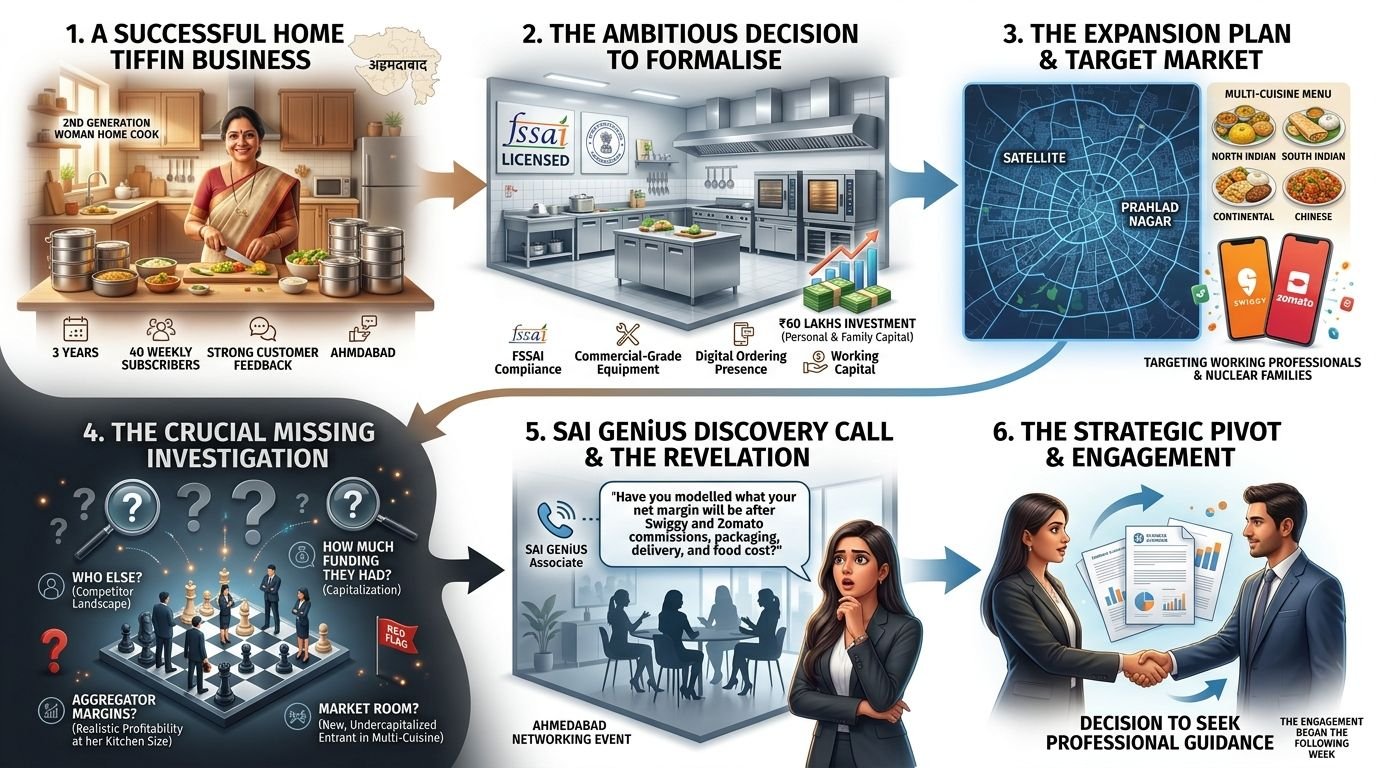
The founder, a second-generation home cook who had been feeding a network of 40 weekly tiffin subscribers from her Ahmedabad home kitchen for three years, had made the decision to formalise her operation into a licensed cloud kitchen with FSSAI compliance, commercial-grade equipment, and a digital ordering presence.
The investment: ₹60 lakhs of personal and family capital, split between kitchen infrastructure, food safety certification, digital ordering platform integration, and working capital. The plan: launch a multi-cuisine cloud kitchen in Ahmedabad's Satellite and Prahlad Nagar neighbourhoods, leveraging Swiggy and Zomato for discovery and delivery, with a menu spanning North Indian, South Indian, Continental, and Chinese cuisine.
The logic, on the surface, was reasonable. Ahmedabad's food delivery market was growing. The neighbourhoods targeted had high concentrations of working professionals and nuclear families. The founder's cooking quality, based on three years of tiffin subscriber feedback, was genuinely strong.
What the founder had not formally investigated: who else was already doing exactly this, how much money they had, what margins the aggregator channel was actually delivering to operators at her kitchen size, and whether "multi-cuisine cloud kitchen in Satellite" was a business model with room for a new, undercapitalised entrant.
A conversation at an Ahmedabad women entrepreneur's network meeting connected the founder to a SAI GENiUS associate. The 30-minute discovery call surfaced a single, uncomfortable question: "Have you modelled what your net margin will be after Swiggy and Zomato commissions, packaging, delivery, and food cost?"
She had not. Not formally. The engagement began the following week.
Four Findings That Made the Original Plan Unviable and Revealed a Better Business Two Floors Above It
The Aggregator Channel Was Structurally Destroying Margin for Operators at Her Scale
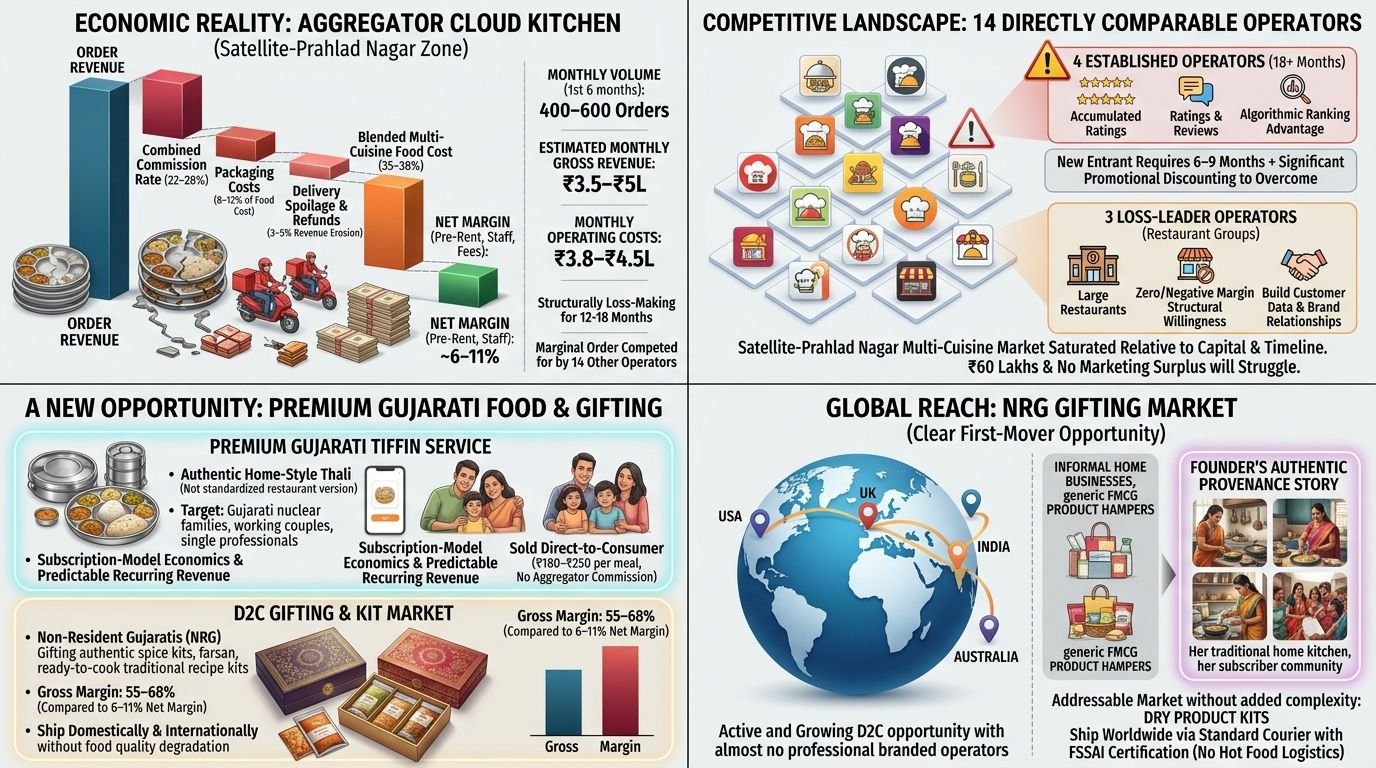
The research team’s food delivery economics analysis produced numbers that the founder had intuited but had not fully modelled. Swiggy and Zomato combined commission rates for cloud kitchens in the Satellite-Prahlad Nagar zone ranged from 22–28% of the order value. Packaging costs for delivery-optimised containers added 8–12% of food cost. Average delivery-related food spoilage and quality complaints (leading to refunds) accounted for a further 3–5% of revenue erosion.
Against a blended food cost of 35–38% for a multi-cuisine menu (which requires a larger raw material inventory with higher wastage rates than a single-cuisine kitchen), the net margin for a cloud kitchen of her planned size operating on aggregator channels was approximately 6–11% before rent, utilities, staffing, and platform listing fees were accounted for.
At projected monthly order volumes of 400–600 orders in the first 6 months, a realistic estimate for a new, unbranded cloud kitchen in a competitive zone, the business would generate approximately ₹3.5–₹5L in monthly gross revenue against a monthly operating cost structure of ₹3.8–₹4.5L. The model was structurally loss-making for the first 12–18 months, with no clear inflexion point unless order volume scaled rapidly in a market where the marginal order was actively being competed for by 14 other cloud kitchens in the same geography.
The Ahmedabad Multi-Cuisine Cloud Kitchen Segment Had 14 Directly Comparable Operators Already Active
The competitive landscape mapping identified 14 cloud kitchens operating in the Satellite-Prahlad Nagar zone with overlapping multi-cuisine menus, similar price points, and identical aggregator channel dependence. Of the 14, four had been operating for 18+ months and had accumulated ratings, reviews, and algorithmic ranking advantages that a new entrant would require 6–9 months and significant promotional discounting to overcome.
Three of the 14 were operated by larger restaurant groups that had dedicated cloud kitchen brands as loss-leading customer acquisition tools for their dine-in operations, meaning they were structurally willing to run cloud kitchen operations at zero or negative margin to build customer data and brand relationships. The founder could not compete with operators for whom cloud kitchen profitability was not a primary objective.
The research team’s assessment: the Satellite-Prahlad Nagar multi-cuisine cloud kitchen market was not saturated in an absolute sense, but it was saturated relative to the founder’s available capital and timeline. A new entrant with ₹60 lakhs and no marketing budget surplus would struggle to achieve the order volume and rating density required to be economically sustainable before the working capital ran out.
A Premium Gujarati Tiffin and Gifting Segment Had Active Demand and No Professional Operator
The research team’s consumer trend analysis specifically, a synthesis of Ahmedabad food delivery search pattern data, social media community listening across Gujarati food groups, and a review of gifting and food delivery behaviour among Ahmedabad’s professional class, identified a segment that the founder’s original plan had completely overlooked: the premium, authentic, home-style Gujarati food segment in both the tiffin service and the gifting category.
The specific demand profile was consistent across multiple sources:
Gujarati nuclear families, working couples, and single professionals in Ahmedabad’s new residential zones wanted authentic home-style Gujarati thali, not the standardised restaurant version, for regular weekday consumption. The existing tiffin services in this segment were predominantly small, informal, and capacity-constrained, with no quality standardisation, no digital ordering infrastructure, and no brand identity beyond WhatsApp group ordering.
The Gujarati diaspora gifting market, specifically, Non-Resident Gujaratis in the USA, UK, Australia, and East Africa, gifting authentic Gujarati spice kits, farsan, and ready-to-cook traditional recipe kits to family and friends in India for festivals, birthdays, and special occasions, was an active and growing D2C opportunity with almost no professional operators. Existing gifting options were generic FMCG hampers that had no authentic Gujarati culinary identity.
The margin structure in both segments was fundamentally different from the aggregator cloud kitchen model:
- Premium tiffin: Sold direct-to-consumer via WhatsApp, website, or app at ₹180–₹250 per meal, with no aggregator commission, higher perceived value, and subscription-model economics that created predictable recurring revenue
- D2C gifting kits: Sold at ₹800–₹2,800 per kit with gross margins of 55–68% compared to the 6–11% net margin of the aggregator cloud kitchen model and the ability to ship domestically and internationally without the food quality degradation that affected hot food delivery
The NRG (Non-Resident Gujarati) Gifting Market Was an Underserved Category With a Clear First-Mover Opportunity
The most commercially distinctive finding in the research was the international gifting dimension of the premium Gujarati food opportunity. The research team’s secondary analysis of NRG community behaviour using diaspora food community forums, international food gifting platform data, and social media listening across Gujarati community groups in the UK and USA found a consistent, repeated, unmet demand: NRGs wanted to send authentic Gujarati food products specific regional specialities, artisanal spice blends, traditional farsan, and home-recipe curry kits to family in India and occasionally to fellow diaspora members for festival gifting.
The supply side of this market was almost absent of professional, branded operators. The category was served by informal home businesses, occasional FMCG product hampers, and expensive speciality Indian food import/export operators who did not have the authentic provenance story that the NRG gifting buyer specifically valued.
The founder’s three years of home-kitchen tiffin operation, her genuine knowledge of traditional Gujarati recipes, and her existing 40-subscriber community of advocates represented exactly the authentic provenance story that no existing operator in the NRG gifting segment could credibly claim.
The international shipping dimension added an addressable market without adding kitchen complexity: dry product kits (spice blends, farsan, ready-to-cook ingredients) could be shipped internationally through standard courier with FSSAI certification, without the infrastructure complexity of hot food delivery.
A Complete Business Model Transformation, Executed in 6 Weeks
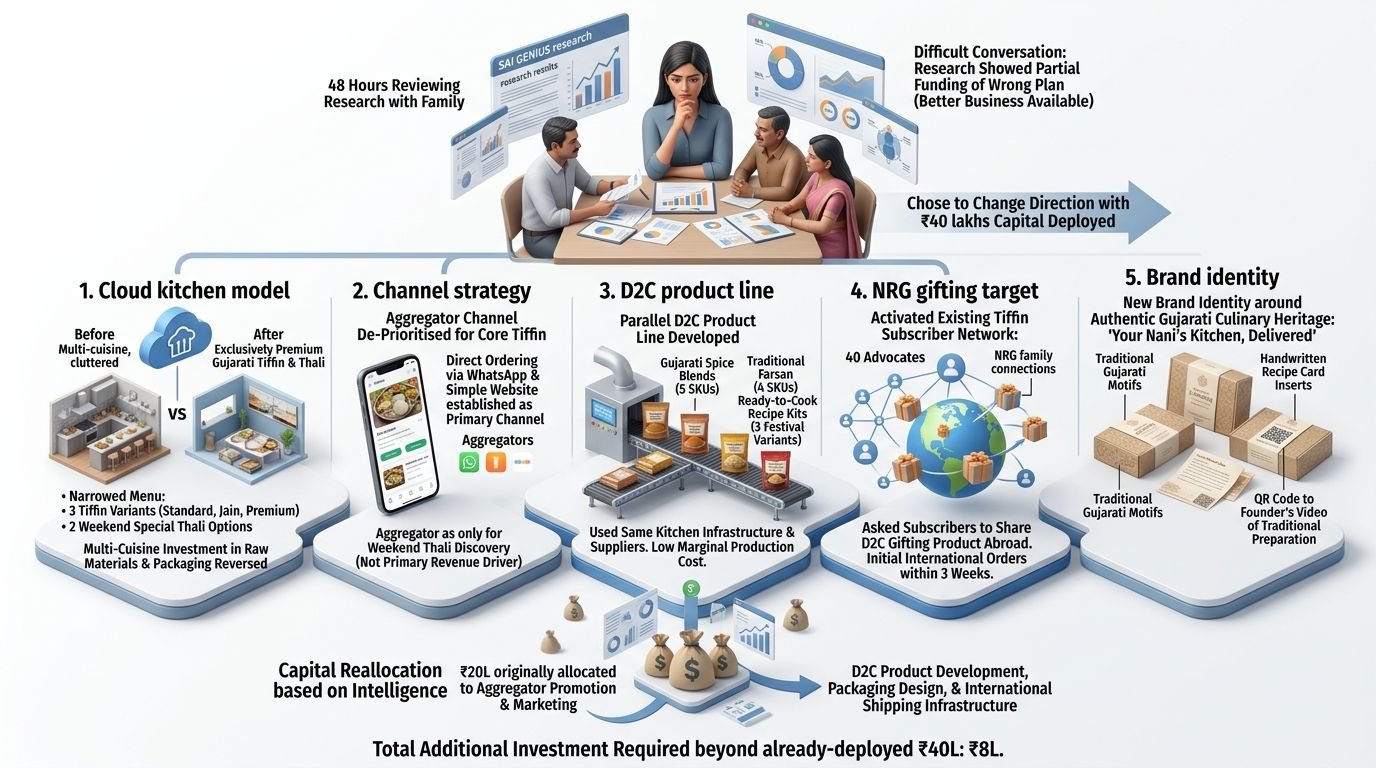
The founder spent 48 hours reviewing the SAI GENiUS research with her family. The conversation, by her account, was the most difficult she had had about the business because the research did not confirm her plan; it showed her that the plan she had already partially funded was the wrong one, and that a better business was available if she was willing to change direction with ₹40 lakhs of her capital already deployed.
She chose to change direction.
Specific decisions made based on the intelligence:
Cloud kitchen model: Retained but completely repositioned from multi-cuisine to exclusively premium Gujarati tiffin and thali. Menu narrowed to 3 tiffin variants (standard, Jain, premium) and 2 weekend special thali options. Multi-cuisine investment in raw material variety and packaging was reversed.
Channel strategy: Aggregator channel de-prioritised for the core tiffin business. Direct ordering via WhatsApp and a simple website was established as the primary channel. Aggregators are retained only for weekend thali discovery, not as the primary revenue driver.
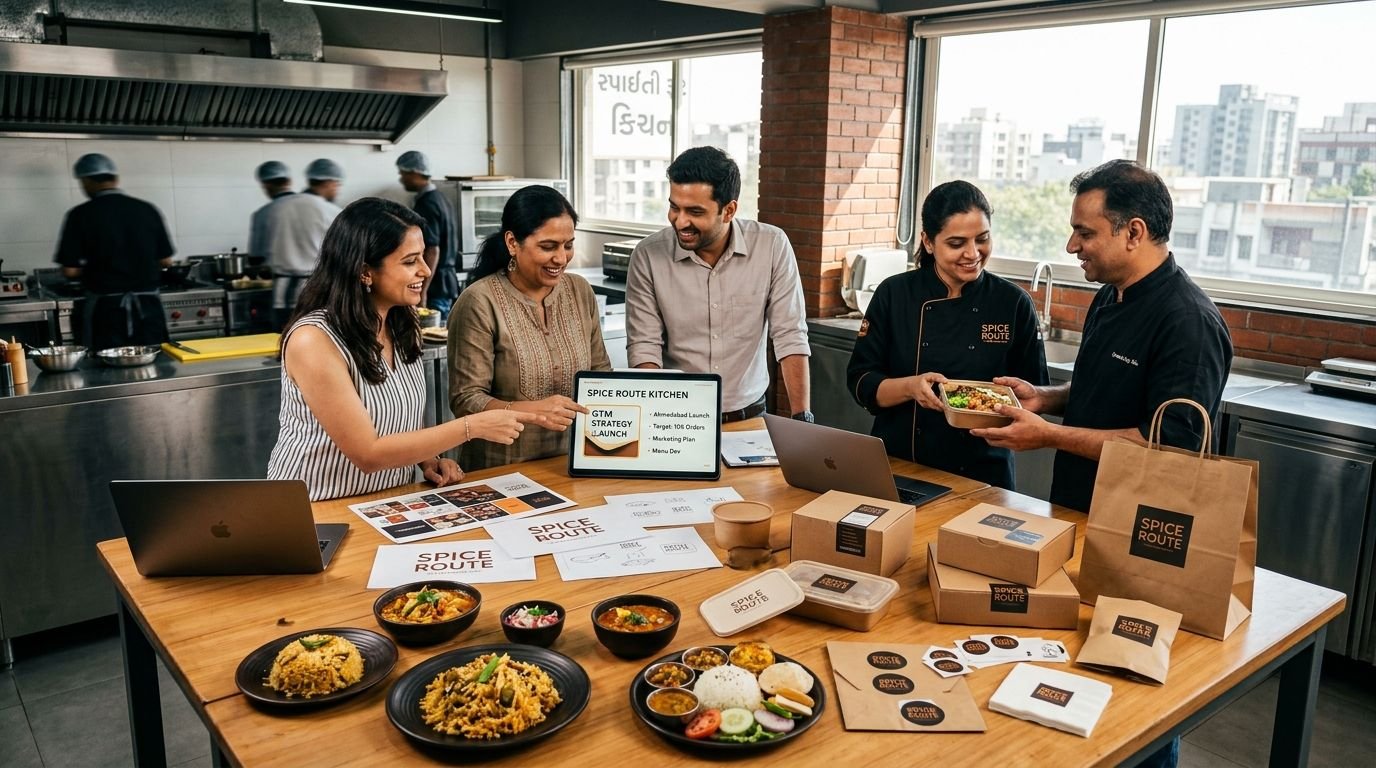
D2C product line: A parallel D2C product line, Gujarati spice blends (5 SKUs), traditional farsan (4 SKUs), and ready-to-cook recipe kits (3 festival variants) was developed alongside the tiffin service. The D2C line used the same kitchen infrastructure and raw material suppliers as the tiffin service, making the marginal production cost very low.
NRG gifting target: The founder activated her existing tiffin subscriber network 40 advocates with strong word-of-mouth, as the first distribution channel for the D2C gifting product, specifically asking subscribers with NRG family connections to share the product with family abroad. The initial international orders came through this network within the first 3 weeks of the D2C launch.
Brand identity: A new brand identity was developed around authentic Gujarati culinary heritage, "Your Nani's Kitchen, Delivered," with packaging and visual design that reflected traditional Gujarati motifs, handwritten recipe card inserts, and a QR code linking to the founder's video of the traditional preparation method for each product.
Capital reallocation: The ₹20L originally allocated to aggregator promotional discounting and paid marketing was redirected to D2C product development, packaging design, and international shipping infrastructure. Total additional investment required beyond the already-deployed ₹40L: ₹8L.
₹1.8 Crore in 10 Months, Three Countries, and a Business That Runs on Repeat Orders
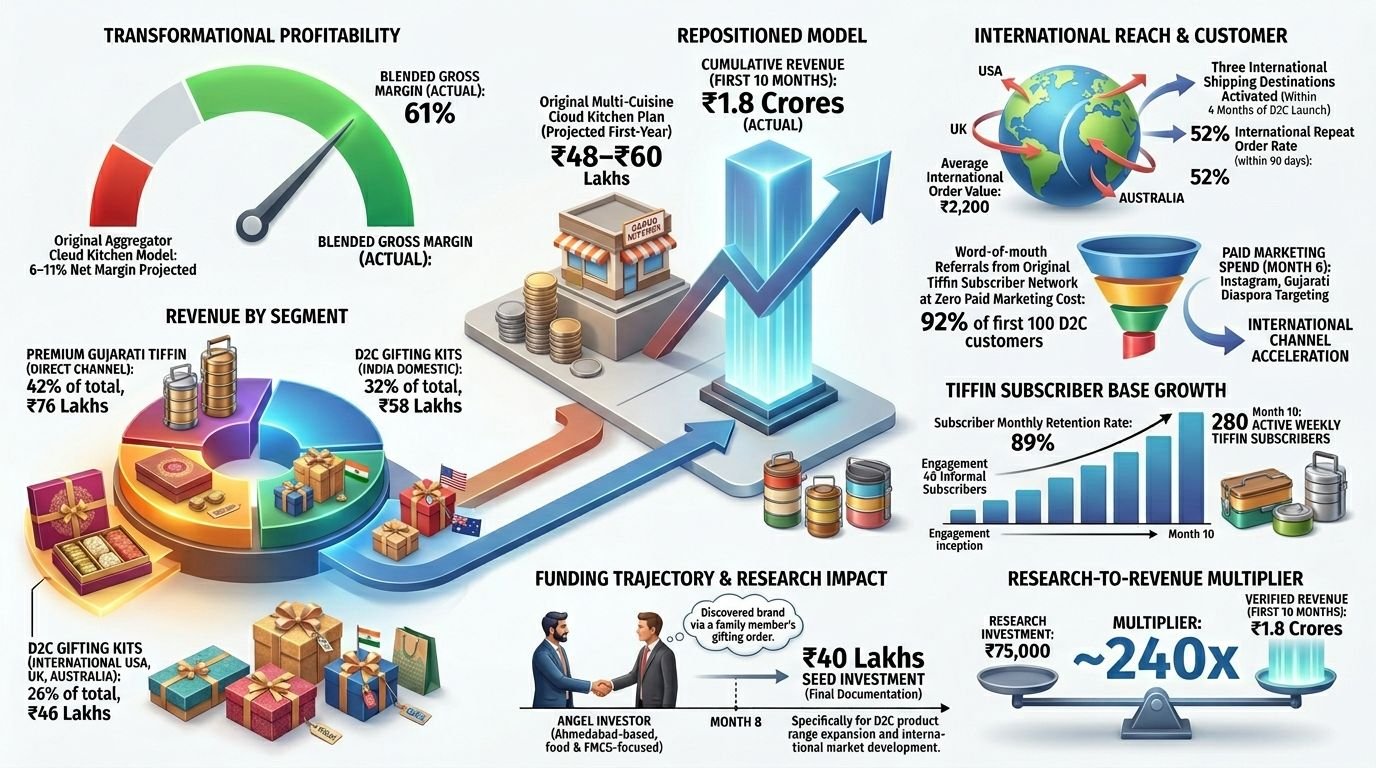
Revenue: ₹1.8 crore cumulative revenue in the first 10 months of operation under the repositioned model — against projected first-year revenue of ₹48–₹60 lakhs under the original multi-cuisine cloud kitchen plan.
Revenue by Segment:
- Premium Gujarati tiffin (direct channel): ₹76L (42% of total)
- D2C gifting kits (India domestic): ₹58L (32% of total)
- D2C gifting kits (international USA, UK, Australia): ₹46L (26% of total)
Gross Margin: Blended gross margin across all segments: 61% compared to the 6–11% net margin projected for the original aggregator cloud kitchen model.
International Reach: Three international shipping destinations were activated within 4 months of the D2C launch. Average international order value: ₹2,200. International repeat order rate (within 90 days): 52%.
Tiffin Subscriber Base: From 40 informal subscribers at engagement inception to 280 active weekly tiffin subscribers at Month 10. Subscriber monthly retention rate: 89%.
Customer Acquisition: 92% of the first 100 D2C gifting customers were acquired through word-of-mouth referrals from the original tiffin subscriber network at zero paid marketing cost. First paid marketing spend (Instagram, Gujarati diaspora targeting) was activated in Month 6, contributing to the international channel acceleration.
Funding Trajectory: An Ahmedabad-based food and FMCG-focused angel investor approached the founder in Month 8 after discovering the brand through a family member's gifting order. A ₹40L seed investment is in final documentation, specifically to fund the D2C product range expansion and international market development.
Research-to-Revenue Multiplier: Research investment: ₹75,000. Verified revenue in the first 10 months: ₹1.8Cr. Multiplier: ~240x.