CASE STUDY — FemTech Startup | Women's Health & Wellness | Market Validation + Investor Deck Research | Bengaluru

CASE STUDY
FemTech (Women's Reproductive Health + Wellness)
Bengaluru, Karnataka
Pre-Seed (₹38L personal capital; targeting first institutional angel round of ₹1–1.5Cr)
Market Validation Research + TAM Sizing + Competitive Positioning + Investor Narrative Development
₹1,25,000
12 days
Repositioned from "women's wellness app" to "PCOS management platform with clinical pathway integration" — a defensible category with a quantified clinical need and no dominant Indian operator
Angel round of ₹1.4Cr raised in 6 weeks post-research; PCOS management vertical launched; 2,800 registered users in 90 days
~11,200x (₹1.4Cr raised / ₹1,25,000 research investment)

CLIENT VOICE
"As a clinician, I had spent seven years watching women come to my consultation room who had been living with PCOS symptoms for 5–8 years without a diagnosis — not because they had not sought help, but because the healthcare system had no capacity to find them and support them at the population level. I built this platform because I knew that the clinical problem was real. What I did not have was the investor language to express the scale of it. The SAI GENiUS research gave me the numbers, the competitive landscape proof, and the narrative structure. The three investors who had said no the first time — two of them said yes the second time. The pitch had not changed. The evidence had."
— Founder (Gynaecologist), PCOS Management Platform, Bengaluru (Identity anonymized with permission)
A Clinician-Founder, a Real Problem, and a Pitch That Was Too Broad to Fund
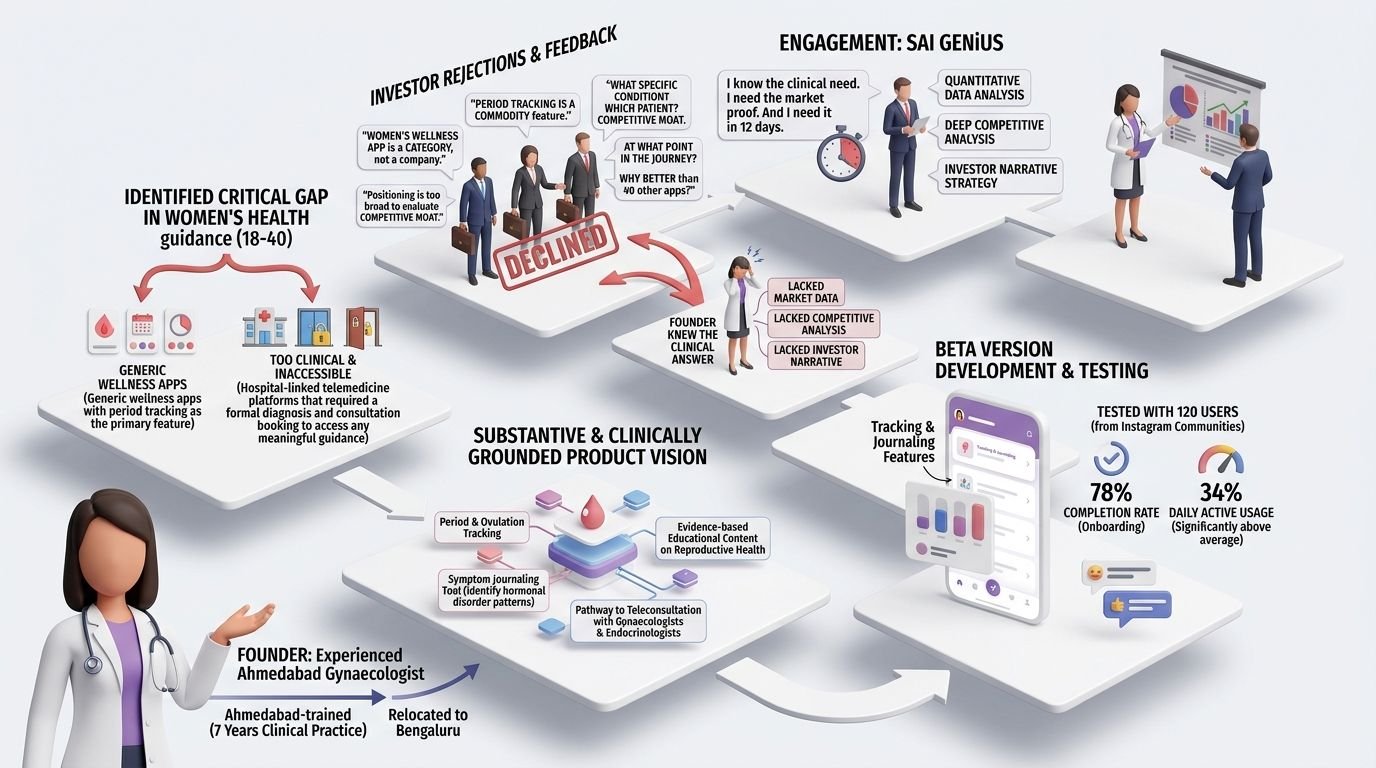
The founder an Ahmedabad-trained gynaecologist who had relocated to Bengaluru after seven years in clinical practice had spent 14 months developing a women's health application with a founding thesis grounded in her clinical experience: India had a severe shortage of accessible, evidence-based reproductive health guidance for women between the ages of 18 and 40, and the existing digital health solutions in this space were either too generic (generic wellness apps with period tracking as the primary feature) or too clinical and inaccessible (hospital-linked telemedicine platforms that required a formal diagnosis and consultation booking to access any meaningful guidance).
Her product vision was substantive and clinically grounded: a platform combining period and ovulation tracking with evidence-based educational content on reproductive health conditions, a symptom journaling tool that could identify patterns consistent with hormonal disorders, and eventually a pathway to teleconsultation with gynaecologists and endocrinologists for users who needed clinical support.
The product was partially built. A beta version with the tracking and symptom journaling features had been tested with 120 users recruited through women's health community groups on Instagram. The feedback was overwhelmingly positive. Completion rates for the onboarding flow were 78%. Daily active usage among the 120 beta users was 34% significantly above average for a health application.
But the investor conversations were not progressing. Three angel investors with healthcare portfolio experience had reviewed the pitch and declined at the first meeting. The feedback was consistent and, on reflection, honest: "Women's wellness app is a category, not a company. Period tracking is a commodity feature. The market is large, but the positioning is too broad for us to evaluate the competitive moat. Tell us specifically what condition you are solving, for which patient, at what point in their clinical journey, and why your product does that better than the 40 other women's health apps already in the market."
The founder knew the answer. She had known it for years from her clinical practice. But she had not had the market data to quantify it, the competitive analysis to document the gap, or the investor narrative to articulate it in the language that a first-time angel investor needed to justify a ₹1 crore commitment to their spouse at the dinner table that evening.
She engaged SAI GENiUS with a simple but specific brief: "I know the clinical need. I need the market proof. And I need it in 12 days."
A ₹14,000 Crore Unaddressed Clinical Market Hiding Inside a Generic Wellness Category
PCOS Was India’s Most Prevalent Underdiagnosed Condition, With a Digital Health Supply Gap of Near-Total Proportions
The research team’s market analysis identified PCOS (Polycystic Ovary Syndrome) as the clinical anchor for the founder’s platform repositioning, not because PCOS was the only condition the platform could eventually address, but because the convergence of three factors made it the most defensible, most fundable, and most commercially actionable first clinical focus:
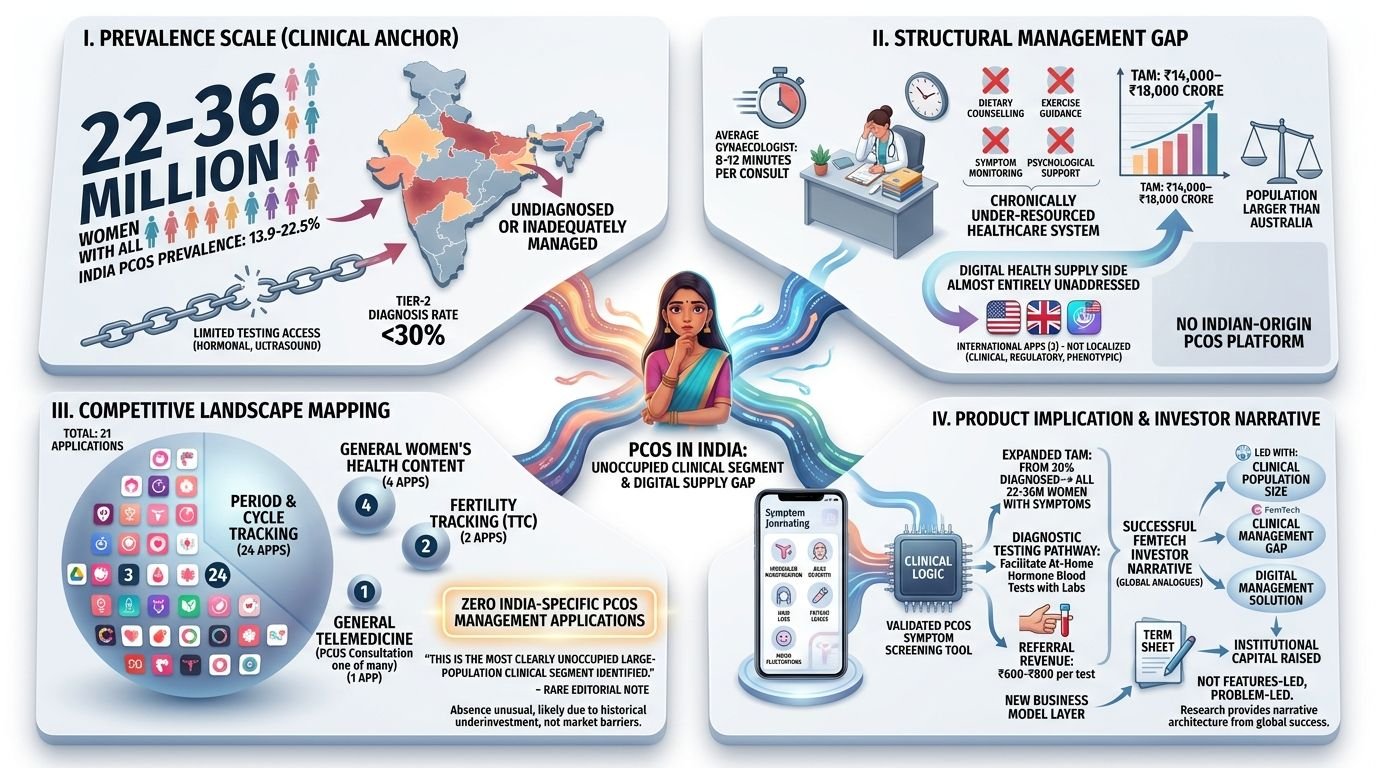
India had an estimated 13.9–22.5% PCOS prevalence among women of reproductive age translating to approximately 22–36 million women in India living with PCOS at any given time, the vast majority either undiagnosed (clinical diagnosis rates in Tier-2 India were below 30% for suspected PCOS cases, primarily due to limited access to the hormonal testing and pelvic ultrasound required for formal diagnosis) or diagnosed but receiving inadequate ongoing management guidance beyond the initial prescription.
The clinical management gap was structural and well-documented: PCOS is a chronic condition requiring lifestyle modification, hormonal monitoring, and regular clinical follow-up all of which the Indian primary and secondary healthcare system was chronically under-resourced to provide for a patient population of this scale. The average gynaecologist in India had 8–12 minutes per consultation insufficient to deliver the dietary counselling, exercise guidance, symptom monitoring education, and psychological support that evidence-based PCOS management required.
The digital health supply side of this market was, in the research team’s assessment, almost entirely unaddressed in India specifically: 3 international PCOS management apps (two US-based, one UK-based) had India user bases but were not designed for India’s clinical infrastructure, regulatory environment, or the specific phenotypic expression of PCOS in Indian women. No Indian-origin platform had PCOS management as its primary clinical focus. The entire gap — 22–36 million women with an active, chronic condition and no accessible digital management tool was unoccupied.
The research team’s estimated addressable market for a PCOS-specific digital health management platform in India, calculated across subscription revenue, teleconsultation revenue, and diagnostic test facilitation, was ₹14,000–₹18,000 crore at full market penetration across the diagnosed and diagnosable population. This was not an abstract TAM. It was a clinically documented demand across a population larger than the entire population of Australia.
The Competitive Landscape Had No Indian Incumbent in the Clinical PCOS Space
The competitive mapping covered 31 women’s health applications with Indian user bases across 9 feature and clinical focus dimensions. The finding was unambiguous:
- 24 of the 31 applications were primarily period and cycle tracking tools with no clinical condition focus
- 4 had general women’s health content libraries without condition-specific management pathways
- 2 were fertility tracking applications primarily targeting women trying to conceive
- 1 was a general telemedicine application with a women’s health speciality that included PCOS consultation as one of many conditions
Zero applications, domestic or international, had India-specific PCOS management as their primary product identity, their primary clinical pathway, and their primary marketing message. The category was completely unoccupied in a focused product positioning. The 22–36 million Indian women with PCOS had no application specifically built for their condition, in their language, calibrated to their clinical reality.
The competitive gap was so complete that the research team flagged it with a rare editorial note: “This is the most clearly unoccupied large-population clinical segment we have identified in our research work to date. The absence of an Indian incumbent in a condition of this prevalence scale is unusual and likely reflects the historical underinvestment in women’s reproductive health as a clinical priority in India’s digital health ecosystem rather than any market access barrier.”
The Symptom Journaling Feature in the Existing Beta Was Potentially a Diagnostic Triage Tool
The research team’s clinical landscape analysis identified a specific product implication that the founder had partially conceived but had not fully developed: the symptom journaling tool already in the beta product which logged irregular menstrual patterns, acne severity, hair loss patterns, fatigue levels, and mood fluctuations was, with modest additional clinical logic, a validated PCOS symptom screening tool that could identify women with high-probability PCOS who had never received a formal diagnosis.
This had two commercial implications. First, it transformed the product from a management tool for diagnosed PCOS patients into a screening-and-management tool for the much larger undiagnosed population, expanding the total addressable user base from the 30% of Indian PCOS patients who had been formally diagnosed to the entire 22–36 million women with active PCOS symptoms. Second, it created a pathway to the diagnostic testing market, specifically hormone panel blood tests that were the standard confirmation tool for PCOS diagnosis, where the platform could facilitate at-home sample collection testing through partnerships with diagnostic laboratories, generating per-test referral revenue alongside subscription income.
The diagnostic facilitation revenue opportunity, estimated at ₹600–₹800 per referred test at a market-standard referral margin, was a business model layer that the founding team’s original “wellness app” positioning had not conceived of and that no existing competitor in the Indian women’s health app category had built.
The Investor Narrative Had a Precise, Fundable Analogue in Global FemTech
The investor positioning section of the SAI GENiUS research identified the global FemTech companies that had successfully raised institutional capital with PCOS or chronic women’s health as their primary clinical focus, and mapped the narrative structures they had used to convert investor interest into term sheets. The pattern was consistent: the successful FemTech fundraisers in global markets had all led with the clinical population size (the diagnosed and undiagnosed PCOS patient base), the clinical management gap (the systemic failure of conventional healthcare to provide ongoing condition management), and the digital management solution (the platform as a scalable clinical support layer, not a wellness app).
None of the successful fundraise narratives had led with the app features. All of them had led with the clinical problem and its population scale. The research provided the founder with the specific narrative architecture drawn from documented successful fundraises in comparable clinical categories globally that her India-specific investor pitch needed to follow.
A Clinical Repositioning, a Diagnostic Partnership Initiated, and a Pitch Rebuilt From the First Slide
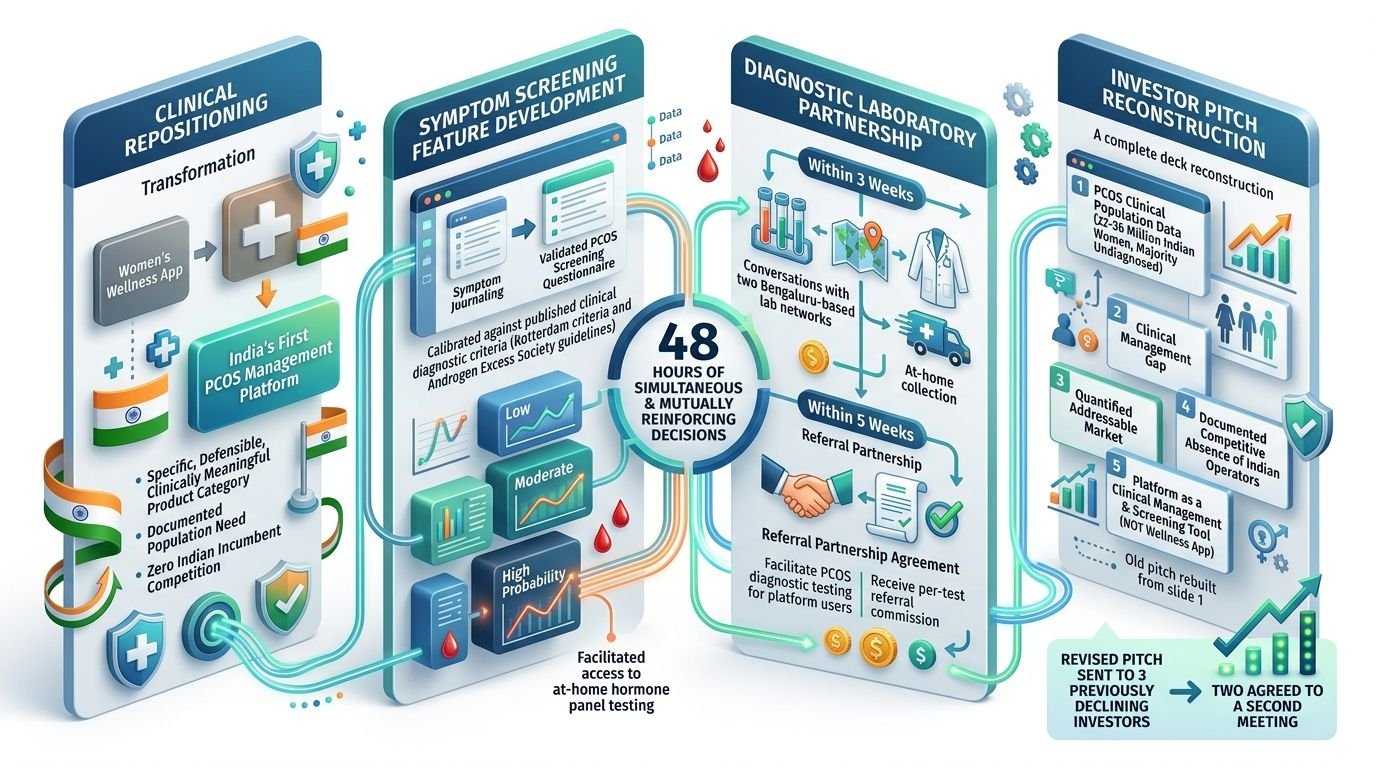
The founder spent the 48 hours following the SAI GENiUS research debrief in what she described as "the most productive two days I have had since I started building this." The decisions were simultaneous and mutually reinforcing.
Clinical Repositioning: The product identity was changed from "women's wellness app" to "India's first PCOS management platform" a specific, defensible, clinically meaningful product category with a documented population need and zero Indian incumbent competition.
Symptom Screening Feature Development: The symptom journaling tool was developed into a validated PCOS screening questionnaire, calibrated against published clinical diagnostic criteria (Rotterdam criteria and the Androgen Excess Society guidelines), with a probability-based output that classified users as low, moderate, or high-probability PCOS and recommended appropriate next steps, including, for high-probability users, facilitated access to at-home hormone panel testing.
Diagnostic Laboratory Partnership: Within 3 weeks of the research, the founder initiated partnership conversations with two Bengaluru-based diagnostic laboratory networks that offered at-home sample collection services. A referral partnership agreement was reached with one network within 5 weeks, giving the platform the ability to facilitate PCOS diagnostic testing for platform users and receive a per-test referral commission.
Investor Pitch Reconstruction: The investor pitch was rebuilt from slide 1 using the narrative architecture identified in the research. The new pitch opened with the PCOS clinical population data (22–36 million Indian women, majority undiagnosed), moved to the clinical management gap, quantified the addressable market, documented the competitive absence of any Indian operator, and presented the platform as a clinical management and screening tool, not a wellness application.
The pitch was materially different. The founder sent the revised pitch to the three investors who had declined at the first meeting. Two agreed to a second meeting.
₹1.4 Crore Angel Round, 2,800 Users in 90 Days, and a Diagnostic Revenue Stream
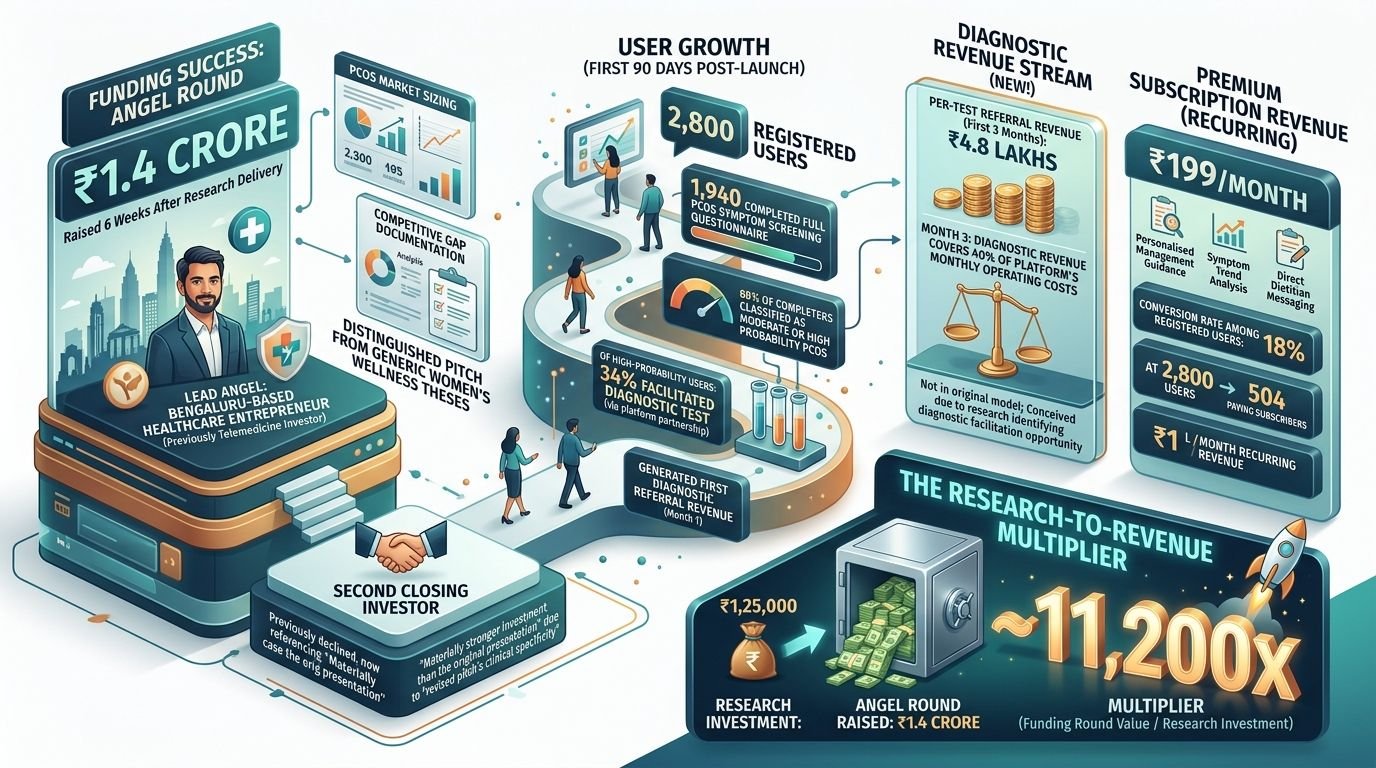
Funding: Angel round of ₹1.4 crore raised 6 weeks after the research was delivered. The lead angel, a Bengaluru-based healthcare entrepreneur who had previously invested in a telemedicine platform, cited the PCOS market sizing and the competitive gap documentation as the two factors that distinguished the pitch from the generic women's wellness investment thesis he had previously seen and declined.
One of the two second-meeting investors who had previously declined became the second closing investor in the round, specifically referencing the revised pitch's clinical specificity as "a materially stronger investment case than the original presentation."
User Growth: 2,800 registered users on the PCOS-repositioned platform in the first 90 days post-launch, of whom 1,940 completed the full PCOS symptom screening questionnaire. 68% of those who completed the screening were classified as moderate or high probability PCOS. Of the high-probability users, 34% went on to facilitate a diagnostic test through the platform's laboratory partnership, generating the first diagnostic referral revenue within Month 1.
Diagnostic Revenue: Per-test referral revenue in the first 3 months: ₹4.8 lakhs. At Month 3, the diagnostic revenue stream was already covering 40% of the platform's monthly operating costs a revenue line that had not existed in the original business model and would not have been conceived without the research finding that identified the diagnostic facilitation opportunity.
Subscription Revenue: Premium subscription (₹199/month, providing personalised management guidance, symptom trend analysis, and direct dietitian messaging) conversion rate among registered users: 18%. At 2,800 registered users, this translates to 504 paying subscribers generating ₹1L/month in subscription recurring revenue.
Research-to-Revenue Multiplier: Research investment: ₹1,25,000. Angel round raised: ₹1.4Cr. Multiplier: ~11,200x (funding round value/research investment).