CASE STUDY — AgriTech Startup | Crop Advisory & Input Procurement | GTM Strategy | Pune

CASE STUDY
AgriTech (Crop Advisory + Agricultural Input Procurement)
Pune, Maharashtra → Nashik District (launch market)
Seed (₹1.8Cr seed funded; targeting first 500 paying farmers in 90 days)
GTM Strategy Research + Farmer Segment Profiling + Channel Mapping
₹90,000
11 days
GTM recalibrated from blanket Maharashtra outreach to Nashik-first, onion grower-primary, FPO-primary channel strategy
500 paying farmers in 60 days (vs. 90-day target and 6-month projection under original plan); 70% FPO-channel acquisition; NPS 71; seed extension raised 4 months early
~31x (₹27.9L first-year farmer revenue / ₹90,000 investment)

CLIENT VOICE
"The FPO channel insight was the single most valuable piece of GTM intelligence anyone has given us since we started building this platform. We had been planning to acquire farmers one by one through digital advertising, which works eventually but slowly and expensively. The research showed us that Maharashtra already had a distribution infrastructure designed to help technology reach farmers at scale. We just had to use it. 218 farmers converted in a week from a single FPO meeting. That is the difference between finding the right channel and spending a year looking for the right channel."
— Co-Founder (Agriculture), AgriTech Platform, Pune (Identity anonymized with permission)
A Product Built for Millions of Farmers, a GTM Built for None of Them Specifically
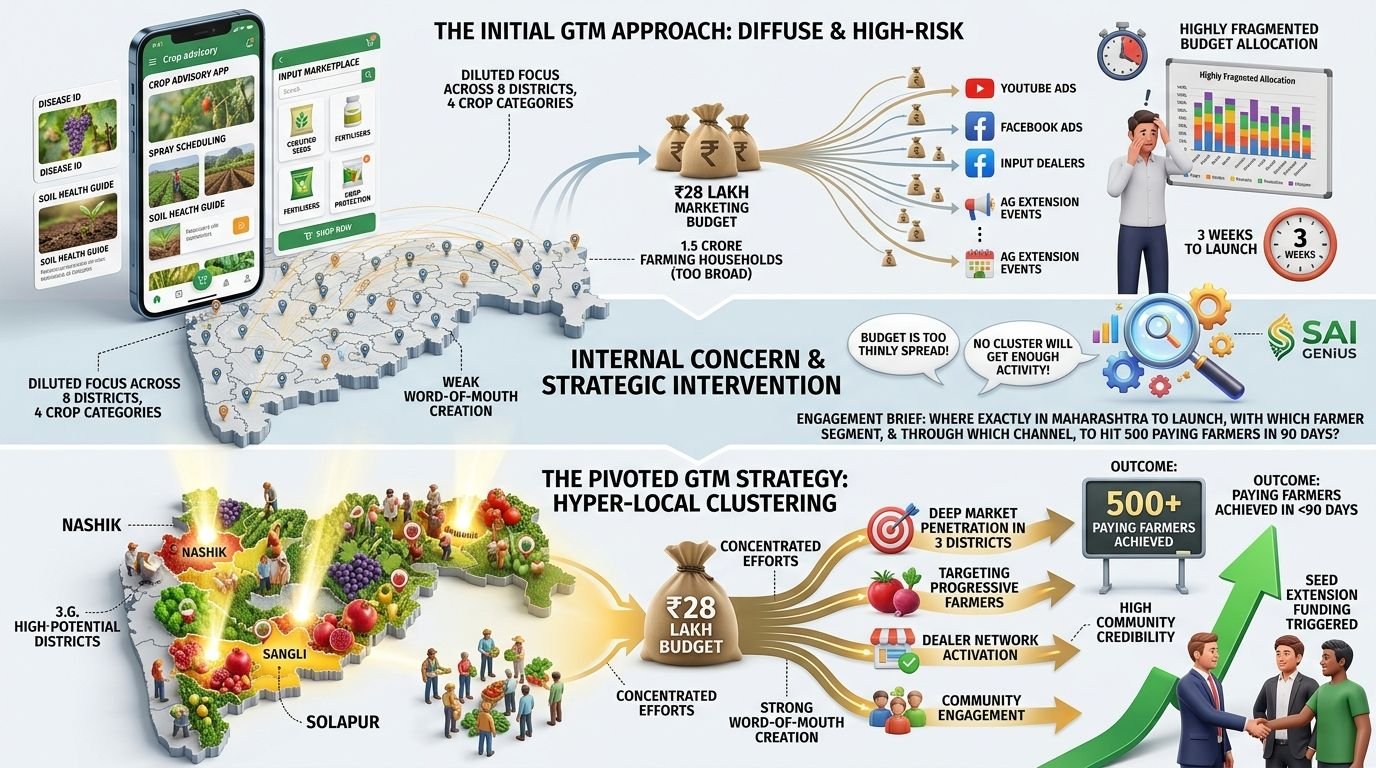
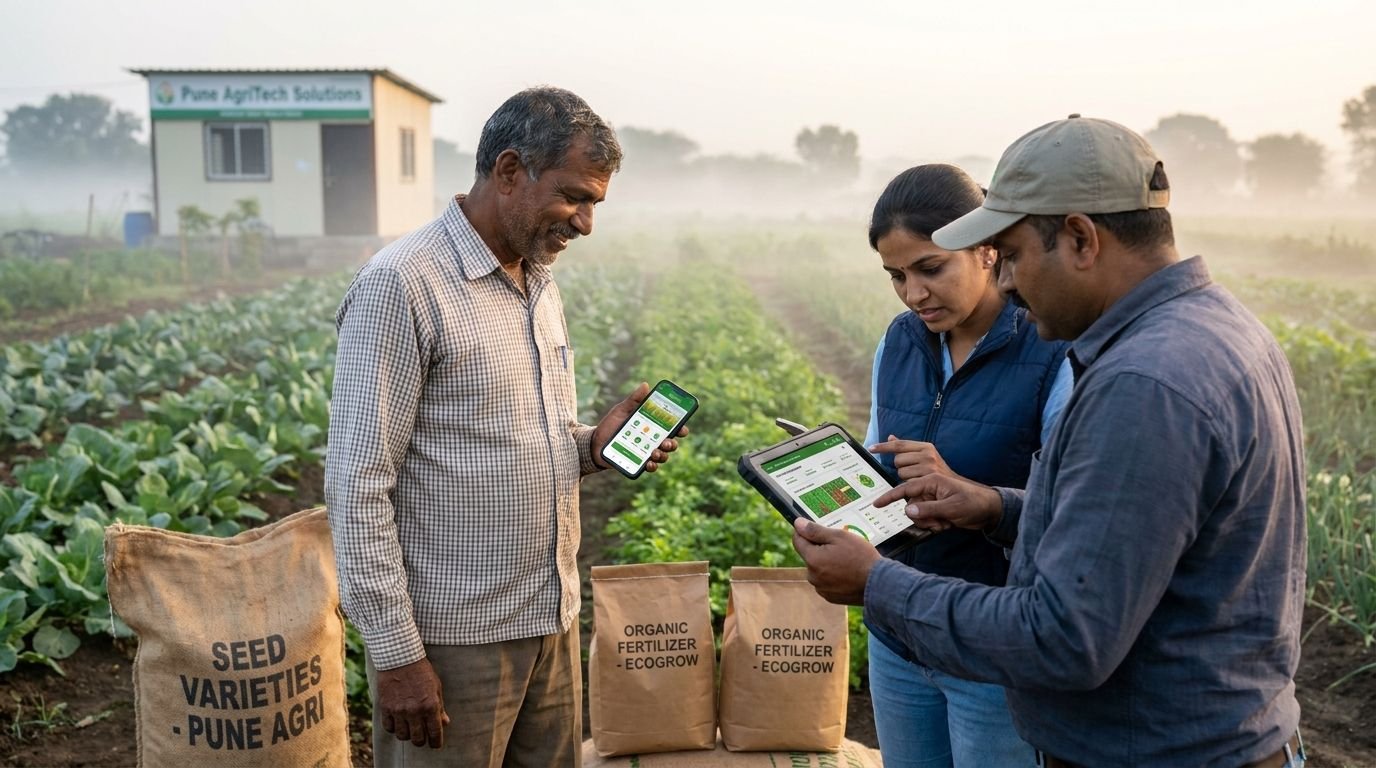
The founding team behind the crop advisory and input procurement platform had done the difficult work correctly. Their product was technically sound: a mobile application offering hyperlocal crop advisory (disease identification via image recognition, weather-linked spray scheduling, soil health guidance), combined with an integrated agricultural input marketplace that allowed farmers to order certified seeds, fertilisers, and crop protection products at prices benchmarked against local market rates.
The technology had been built over 18 months with input from 40 farmer beta testers in Pune and Satara districts. The product worked. The farmers who had tested it liked it. The platform had a credible advisory content library in Marathi, Hindi, and English. The input procurement marketplace had 12 verified supplier partnerships covering Maharashtra's major agricultural input categories.
The seed funding of ₹1.8 crore from two angel investors with agricultural sector backgrounds came with a standard milestone: demonstrate 500 paying farmers within the first 90 days of commercial launch. This was the number required to trigger the seed extension round and fund the next 12 months of operations.
The GTM plan was ambitious and geographically unfocused: "Maharashtra farmer outreach" through a combination of social media advertising on YouTube and Facebook (where agricultural content had strong organic reach in the Maharashtra farming community), agricultural input dealer partnerships (leveraging the input marketplace supplier network for referrals), and participation in district-level agricultural extension events.
The logic was not unreasonable. Maharashtra had approximately 1.5 crore farming households. The platform could theoretically find 500 paying farmers among 1.5 crore. The problem, invisible to the founding team in the planning phase, was that "Maharashtra farmer" was not a segment. It was a geography. And geography, without segment specificity, is not a distribution strategy.
Three weeks before launch, one co-founder raised an internal concern: the marketing budget for the first 90 days, ₹28 lakhs, was being divided equally across 3 channels, 4 crop categories, and 8 districts. At that diffusion rate, no single cluster would receive enough concentrated marketing activity to create the word-of-mouth and community credibility that agricultural technology adoption almost always requires to overcome initial scepticism.
The concern was well-founded. It led to an SAI GENiUS engagement with a specific brief: "Where exactly in Maharashtra should we launch, with which farmer segment, and through which channel, to hit 500 paying farmers in 90 days without spreading ourselves too thin?"
Four Findings That Converted a Blanket Geography Into a Precise Launch Target
Nashik’s Onion Farmers Were the Single Most Commercially Motivated Segment in Maharashtra
The segment profiling analysis evaluated the founding team’s product against the economic profile of Maharashtra’s major agricultural segments: cotton (Vidarbha and Marathwada), sugarcane (western Maharashtra), grapes (Nashik and Sangli), onion (Nashik), soybean (central Maharashtra), and wheat (northern Maharashtra).
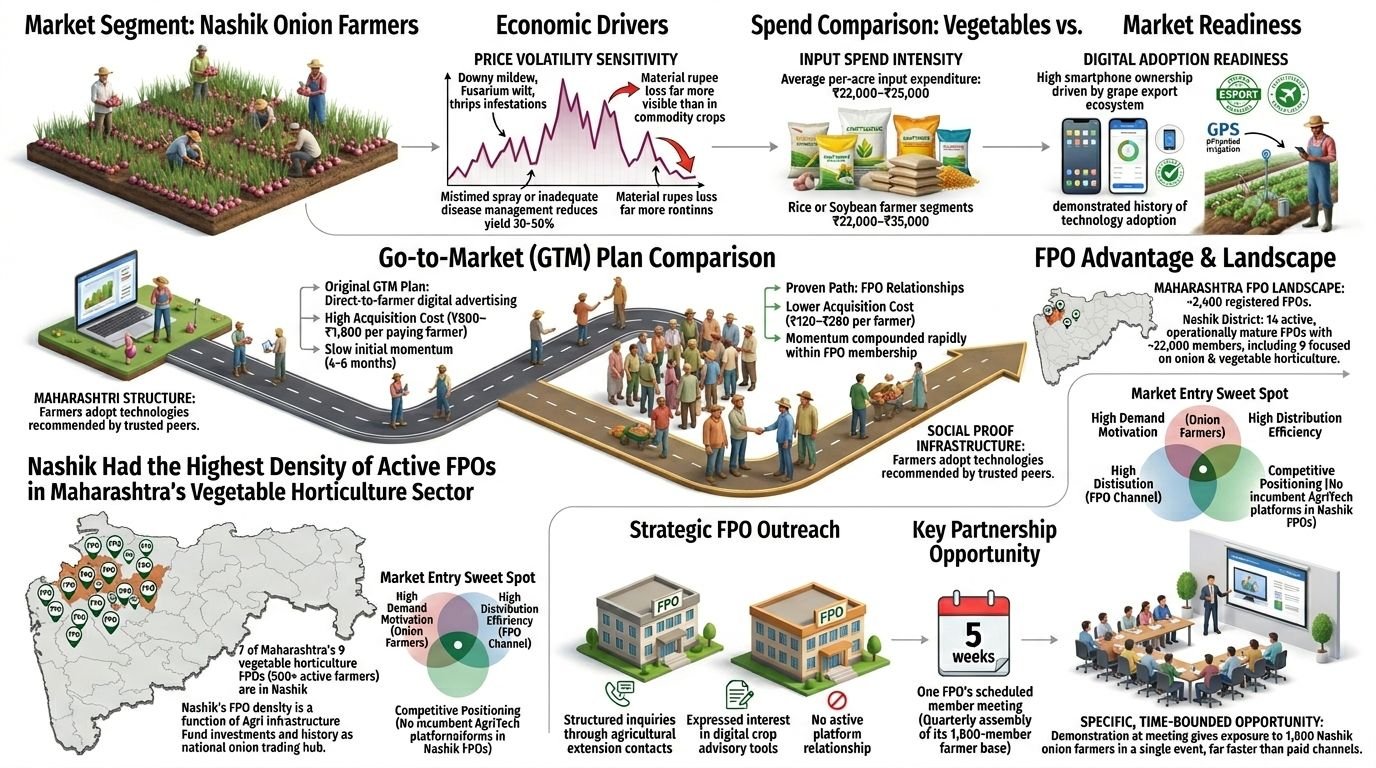
The analysis found that Nashik’s onion-growing community, approximately 2.5 lakh farming households across Nashik, Niphad, Dindori, and Chandwad talukas, had a uniquely high commercial motivation for precision crop advisory and input procurement:
Price volatility sensitivity: Onion farming is one of Maharashtra’s most economically volatile crop enterprises. A single mistimed spray decision or inadequate disease management intervention can reduce yield by 30–50% in a season characterised by downy mildew, Fusarium wilt, or thrips infestations that regularly affect crops in Nashik. The economic consequence of a wrong advisory decision was therefore materially visible to the farmer in direct rupee terms, far more visible than in commodity crops, where government procurement pricing floors partially absorbed yield variation.
Input spend intensity: Nashik’s onion farmers were among the highest per-acre agri-input spenders in Maharashtra’s vegetable horticulture segment. Average per-acre input expenditure for onion cultivation was estimated at ₹22,000–₹35,000 per season, depending on crop variety and production intensity. At the platform’s input marketplace margin structure, this represented a significantly higher per-farmer transaction value than the rice or soybean farmer segments the founding team had originally planned to target first.
Digital adoption readiness: Nashik’s farmer community had a comparatively high rate of smartphone ownership (driven partly by the district’s grape export ecosystem, which had introduced farmers to digital compliance documentation for export certification) and a demonstrated history of technology adoption in agricultural contexts. GPS-guided irrigation scheduling had been adopted by a meaningful minority of Nashik’s larger farms in the preceding 3 years.
The combination of high willingness to pay, high per-transaction value, high technology readiness, and the emotionally salient economic consequences of crop advisory errors made Nashik’s onion farmers the most commercially motivated first segment the research could identify in Maharashtra.
The FPO Channel Was the Most Underutilised Distribution Infrastructure in Maharashtra AgriTech
The FPO landscape mapping produced the most operationally significant finding in the engagement. This finding directly explained why the founding team’s original GTM plan was structurally unlikely to hit the 500-farmer target on the projected timeline.
Maharashtra had approximately 2,400 registered FPOs as of the research date. Nashik district alone had 14 active, operationally mature FPOs with a combined membership of approximately 22,000 farmers, including 9 FPOs whose primary commodity focus was onion and vegetable horticulture.
The research team’s 3 AgriTech founder conversations produced a consistent pattern: every founder who had achieved rapid initial farmer acquisition in Maharashtra had done so through FPO relationships, not through direct-to-farmer digital advertising. The founders who had relied primarily on digital channels reported acquisition costs of ₹800–₹1,800 per paying farmer, with slow initial momentum that typically required 4–6 months to generate meaningful word-of-mouth acceleration.
The founders who had launched through FPO relationships reported acquisition costs of ₹120–₹280 per farmer (primarily relationship development and demonstration costs) and momentum that compounded rapidly within the FPO membership once the initial cohort of 50–100 farmers had visible crop advisory outcomes to share with their peers.
The structural reason for this asymmetry was not surprising in retrospect: the adoption of agricultural technology in India is fundamentally a social proof phenomenon. Farmers adopt technologies recommended by people they trust, specifically, other farmers with similar crops, land sizes, and economic circumstances who have already tried the technology and benefited from it. FPO networks, by definition, aggregate exactly those peer relationships. They are not distribution channels. They are a pre-built social proof infrastructure.
The founding team’s original GTM plan had zero deliberate FPO activation. Not because they had evaluated and declined, but because the team had not mapped Maharashtra’s FPO landscape against their target geography and segment, and therefore had not recognised the distribution leverage it represented.
Nashik Had the Highest Density of Active FPOs in Maharashtra’s Vegetable Horticulture Sector
The geographic analysis found that Nashik district was not only the most commercially motivated farmer segment it was also the geography with the highest density of active, operationally mature FPOs aligned to the founding team’s target crop category.
Of Maharashtra’s 9 vegetable horticulture-focused FPOs with 500+ active farmer members, 7 were concentrated in Nashik district. The remaining 2 were in Sangli and Pune districts. Nashik’s FPO density in the onion and vegetable category was a function of the government’s Agri Infrastructure Fund investments in the district’s horticulture cluster and the district’s history as a national onion trading hub with established farmer collective infrastructure.
This meant that the founding team’s most commercially motivated farmer segment and their highest-leverage distribution channel were co-located in the same district. The research team framed this as a “market entry sweet spot”, a geographic and segment intersection where demand motivation, distribution efficiency, and competitive positioning (no incumbent AgriTech platform had established meaningful Nashik FPO relationships) converged simultaneously.
The Two Largest Nashik FPOs Had Active Digital Tools Needs and No Current Platform Relationship
The research team made structured inquiries through agricultural extension contacts and secondary research into the technology adoption status of the two largest Nashik vegetable horticulture FPOs. Both had expressed interest in recent district agricultural committee discussions on digital crop advisory tools for their member farmers. Neither had an active platform relationship. Both were known to evaluate tools through structured demonstrations rather than unsolicited approaches, meaning a credible introduction through the district agricultural extension office or a peer FPO referral was materially more likely to generate a meeting than a cold outreach approach.
One FPO had a scheduled member meeting, a quarterly assembly of its 1,800-member farmer base, in 5 weeks. The research team noted this as a specific, time-bounded opportunity: a demonstration at the quarterly meeting, if arranged within 3 weeks, would give the platform’s crop advisory tools exposure to 1,800 Nashik onion farmers in a single event, an acquisition opportunity that would require weeks of direct-to-farmer digital advertising to approximate through paid channels.
A Four-Week GTM Rebuild, Launched From a Standing Start
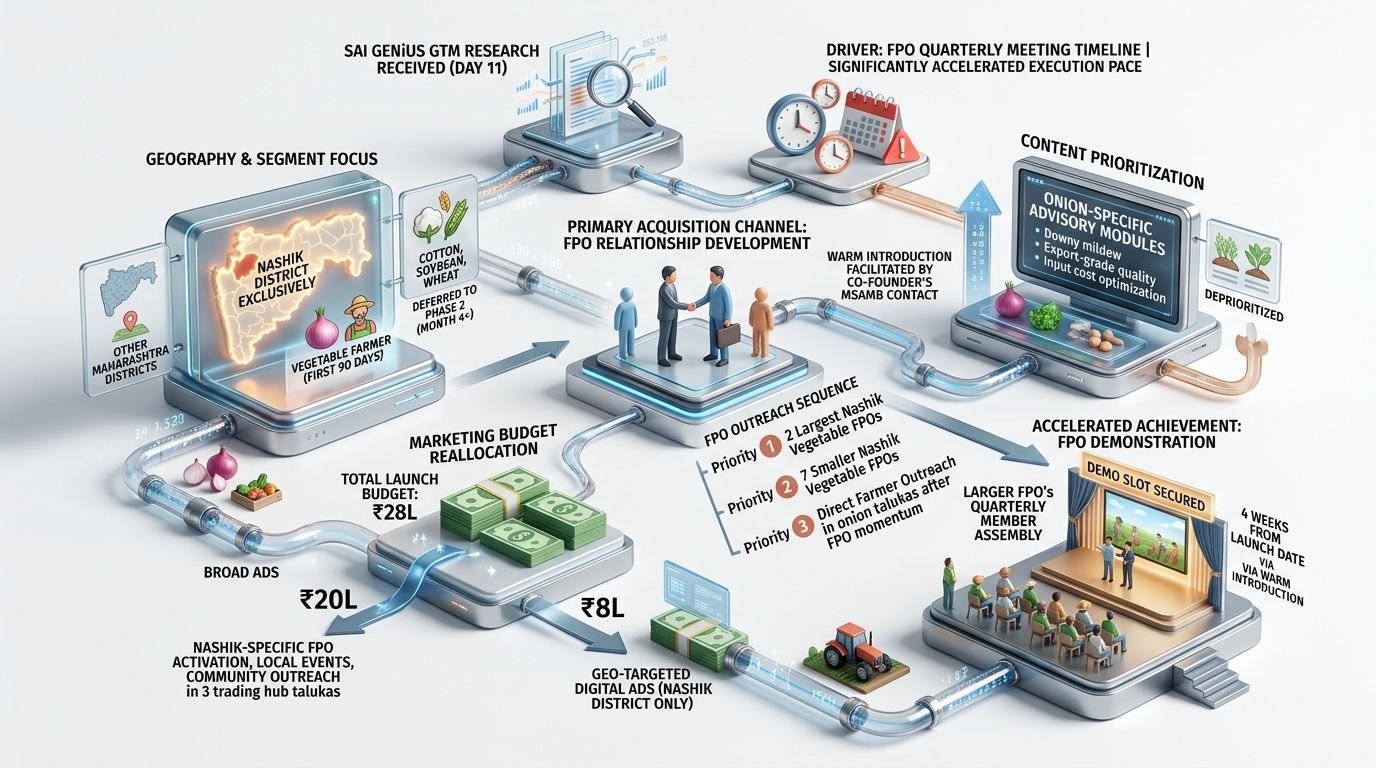
The founding team received the SAI GENiUS GTM research on Day 11 and implemented the core recommendations within 30 days, with the urgency of the FPO quarterly meeting timeline accelerating the execution pace significantly.
Specific changes made based on the intelligence:
- Primary launch geography: Nashik district exclusively for the first 90 days. All other Maharashtra districts deferred to Phase 2 (Month 4+)
- Primary target segment: Onion and vegetable horticulture farmers. Cotton, soybean, and wheat segments deferred to Phase 2
- Primary acquisition channel: FPO relationship development, activated immediately through a warm introduction facilitated by one co-founder's contact at the Maharashtra State Agricultural Marketing Board
- FPO outreach sequence: Priority 1, the two largest Nashik vegetable FPOs; Priority 2, the 7 smaller Nashik vegetable FPOs; Priority 3, direct farmer outreach within onion-growing talukas after FPO momentum was established
- Content prioritisation: Onion-specific advisory modules (downy mildew management, export-grade quality protocols, input cost optimisation) elevated to launch priority. Generic Maharashtra crop content deprioritised
- Marketing budget reallocation: ₹20L of the ₹28L launch marketing budget redirected from broad Maharashtra digital advertising to Nashik-specific FPO activation, local agricultural event participation, and onion farmer community outreach in Nashik's three primary trading hub talukas. ₹8L retained for digital advertising, now geo-targeted exclusively to the Nashik district
- Quarterly meeting: Secured a demonstration slot at the larger FPO's quarterly member assembly, 4 weeks from launch date, through the warm introduction the research had facilitated
500 Farmers in 60 Days, an NPS of 71, and a Seed Extension Round Raised Four Months Early
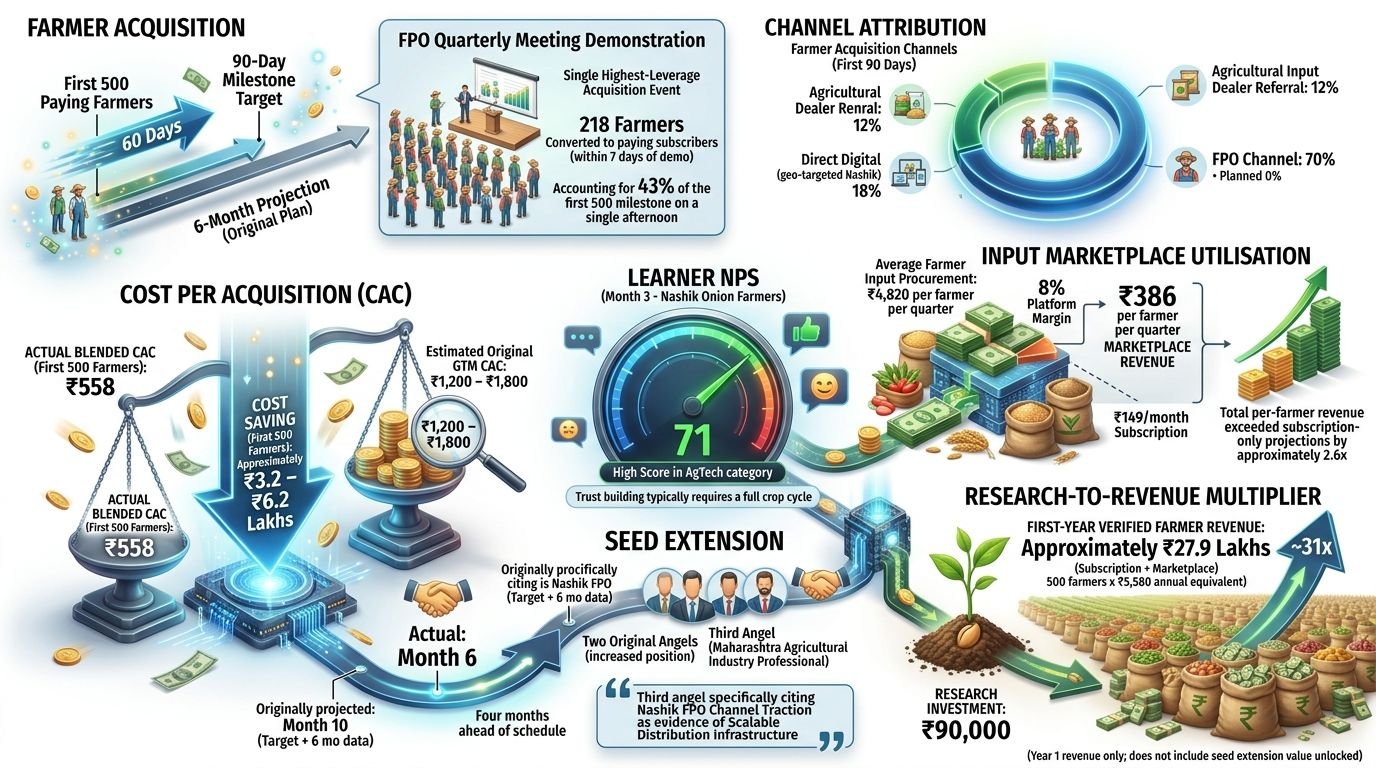
Farmer Acquisition: The first 500 paying farmers were acquired in 60 days, against the 90-day milestone target and dramatically ahead of the 6-month projection that had characterised the original blanket Maharashtra GTM plan. The FPO quarterly meeting demonstration was the single highest-leverage acquisition event of the launch period: 218 farmers from the meeting converted to paying subscribers within 7 days of the demonstration, accounting for 43% of the first 500 milestone on a single afternoon.
Channel Attribution: FPO channel: 70% of total farmer acquisition in the first 90 days (against 0% planned FPO channel allocation in the original GTM). Direct digital (geo-targeted Nashik): 18%. Agricultural input dealer referral: 12%.
Cost Per Acquisition: Blended actual CAC (first 500 farmers): ₹558. Estimated CAC under original blanket Maharashtra digital-primary GTM: ₹1,200–₹1,800 (extrapolated from comparable platform data gathered in the research). Cost saving on the first 500 farmers alone: approximately ₹3.2–₹6.2 lakhs.
Learner NPS: Platform NPS among Nashik onion farmers at Month 3: 71, a high score in the agricultural technology category, where trust-building typically requires a full crop cycle before meaningful NPS levels are achieved.
Input Marketplace Utilisation: Average farmer input procurement through the platform's marketplace (Month 1–3): ₹4,820 per farmer per quarter. At the platform's 8% marketplace margin, this translated to ₹386 per farmer per quarter in marketplace revenue against a ₹149/month subscription. The total per-farmer revenue exceeded subscription-only projections by approximately 2.6x.
Seed Extension: The seed extension round, originally projected to be raised at Month 10 (pending 500-farmer milestone plus 6 months of operating data) was raised in Month 6, four months ahead of schedule. The two original angels increased their position, and a third angel (a Maharashtra agricultural industry professional) joined the round, specifically citing the Nashik FPO channel traction as evidence of scalable distribution infrastructure.
Research-to-Revenue Multiplier: Research investment: ₹90,000. First-year verified farmer revenue (subscription + marketplace, 500 farmers × ₹5,580 annual equivalent): approximately ₹27.9L. Multiplier: ~31x (Year 1 revenue only; does not include seed extension value unlocked).