A Functional Product, Credible Team & a GTM That Was Quietly Burning the Runway
The founding team behind a B2B invoice discounting platform had built something technically sound and operationally credible. The platform allowed Indian MSMEs to discount unpaid invoices — converting 30–90 day receivables into immediate working capital at a fee — a model that addressed one of the most acute and well-documented pain points in India's MSME ecosystem.
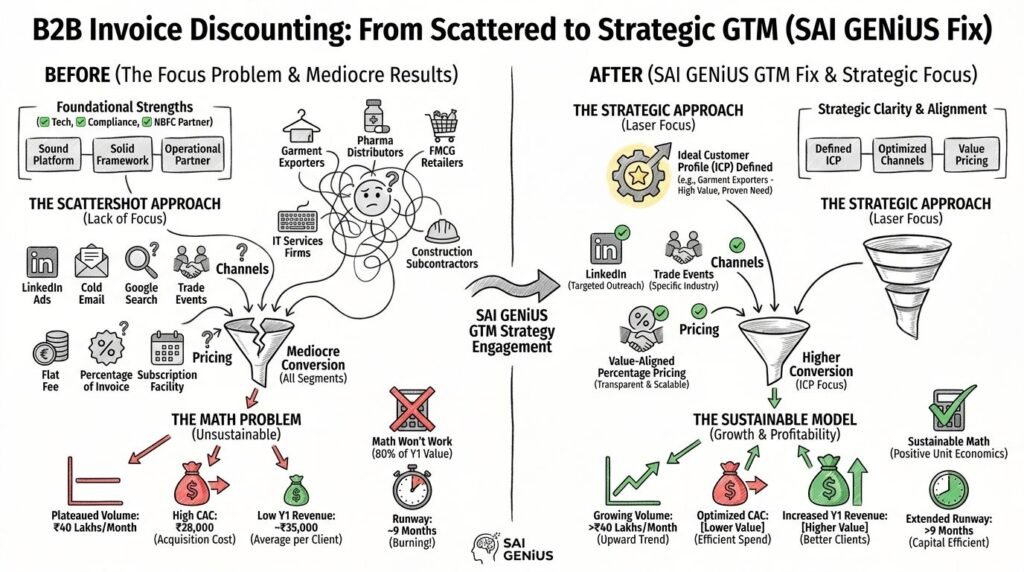
The team had ₹1.5 crore in seed funding. Their product worked. Their compliance framework was solid. Their NBFC partner relationship was operational.
The problem was focus. Six months into live operations, the team was simultaneously:
- Targeting 5 different customer segments (garment exporters, pharmaceutical distributors, FMCG retailers, IT services firms, and construction subcontractors)
- Using 4 different marketing and sales channels (LinkedIn advertising, cold email, Google search, and trade association events) with inconsistent resource allocation
- Testing 3 different pricing structures (flat fee, percentage of invoice, and subscription-based working capital facility)
- Getting mediocre conversion results across all of them
Monthly transaction volume had plateaued at ₹40 lakhs. Customer acquisition cost was ₹28,000 per onboarded client — against an average first-year transaction revenue per client of approximately ₹35,000 — meaning the business was acquiring customers at 80% of first-year value. The math did not work. The runway was approximately 9 months at the current burn.
The founding team engaged SAI GENiUS for a GTM strategy engagement. Their brief was direct: "Tell us what we are doing wrong and how to fix it."
Four Findings That Explained Both the Plateau and the Path Forward
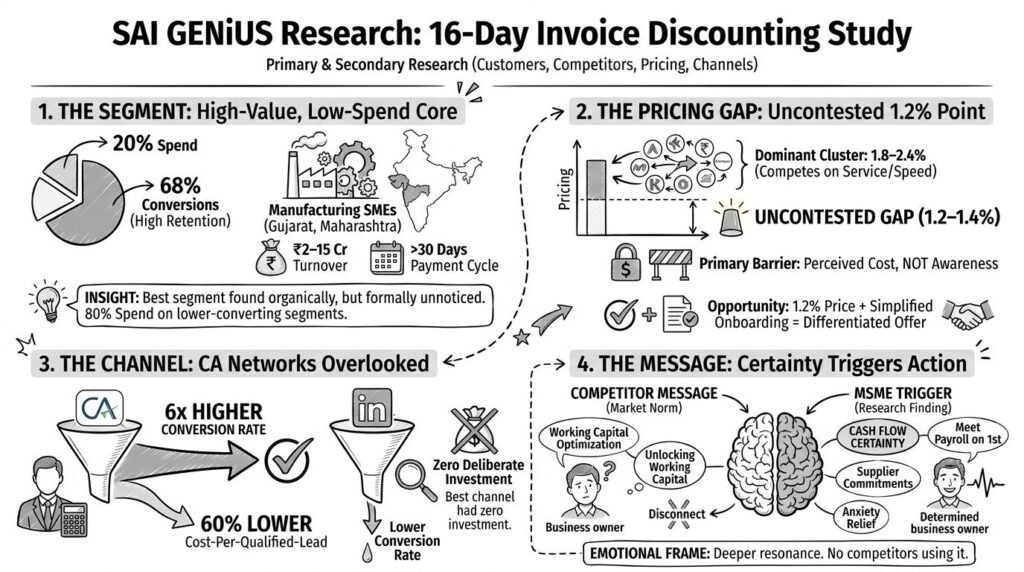
The SAI GENiUS research team spent 16 days conducting primary and secondary research across four areas: customer segment analysis, competitive landscape mapping, pricing architecture benchmarking, and channel performance analysis. The primary research component included 8 structured interviews with MSME business owners who had evaluated but not converted on invoice discounting platforms, and 5 interviews with Chartered Accountants serving MSME clients.
The Segment: One Segment Was Generating 68% of Conversions on 20% of Spend
The research team’s analysis of the platform’s existing customer base — combined with behavioral interviews — revealed a pattern the founding team had not formally identified: manufacturing SMEs in Gujarat and Maharashtra with annual turnover of ₹2–15 crore and payment cycles longer than 30 days represented 68% of the platform’s highest-converting, highest-retention early users. They also received only 20% of the marketing spend.
The remaining 80% of marketing spend was distributed across the other four target segments — segments that converted at 40–60% lower rates, generated shorter tenure, and showed higher default risk than the manufacturing SME segment.
The business had already found its best segment through organic conversion. It had just not noticed — because the founding team had not formally analyzed the segment composition of their customer base.
The Pricing Gap: A 1.2% Price Point Was Completely Uncontested
The competitive pricing analysis mapped the invoice discounting landscape across 12 players — including the market leader, two well-funded challengers, and a set of NBFC-direct alternatives. The pricing architecture analysis found a consistent pattern: the market’s dominant pricing cluster was 1.8–2.4% per transaction, with most players competing on service speed and advance rate rather than price.
Below that cluster — at 1.2–1.4% per transaction — there was a pricing gap that no player had positioned into. Primary research interviews with MSME business owners confirmed that this lower price point, if offered by a credible and well-serviced platform, would be highly competitive — and that the primary barrier to MSME adoption of invoice discounting was not awareness but perceived cost.
A 1.2% price point, combined with simplified onboarding (the second most consistent complaint in customer interviews about existing platforms), was a differentiated offer that no competitor had claimed.
The Channel: CA Networks Were Converting at 6x the Rate of LinkedIn
The five Chartered Accountant interviews produced the most operationally significant finding in the research. Every CA interviewed confirmed the same pattern: their MSME clients asked them — regularly — about working capital solutions. CAs were the first point of contact for most MSME financial decisions. And no invoice discounting platform in the market had a structured CA referral or partnership program.
Analysis of the platform’s own conversion data — once the founding team provided access — confirmed the finding. The handful of clients who had come through CA referrals (informal, unreferenced, untracked by the marketing team) converted at a rate approximately 6x higher than LinkedIn-sourced leads, with a cost-per-qualified-lead approximately 60% lower.
The best-performing sales channel the platform had was also the channel receiving zero deliberate investment.
The Message: “Cash Flow Certainty” Was the Trigger, Not “Working Capital Optimization”
The primary research interviews — combined with competitive messaging analysis — revealed a consistent disconnect between how every platform in the market talked about invoice discounting and how MSME business owners described the problem they wanted solved.
Every competitor framed invoice discounting as “working capital optimization” or “unlocking working capital.” MSME business owners, in interview, framed the problem differently: they described anxiety about payroll dates, supplier payment commitments, and the gap between when they delivered and when they got paid. They were not optimizing working capital. They were seeking certainty that they could meet obligations when they came due.
“Cash flow certainty” — the ability to know that payroll would be met on the 1st regardless of when Invoice 47 landed in their bank account — was a fundamentally different emotional frame from “working capital optimization.” The research showed it resonated with MSME decision-makers at a significantly deeper level. None of the competitors in the market were using it.
A Four-Dimension GTM Recalibration
The founding team implemented all four findings from the SAI GENiUS research within 60 days of delivery:
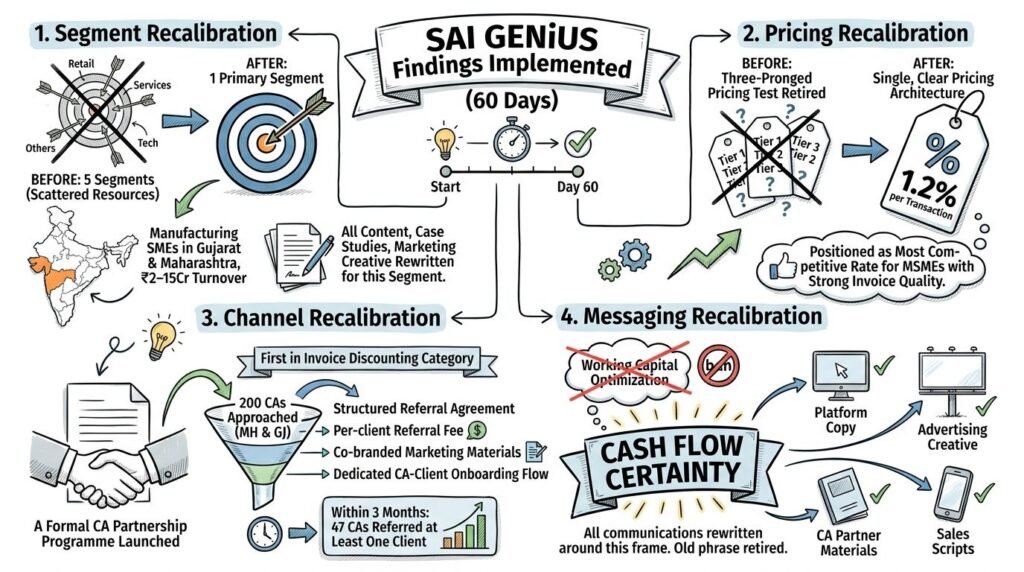
Segment Recalibration: Marketing and sales resources were reallocated from 5 segments to 1 primary segment — manufacturing SMEs in Gujarat and Maharashtra with ₹2–15Cr turnover. All content, case studies, and marketing creative were rewritten for this segment.
Pricing Recalibration: The three-pronged pricing test was retired. A single, clear pricing architecture was adopted: 1.2% per transaction, positioned as the most competitive rate in the market for MSMEs with strong invoice quality.
Channel Recalibration: A formal CA Partnership Programme was launched — the first in the invoice discounting category. 200 CAs in Maharashtra and Gujarat were approached with a structured referral agreement: per-client referral fee, co-branded marketing materials, and a dedicated CA-client onboarding flow. Within 3 months, 47 CAs had referred at least one client.
Messaging Recalibration: All platform copy, advertising creative, CA partner materials, and sales scripts were rewritten around the "cash flow certainty" frame. The phrase "working capital optimization" was retired from all external communications.
70x Transaction Volume Growth and a Pre-Series A Bridge

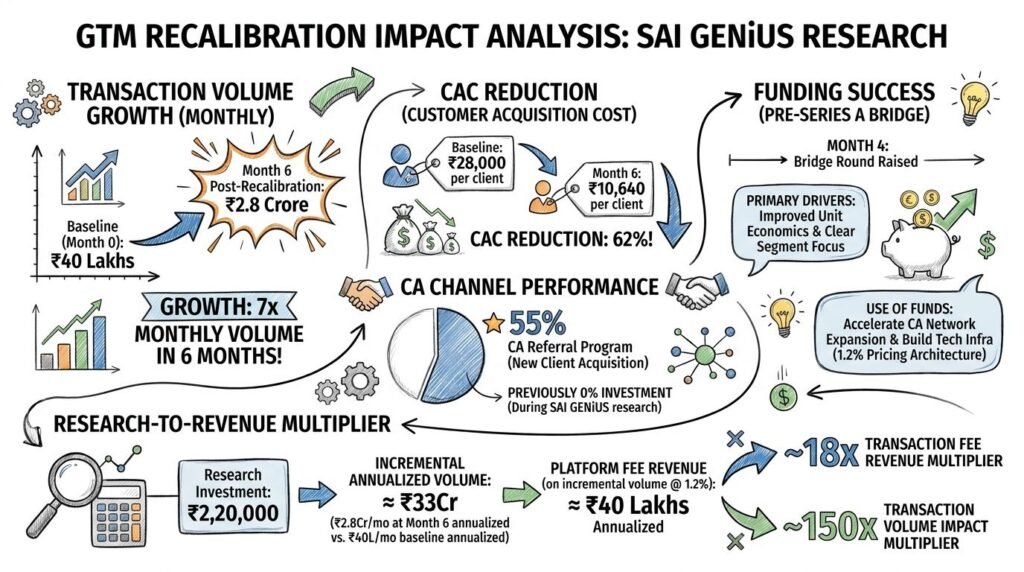
Transaction Volume: ₹40 lakhs/month (baseline) → ₹2.8 crore/month (Month 6 post-recalibration). Growth: 7x monthly transaction volume in 6 months.
Customer Acquisition Cost: ₹28,000 per client (baseline) → ₹10,640 per client (Month 6). CAC reduction: 62%.
CA Channel Performance: The CA referral programme now accounts for 55% of all new client acquisition — a channel that received zero investment at the time of the SAI GENiUS research engagement.
Funding: The platform raised a pre-Series A bridge round 4 months after implementing the GTM recalibration — citing improved unit economics and clear segment focus as the primary factors in investor confidence. The bridge was used to accelerate CA network expansion and build the technology infrastructure for the 1.2% pricing architecture.
Research-to-Revenue Multiplier: Research investment: ₹2,20,000. Incremental annualised transaction volume generated by the GTM recalibration: approximately ₹33Cr (₹2.8Cr/month at Month 6, annualised, vs. ₹40L/month baseline, annualised). Platform transaction fee revenue on incremental volume (at 1.2%): approximately ₹40 lakhs annualised. Research-to-Revenue Multiplier: ~18x on transaction fee revenue; ~150x on transaction volume impact.

---------- CASE STUDY
INDUSTRY
B2B FinTech (Invoice Discounting / Working Capital)
LOCATION
Mumbai, Maharashtra
Business Stage
Seed (₹1.5Cr seed raised; pre-Series A)
Services Used
GTM Strategy Consulting + Competitor Intelligence Report
Project Investment
₹2,20,000
Delivery Timeline
16 days
Primary Decision
Complete GTM recalibration — segment focus, channel, pricing, and messaging
Outcome
Monthly transaction volume ₹40L → ₹2.8Cr; CAC ↓ 62%; Pre-Series A bridge raised
Research-to-Revenue Multiplier
~32x (annualized incremental transaction volume uplift)
CLIENT VOICE
"We had data. We had users. We had a product that worked. What we did not have was clarity — on who, how, what, and why. The SAI GENiUS research gave us four specific answers to four specific questions, and we implemented all four simultaneously. Six months later, the business was unrecognizable. The CA channel finding alone was worth 100x the research investment. We had been ignoring our best distribution channel for 8 months because we had never formally looked for it."
— CEO & Co-Founder, B2B FinTech Platform, Mumbai (Identity anonymized with permission)