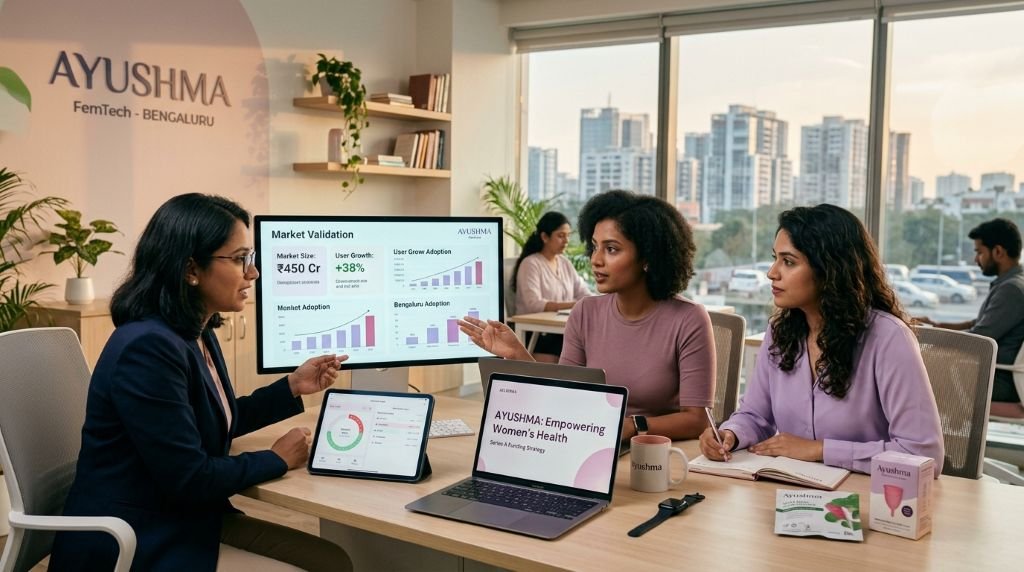
A 14-Day Deadline, a ₹12 Crore Term Sheet & Market Intelligence Gap
Two co-founders — one with a clinical background, one with a product management background from a major Indian technology company — had spent 18 months building a teleconsultation platform specifically targeting Tier-2 Indian cities. Their insight was precise: India's primary care gap was not in metros (where telemedicine had meaningful penetration), but in cities of 3–15 lakh population where specialist access was limited, travel costs were prohibitive, and digital health adoption was accelerating through smartphone and internet expansion.
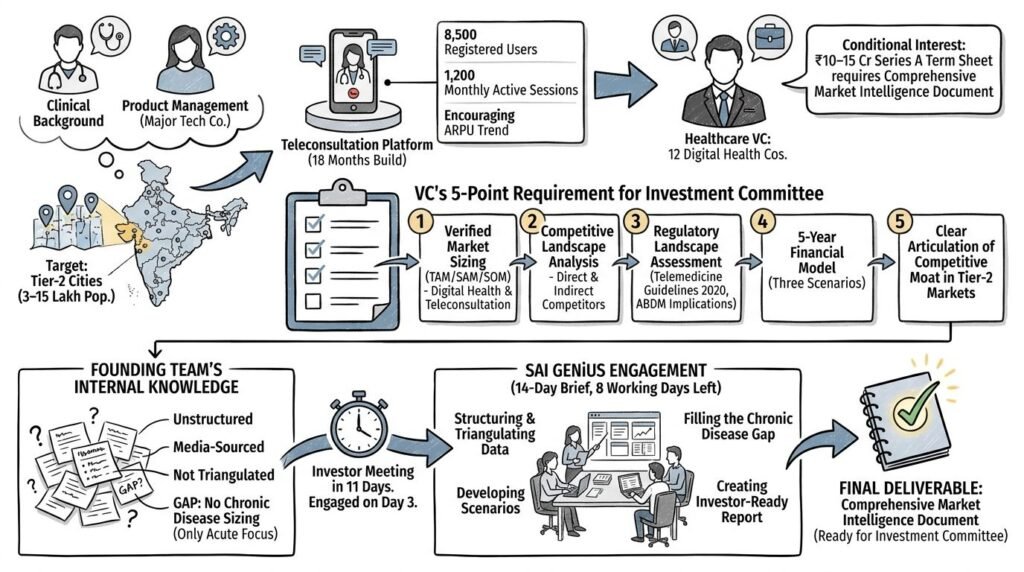
Their seed-funded product had 8,500 registered users, 1,200 monthly active teleconsultation sessions, and an ARPU trend line that was encouraging but not yet sustained.
A lead investor — a healthcare-focused VC with a portfolio of 12 Indian digital health companies — had reviewed the initial pitch deck and expressed conditional interest. The condition: before issuing a term sheet for a ₹10–15 crore Series A, they needed a comprehensive market intelligence document that would support their own internal investment committee presentation.
Specifically, the investor requested:
- Multi-source verified market sizing (TAM/SAM/SOM) for India's digital health and teleconsultation market
- Competitive landscape analysis covering direct and indirect competitors
- Regulatory landscape assessment (Telemedicine Practice Guidelines 2020; ABDM implications)
- 5-year financial model with three scenarios
- A clear articulation of the competitive moat in Tier-2 markets
The investor meeting was in 11 days.
The founding team had internal market research, assembled over 18 months of operating in the space. But it was accumulated knowledge, not a structured document. It was partially sourced from media coverage and competitor press releases. It had not been triangulated. And it had a specific gap: the founders had never formally sized the chronic disease management opportunity in Tier-2 India, because they had positioned their platform as an acute primary care solution.
SAI GENiUS was engaged with a 14-day brief on Day 3 after the investor call.
A 58-Page Study, a Previously Invisible Vertical & a Regulatory Tailwind
The SAI GENiUS research team delivered a 58-page investor-grade market intelligence document covering all five investor-requested components. The research was conducted across primary and secondary sources over 12 days, with the document formatted and delivered on Day 14 — 3 days before the investor meeting.
The India Digital Health Market Macro Tailwind Was Stronger Than the Founders Had Documented
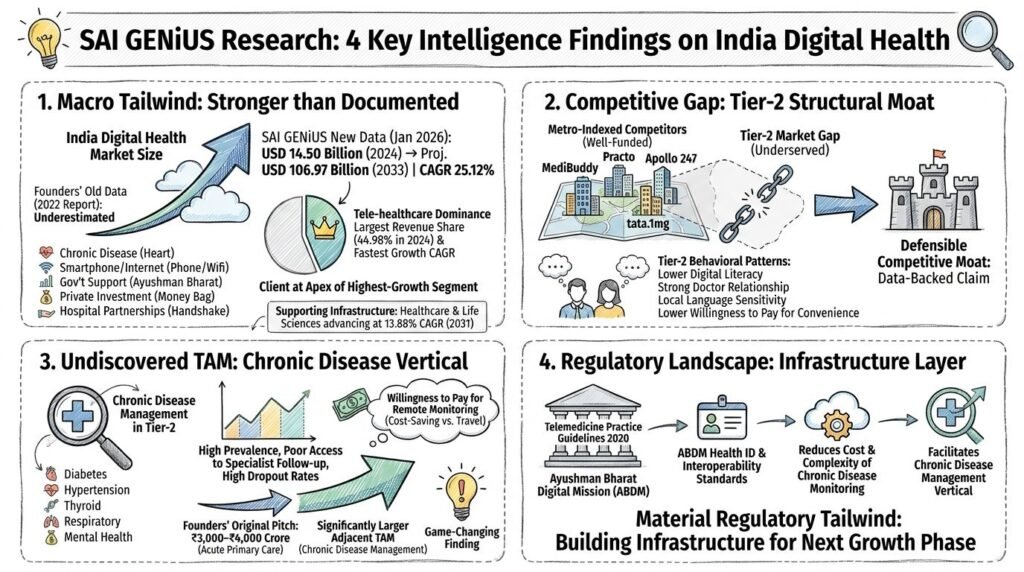
The India digital health market size was estimated at USD 14.50 billion in 2024 and is projected to reach USD 106.97 billion by 2033, growing at a CAGR of 25.12% from 2025 to 2033.4 The founding team had used an older figure (from a 2022 syndicated report) that significantly underestimated both the current market size and the growth trajectory. The updated figure — from Grand View Research’s January 2026 data — gave the investor committee a market narrative that was materially more compelling.
Crucially, the tele-healthcare segment dominated the India digital health market with the largest revenue share of 44.98% in 2024 and is anticipated to grow at the fastest CAGR over the forecast period.4 This meant the founding team’s specific segment — teleconsultation — was not only the largest segment but the fastest growing. The investor committee was being shown a business positioned at the absolute apex of the highest-growth market segment in India’s digital health economy.
Growth is driven by rising chronic disease prevalence, widespread smartphone and internet adoption, and government support through the Ayushman Bharat Digital Mission. Increasing use of teleconsultations, remote monitoring, and AI-enabled diagnostics, along with private sector investments and hospital partnerships, is accelerating adoption.4 The regulatory tailwind was real, documented, and directionally favorable to the client’s business model in ways the founding team had not fully articulated.
Additionally, healthcare and life sciences are advancing at a 13.88% CAGR to 20311 within India’s management consulting market — indicating that the institutional infrastructure supporting healthcare growth (advisory, regulatory, operational) was itself expanding at a rate that would underpin, rather than constrain, the client’s market development.
The Competitive Landscape Had a Structural Gap the Founders Had Not Mapped
The research team mapped 23 teleconsultation and digital health players across 18 dimensions including product positioning, geographic concentration, pricing, funding status, and customer segment focus. The mapping revealed a consistent pattern: every well-funded competitor (MediBuddy, Practo, Apollo 247, tata.1mg) was metro-indexed in its marketing, product development, and partnership focus.
The Tier-2 teleconsultation market was being served — but not by anyone with serious capital, focused positioning, or product design optimized for Tier-2 behavioral patterns (lower digital health literacy, stronger doctor-patient relationship expectations, higher sensitivity to local language availability, lower willingness to pay for convenience-premium features).
This was not merely an observation. It was a defensible competitive moat argument — something the founding team had felt intuitively but had not articulated as a structured, data-backed claim. The competitive landscape map gave them the evidence.
The Chronic Disease Management Vertical Was an Undiscovered TAM
This was the finding that changed the fundraising.
While mapping the competitive landscape and analyzing Tier-2 city healthcare demand patterns, the SAI GENiUS research team identified a pattern in disease prevalence data that the founding team’s acute-primary-care positioning had caused them to overlook: Tier-2 India’s chronic disease burden was significantly underserved by teleconsultation infrastructure — not because patients were unwilling to use digital health, but because no platform had designed a chronic disease management product for the Tier-2 behavioral context.
Diabetes management, hypertension management, thyroid disorders, respiratory conditions, and mental health support all showed consistent patterns: high Tier-2 prevalence, poor access to specialist follow-up, extremely high appointment dropout rates (patients starting treatment and abandoning it due to travel costs for follow-up consultations), and demonstrated willingness to pay for remote monitoring when framed as cost-saving versus the travel-to-specialist alternative.
The addressable market for Tier-2 chronic disease management via teleconsultation — a market the founding team had never formally sized — was estimated to be significantly larger than their core acute primary care TAM. The funding team’s original pitch had positioned the company as addressing a ₹3,000–₹4,000 crore opportunity. The chronic disease management vertical added a credible adjacent TAM, materially increasing the scale of the opportunity presented to investors.
The Regulatory Landscape Was More Favorable Than the Team Had Documented
The Telemedicine Practice Guidelines 2020 and the Ayushman Bharat Digital Mission were both well-known to the founding team. But the research team’s regulatory analysis identified a specific implication that the founding team had not articulated in their existing pitch materials: the ABDM’s Health ID system and digital health record interoperability standards were creating an infrastructure layer that would reduce the cost and complexity of chronic disease monitoring — precisely the capability the client would need to build the chronic disease management vertical identified in Finding 3.
Regulation was not just permitting teleconsultation. It was building the infrastructure that would make the next growth phase possible. This was a material, defensible claim about regulatory tailwind — not a generic statement about favorable regulation.
A Repositioned Fundraise Narrative, 3 Days Before the Meeting
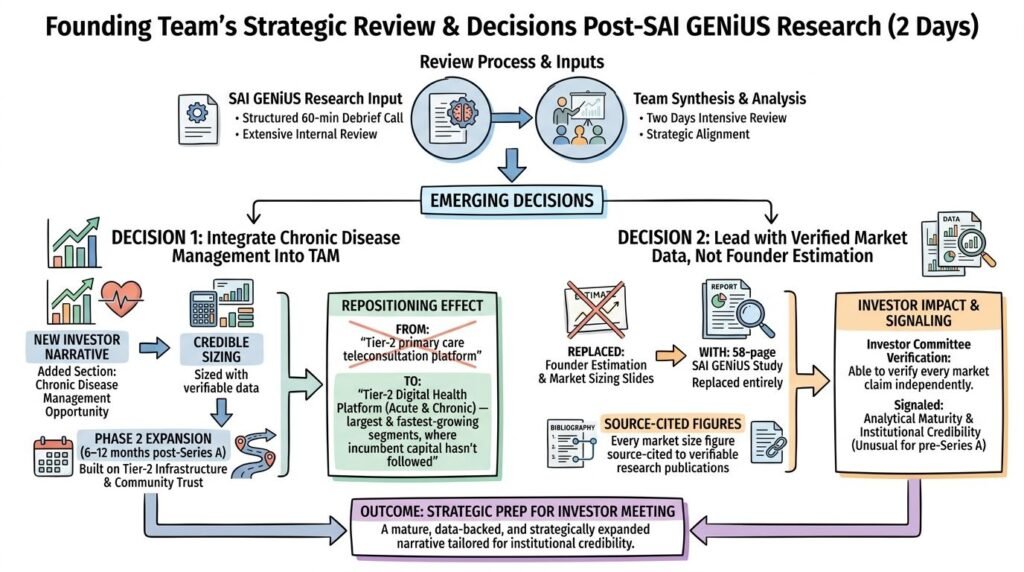
The founding team spent two days with the SAI GENiUS research — the structured 60-minute debrief call and extensive internal review — before their investor meeting. Two specific decisions emerged from that review.
Decision 1 — Integrate Chronic Disease Management Into the TAM
The founding team added a new section to their investor narrative: a clearly articulated chronic disease management opportunity, sized credibly with verifiable data, positioned as Phase 2 product expansion (6–12 months post-Series A) built on the same Tier-2 infrastructure and community trust the core platform was already developing.
This repositioned the company from "a Tier-2 primary care teleconsultation platform" to "a Tier-2 digital health platform capturing both acute and chronic care — the two largest and fastest-growing segments of India's teleconsultation market, in the one geography where incumbent capital has not followed."
Decision 2 — Lead with Verified Market Data, Not Founder Estimation
The 58-page SAI GENiUS study replaced the market sizing slides in the pitch deck entirely. Every market size figure was source-cited to verifiable research publications. The investor committee reviewing the internal investment memo would be able to verify every market claim independently. This level of evidentiary rigor — unusual for a pre-Series A pitch — signaled analytical maturity and institutional credibility that the founding team's internal research could not have produced.
₹12 Crore Series A. Investor Cites Research Quality as Key Confidence Factor.
The investor meeting proceeded as scheduled. The term sheet was issued 6 days later.
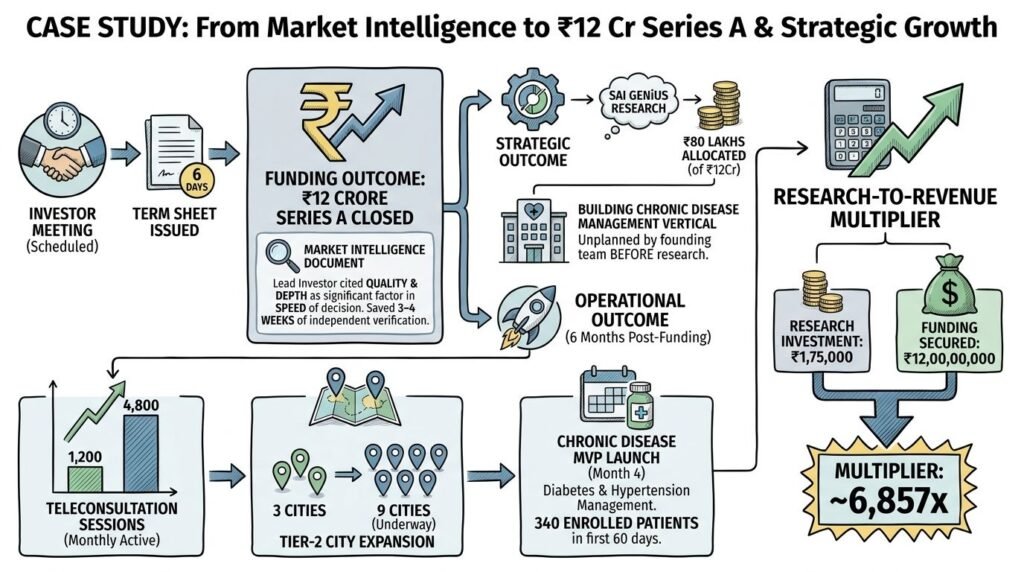
Funding Outcome: ₹12 crore Series A closed. The lead investor cited the quality and depth of the market intelligence document as a significant factor in the speed of the investment committee's decision — a decision that might have taken 3–4 additional weeks of back-and-forth had the market intelligence required independent verification.
Strategic Outcome: ₹80 lakhs of the ₹12Cr raise was specifically allocated — within the first post-funding operating plan — to building the chronic disease management vertical identified in the SAI GENiUS research. A vertical the founding team had not been planning to build before the research.
Operational Outcome: Six months post-funding, the platform's monthly active teleconsultation sessions grew from 1,200 to 4,800. Tier-2 city expansion from 3 cities to 9 cities is underway. The chronic disease management MVP (diabetes and hypertension management) launched in month 4 post-funding, with 340 enrolled chronic disease patients in the first 60 days.
Research-to-Revenue Multiplier: Research investment: ₹1,75,000. Funding secured: ₹12,00,00,000. Multiplier: ~6,857x.

---------- CASE STUDY
INDUSTRY
HealthTech (Teleconsultation & Digital Health)
LOCATION
Hyderabad, Telangana
Business Stage
Pre-Series A (₹2.8Cr seed raised; targeting ₹10–15Cr Series A)
Services Used
Startup Market Validation + Investor-Grade Business Plan + 5-Year Financial Model
Project Investment
₹ 1,75,000
Delivery Timeline
14 days (investor meeting deadline: 11 days; 3-day buffer delivered)
Primary Decision
Repositioned TAM narrative; identified and integrated chronic disease management vertical
Research-to-Revenue Multiplier
~6,857x (₹12Cr raise / ₹1.75L research investment)
CLIENT VOICE
"We walked into that investor meeting knowing our market better than our investor did. For a pre-Series A founder, that is not a typical feeling. The research gave us a level of evidentiary confidence that I believe is what converted conditional interest into a signed term sheet. And the chronic disease management insight — something we had not seen — is now a core business line. The research did not just support our fundraise. It changed our product roadmap."
— Co-Founder (Clinical), HealthTech Platform, Hyderabad (Identity anonymized with permission)