advanced divider
GTM Strategy
GTM Strategy

The Most Predictable Failure in Indian D2C

image

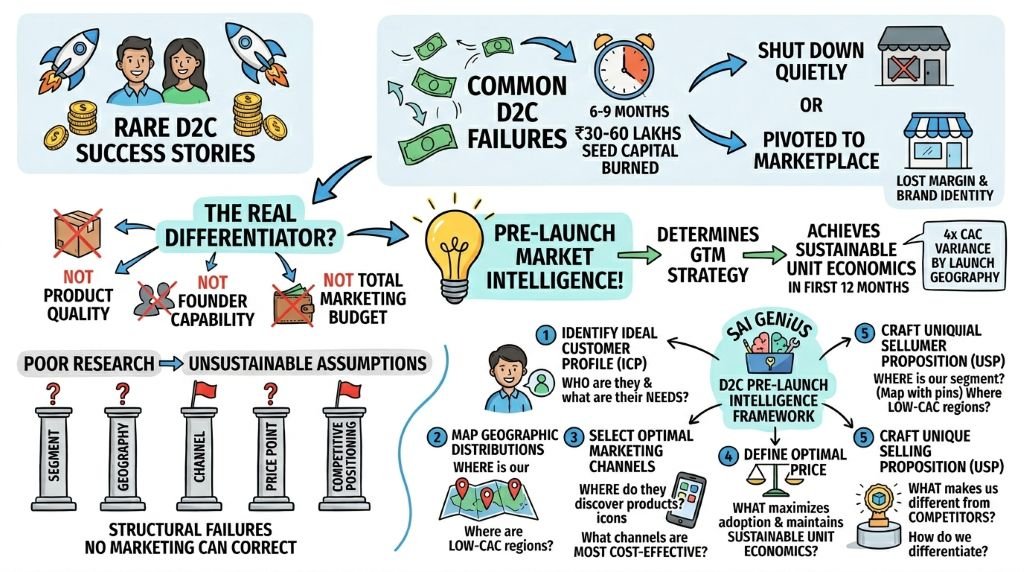
The Indian D2C market has produced some of the most compelling startup success stories of the last decade. It has also produced a considerably larger number of brands that burned through ₹30–60 lakhs of seed capital in 6–9 months, failed to achieve the CAC targets their financial model required, and either shut down quietly or pivoted to a marketplace model that eliminated their margin and their brand identity simultaneously.

What separates the two outcomes is not product quality. It is not a founder capability. It is not even the total marketing budget available. In the majority of cases, the difference between a D2C brand that achieves sustainable unit economics in its first 12 months and one that does not is determined before the first marketing rupee is spent — in the quality of the market intelligence that informed the GTM strategy.

The brands that fail are not failing because their marketing execution is poor. They are failing because the strategic assumptions underneath the marketing execution — the segment, the geography, the channel, the price point, and the competitive positioning — were built on insufficient research. And in a market where CAC can vary by 4x depending purely on launch geography, those assumption errors are not minor miscalibrations. They are structural failures that no amount of marketing execution can correct.

The SAI GENiUS D2C Pre-Launch Intelligence Framework exists to answer the 5 questions that determine those strategic assumptions — before the budget is committed.

advanced divider
GTM Strategy
Question 1: Who, Specifically, Is Your First 100 Customers — and Have You Actually Spoken to Them?
image

Not your target demographic. Your first 100 customers.

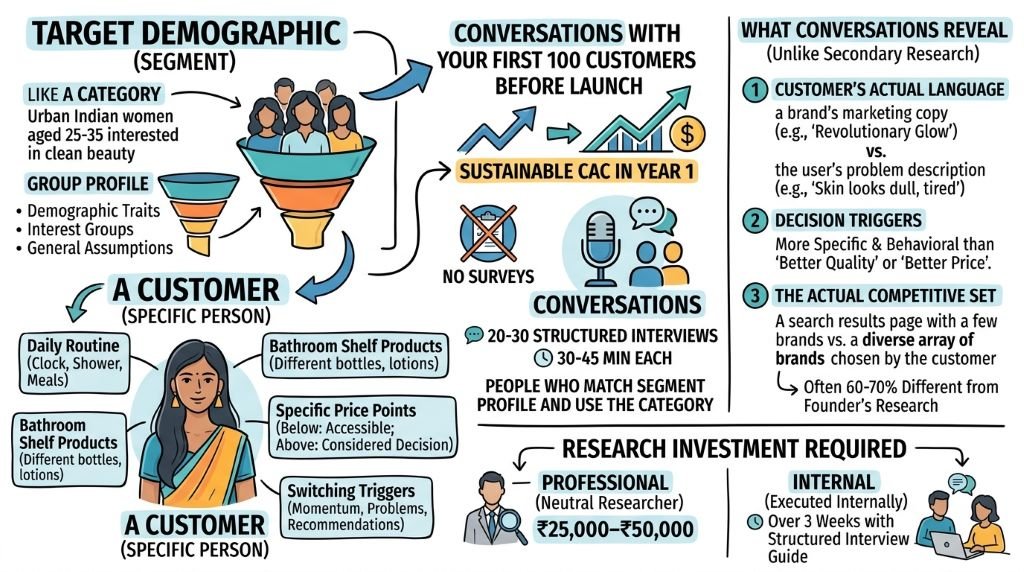
There is a meaningful difference between a customer segment definition and a customer. A segment is a category — “urban Indian women aged 25–35 interested in clean beauty.” A customer is a specific person with a specific daily routine, a specific set of products currently on their bathroom shelf, a specific price point below which the purchase feels accessible and above which it feels like a considered decision, and a specific set of switching triggers that would cause them to try something new.

The brands that achieve sustainable CAC in their first year of D2C operation have, without exception, spoken to a meaningful number of their first 100 customers before launching. Not surveys — conversations. 20–30 structured interviews, 30–45 minutes each, with people who match the target segment profile and who currently use the category the brand is entering.

These conversations reveal three things that no secondary research source can provide: the language the customer actually uses to describe their problem (which is almost always different from the language the brand is using in its marketing copy), the decision triggers that would cause them to try a new brand in this category (which are almost always more specific and more behavioral than “better quality” or “better price”), and the competitive set they are actually choosing from — which is often 60–70% different from the competitive set the founding team assembled by Googling their category.

Research investment required: 20–30 customer interviews, conducted by a neutral researcher — ₹25,000–₹50,000 professionally, or executable internally over 3 weeks with a structured interview guide.

advanced divider
GTM Strategy
Question 2: Is Your Target Geography Right — or Are You Defaulting to Metro Because That Is Where You Are?
image

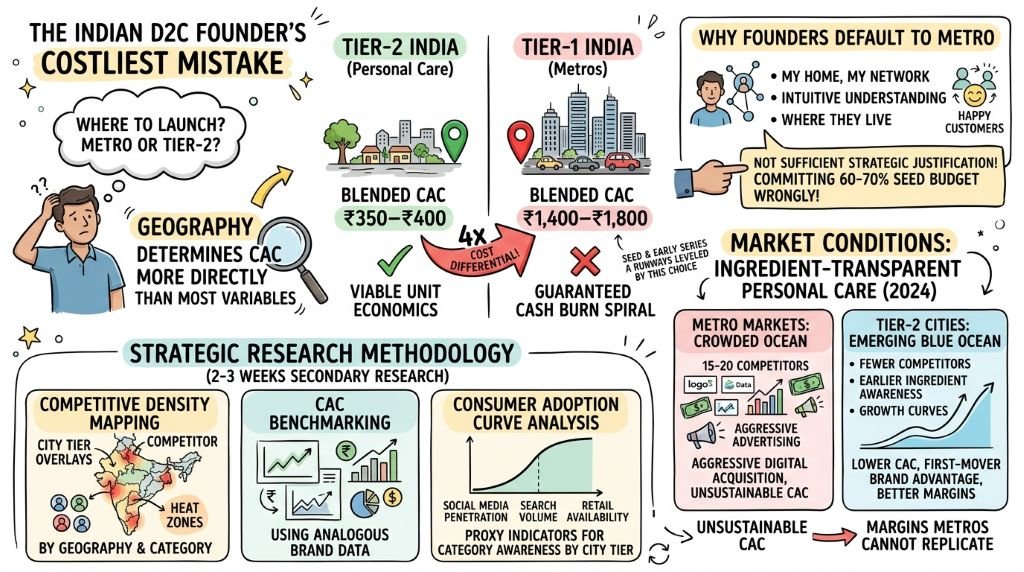
This is the question that Indian D2C founders most consistently get wrong — and the one with the highest financial consequence, because geography determines CAC more directly than almost any other variable in the D2C equation.

The blended CAC for a D2C personal care brand in Tier-2 India runs ₹350–₹400. The same brand, targeting a comparable segment in Tier-1, will typically see a blended CAC of ₹1,400–₹1,800. That is a 4x cost differential — a difference that, at the seed stage and early Series A runway levels that most Indian D2C brands are operating on, is the difference between a viable unit economic model and a guaranteed cash burn spiral.

Most D2C founders default to metro launch, not because the data supports it, but because it is where they live, where their network is concentrated, and where their intuitive understanding of the customer is strongest. These are reasonable inputs. They are not sufficient strategic justification for committing 60–70% of a limited seed budget to the most expensive customer acquisition geography in the country.

The specific market conditions that made ingredient-transparent personal care more profitable in Tier-2 India than in metro markets illustrate this precisely. In metro markets, the clean beauty category was already crowded by 2024, with 15–20 well-funded competitors running aggressive digital acquisition strategies that had pushed CAC to unsustainable levels for new entrants. In Tier-2 cities, the same category had significantly less competitive density, consumers were at an earlier stage of ingredient-awareness adoption, and the combination of lower CAC and first-mover brand positioning in an emerging category produced margin structures that metro launches could not replicate.

The research methodology for this question is a 2–3 week secondary research exercise: competitive density mapping by geography and category, CAC benchmarking using analogous brand data, and consumer adoption curve analysis using social media penetration, search volume, and retail availability as proxy indicators for category awareness by city tier.


advanced divider
SME Strategy
Question 3: What Is Your Realistic Channel CAC — and Is Your Unit Economics Model Built on Evidence or Assumption?
image

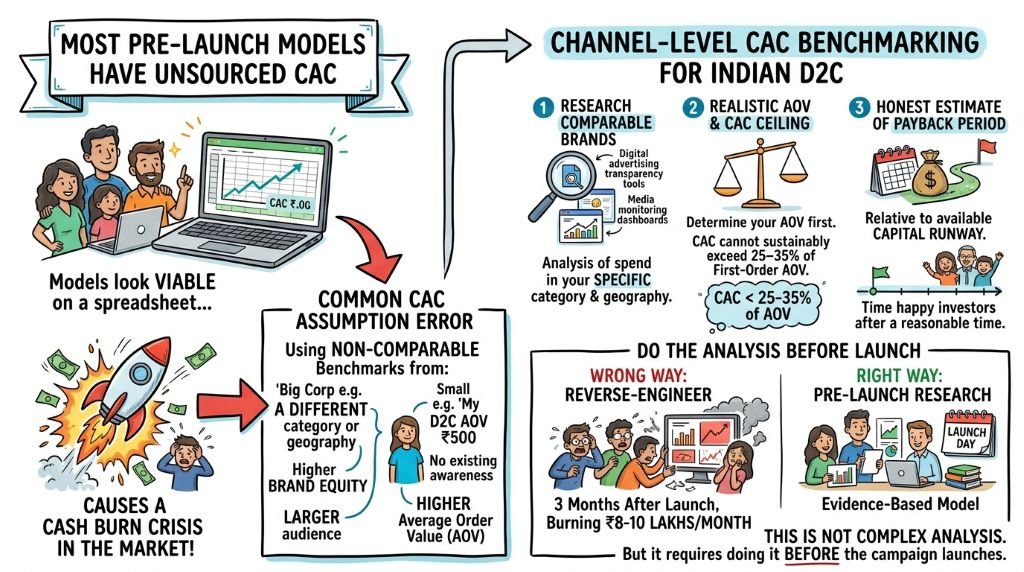
Most D2C pre-launch financial models contain a CAC assumption. Almost none of them contain a sourced, evidence-based CAC assumption — because sourced evidence requires research, and most founding teams build their financial model before they have done the research.

The result is a financial model that looks viable on a spreadsheet and produces a cash burn crisis in the market. The most common CAC assumption error: using a benchmark from a category or geography that is not comparable to the actual launch context, or using a benchmark from a brand with significantly higher brand equity, larger audience, or higher average order value that makes their CAC mathematically non-comparable to an early-stage brand with no existing awareness.

Channel-level CAC benchmarking for an Indian D2C brand requires at minimum: an analysis of what comparable brands in your specific category and geography are spending on customer acquisition (using digital advertising transparency tools and competitive media monitoring), a realistic assessment of your average order value and the CAC ceiling it creates (your CAC cannot sustainably exceed 25–35% of first-order AOV in most D2C categories), and an honest estimate of your payback period at that CAC relative to the capital runway you have available.

This is not complex analysis. But it requires doing the analysis before the campaign launches — not reverse-engineering it from actual performance 3 months into a campaign that is burning ₹8–10 lakhs per month.

advanced divider
GTM Strategy
Question 4: What Is Your Pricing Anchored To — and Is That Anchor One Your Target Customer Recognizes?
image

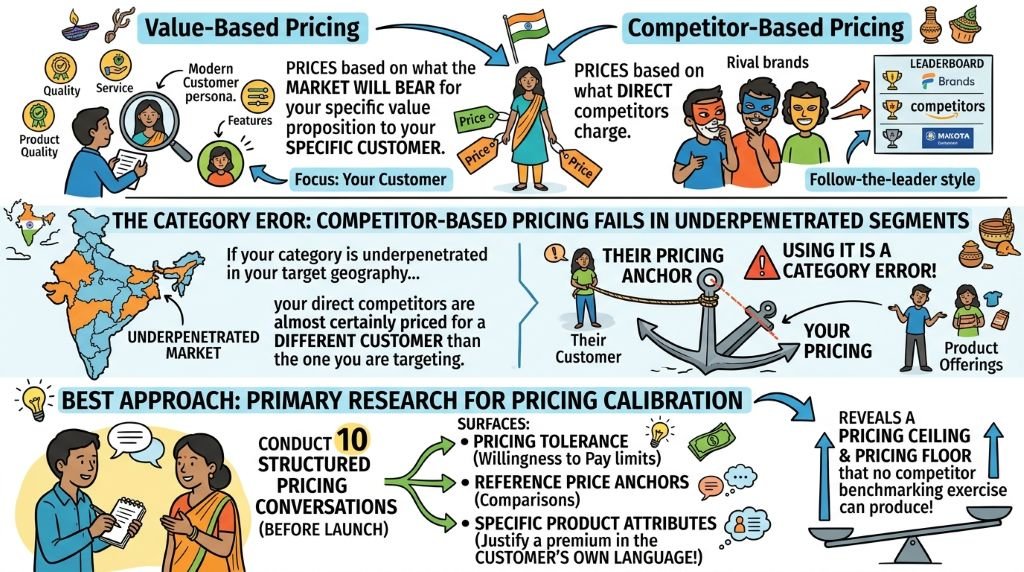
Indian D2C pricing decisions fall into two categories: brands that price based on what the market will bear for their specific value proposition to their specific customer, and brands that price based on what their direct competitors charge.

The second category produces systematic under-pricing in underpenetrated segments — because if your category is underpenetrated in your target geography, your direct competitors are almost certainly priced for a different customer than the one you are targeting. Their pricing anchor is their customer. Using it as yours is a category error.

The research methodology for pricing calibration is the same primary research that answered Question 1 — structured customer interviews, specifically designed to surface pricing tolerance, reference price anchors, and the specific product attributes that justify a premium in the customer’s own language. Ten structured pricing conversations, conducted before launch, will reveal a pricing ceiling and a pricing floor that no competitor benchmarking exercise can produce.

advanced divider
GTM Strategy
Question 5: What Does Your Category Competitive Density Look Like in the Next 18 Months — Not Just Today?
image

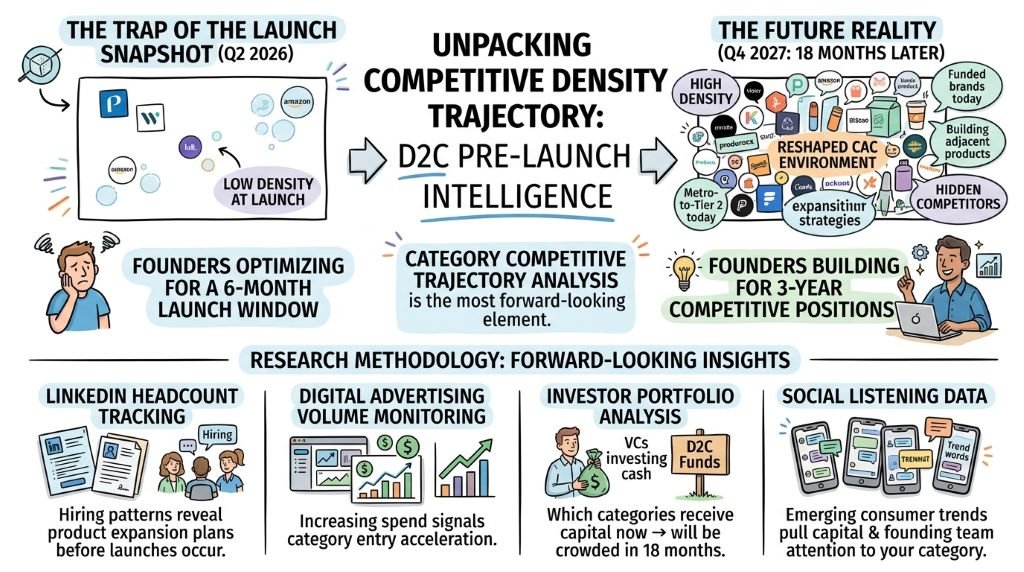
Competitive density at launch is a snapshot. The category you launch into in Q2 2026 will not have the same competitive structure in Q4 2027 — and the brands that are funded today, building products in adjacent positions, or preparing metro-to-Tier-2 expansion strategies are the competitors that will reshape your CAC environment in 12–18 months.

Category competitive trajectory analysis is the most forward-looking element of the D2C Pre-Launch Intelligence Framework, and the one that most distinguishes founders who are building for 3-year competitive positions from founders who are optimizing for a 6-month launch window.

The research methodology: LinkedIn headcount tracking of competitors in your category (hiring patterns reveal product expansion plans before launches occur), digital advertising volume monitoring (increasing spend signals category entry acceleration), investor portfolio analysis of active D2C funds (which categories are receiving capital now, which will be crowded in 18 months), and social listening data (which emerging consumer trends are pulling capital and founding team attention into your category).

advanced divider
GTM Strategy
GTM Strategy
What To Do Next — Monday Morning Actions
image

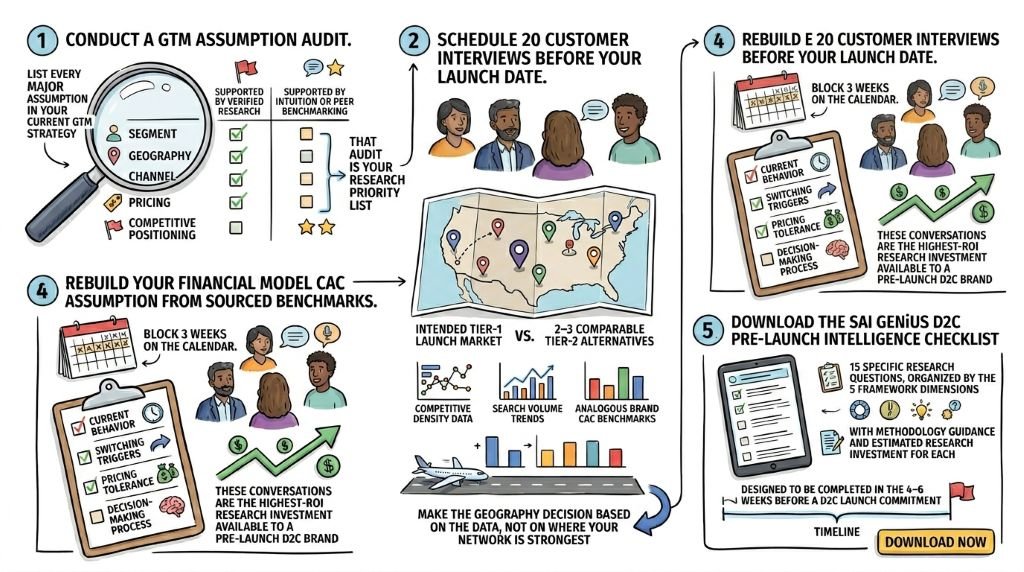
1. Conduct a GTM assumption audit. List every major assumption in your current GTM strategy — segment, geography, channel, pricing, competitive positioning — and identify which are supported by verified research and which are supported by intuition or peer benchmarking. That audit is your research priority list.

2. Schedule 20 customer interviews before your launch date. Block 3 weeks on the calendar. Design a structured interview guide focused on current behavior, switching triggers, pricing tolerance, and the decision-making process. These conversations are the highest-ROI research investment available to a pre-launch D2C brand.

3. Run a geography CAC comparison before committing to metro launch. Pull competitive density data, search volume trends, and analogous brand CAC benchmarks for both your intended Tier-1 launch market and 2–3 comparable Tier-2 alternatives. Make the geography decision based on the data, not on where your network is strongest.

4. Rebuild your financial model CAC assumption from sourced benchmarks. Replace the assumed CAC in your financial model with a number that is derived from comparable brands in comparable categories and geographies. Then model the runway impact at 1.5x and 2x that number — because first-year CAC in a new market almost always exceeds the benchmark.

5. Download the SAI GENiUS D2C Pre-Launch Intelligence Checklist — 15 specific research questions, organized by the 5 framework dimensions, with methodology guidance and estimated research investment for each. Designed to be completed in 4–6 weeks before a D2C launch commitment.