The Geography of Indian Business Intelligence and Its Most Significant Blind Spot
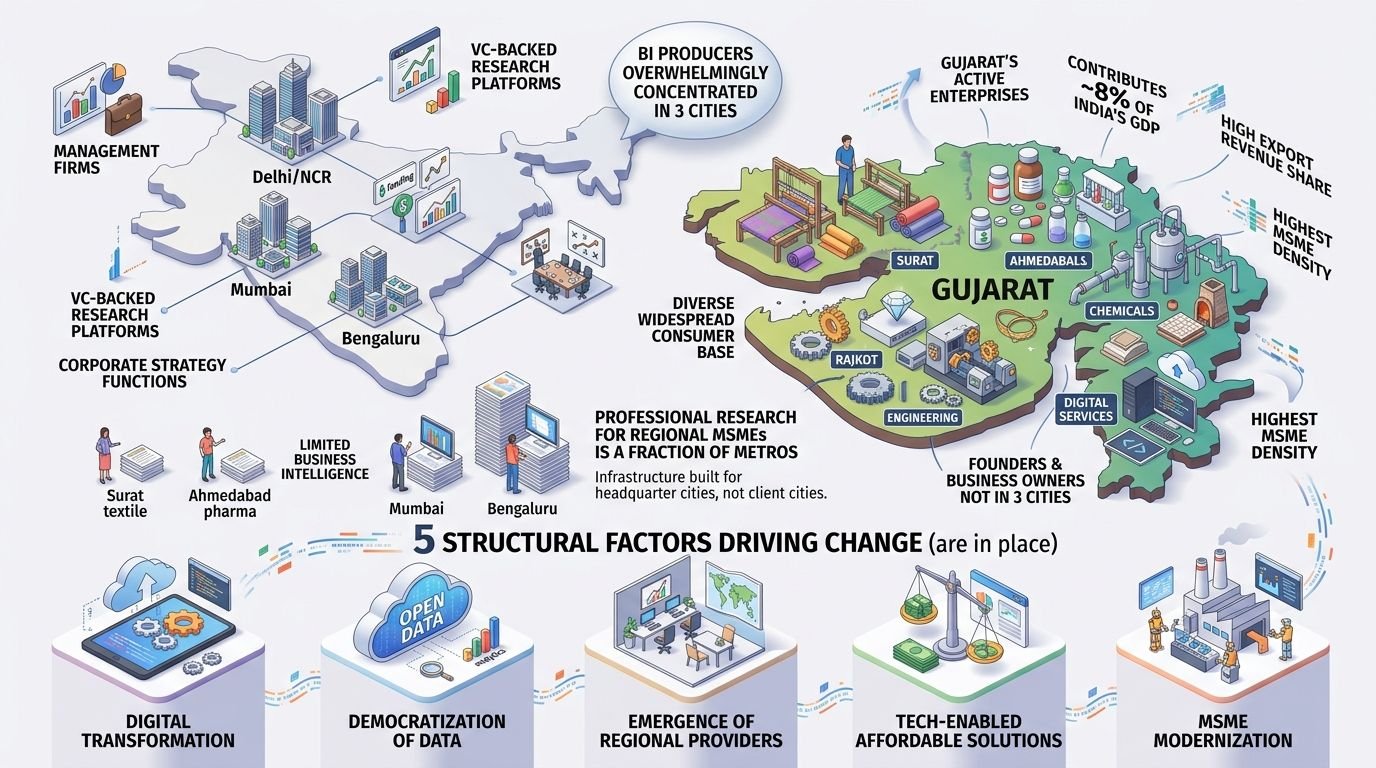
India’s business intelligence ecosystem has a geography problem. The institutions that produce it, management consulting firms, VC-backed research platforms, and corporate strategy functions, are overwhelmingly concentrated in three cities. The founders and business owners who consume it are not.
Gujarat’s registered businesses across textiles, pharmaceuticals, chemicals, ceramics, diamonds, engineering, and a fast-growing digital services sector represent one of the largest concentrations of commercially active enterprises in the country. Gujarat contributes approximately 8% of India’s GDP and a disproportionate share of its export revenue. Its MSME density, measured by registered businesses per square kilometre of industrial area, is among the highest in the nation.
Yet the professional research and strategic intelligence available to a Surat textile manufacturer, an Ahmedabad pharma SME, or a Rajkot engineering exporter is a fraction of what is available to a comparable business in Mumbai or Bengaluru, not because the need is smaller, but because the intelligence infrastructure has been built for the cities where the research firms are headquartered, not for the cities where the clients are.
This is changing. And the 5 structural factors driving the change are already in place.
The 5 Structural Factors Making Ahmedabad India's Next Business Intelligence Hub
IIM-Ahmedabad and the Research Infrastructure It Anchors
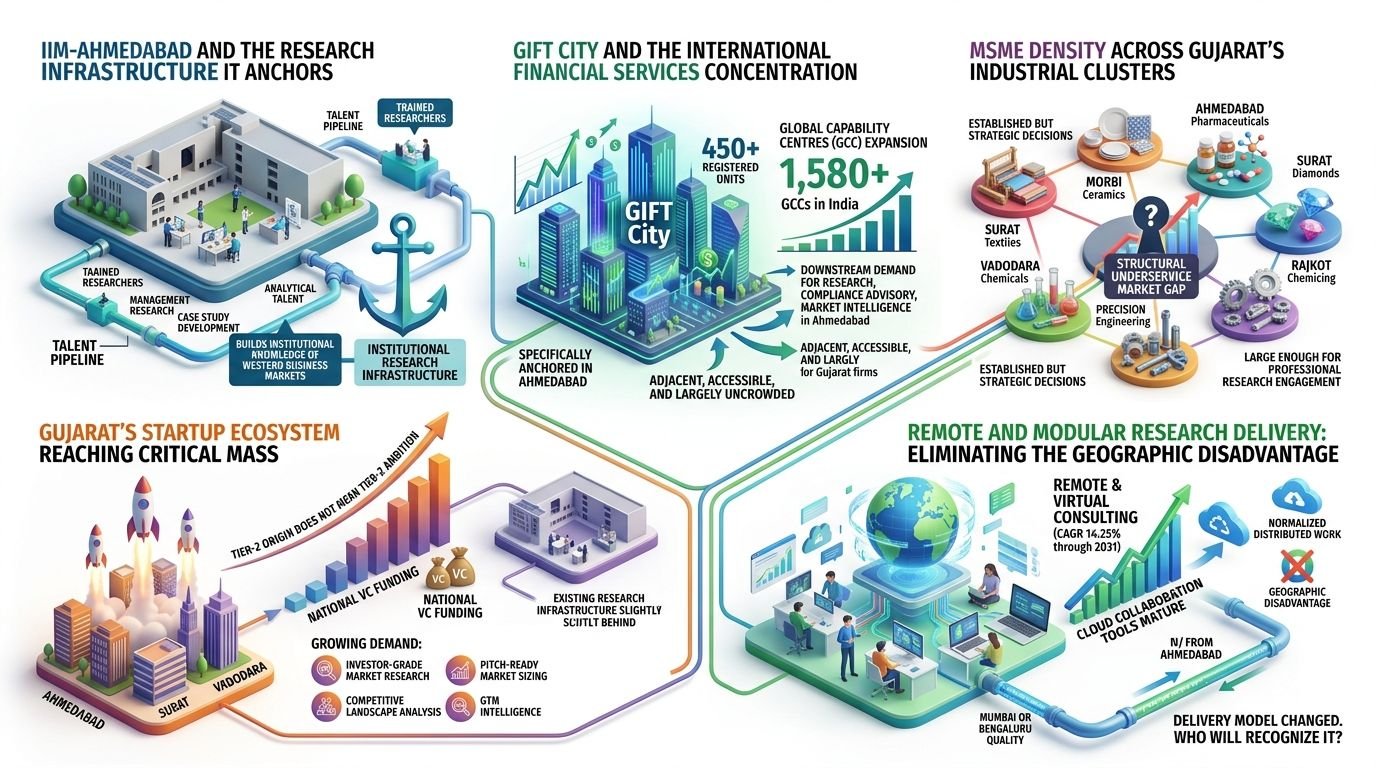
IIM-Ahmedabad is one of Asia’s premier management institutions and its presence in Ahmedabad creates an institutional research infrastructure that most Indian cities outside the traditional metro cluster do not have. The concentration of management research, case study development, and analytical talent that IIM-A produces and attracts is not simply an academic asset. It is the foundation of a professional intelligence ecosystem producing trained researchers, building institutional knowledge of India’s western business markets, and creating the talent pipeline that intelligence-focused firms operating in Ahmedabad can access.
GIFT City and the International Financial Services Concentration
GIFT City’s 450+ registered units represent a concentration of international financial services activity that has no precedent outside Mumbai in the Indian context. More than 1,580 global capability centres already operate in India, and the GCC expansion dynamic, combined with GIFT City’s international financial services infrastructure, is creating a downstream demand for professional research, compliance advisory, and market intelligence that is specifically anchored in the Ahmedabad geography. For Gujarat-based intelligence firms and professional services businesses, this demand is adjacent, accessible, and largely uncrowded.
MSME Density Across Gujarat’s Industrial Clusters
Gujarat’s industrial clusters textiles in Surat, ceramics in Morbi, pharmaceuticals in Ahmedabad, diamonds in Surat, chemicals in Vadodara, precision engineering in Rajkot represent extraordinary concentrations of businesses at a common stage of development: established enough to have real strategic decisions to make, growing fast enough that the cost of making the wrong ones is significant, and large enough that a scoped professional research engagement is financially accessible. The structural underservice of this cluster by institutional research is not a permanent condition. It is a market gap, and market gaps in growing sectors close.
Gujarat’s Startup Ecosystem Reaching Critical Mass
Gujarat’s startup ecosystem, anchored in Ahmedabad, Surat, and Vadodara, has historically been underrepresented in national VC funding flows relative to its economic size. That underrepresentation is beginning to close as a cohort of Gujarat-origin startups demonstrates that Tier-2 origin does not mean Tier-2 ambition. As Gujarat’s startup ecosystem reaches the scale at which institutional investor attention follows, the demand for investor-grade market research, pitch-ready market sizing, competitive landscape analysis, and GTM intelligence is growing at a rate that the existing research infrastructure in the city is not yet meeting.
Remote and Modular Research Delivery: Eliminating the Geographic Disadvantage
Remote and Virtual Consulting is set to climb at a 14.25% CAGR through 2031 as cloud collaboration tools mature and clients normalise distributed work. This structural shift in consulting delivery is the single most important development for Gujarat business owners in the intelligence market because it eliminates the geographic rationale for the intelligence gap. A research engagement that previously required proximity to a Mumbai or Bengaluru consulting office can now be delivered with identical quality from and to Ahmedabad. The delivery model has changed. The question is which Gujarat businesses will be the first to recognise it.

The 3 Ahmedabad-Specific Business Intelligence Opportunities
GIFT City B2B Intelligence Services
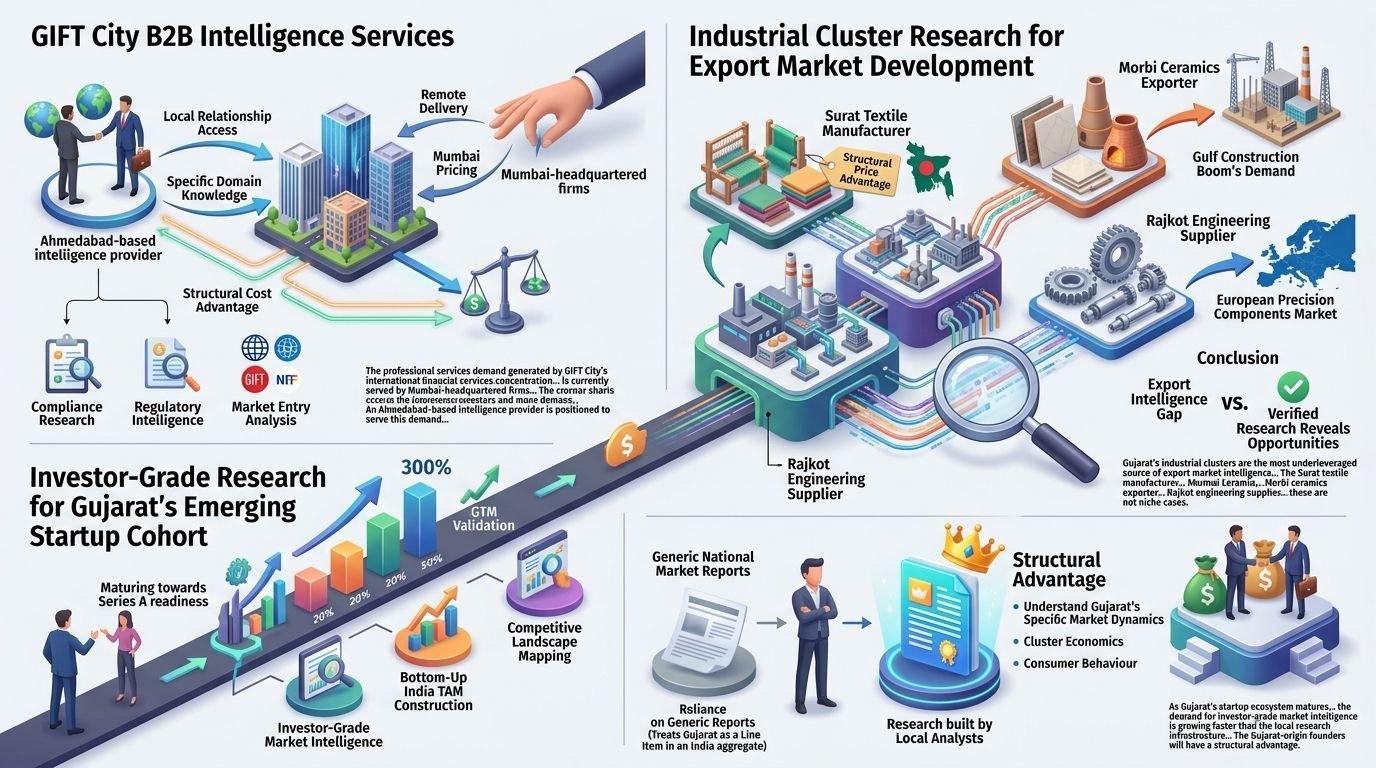
The professional services demand generated by GIFT City’s international financial services concentration compliance research, regulatory intelligence, and market entry analysis for international firms establishing a GIFT City presence is currently served by Mumbai-headquartered firms at Mumbai pricing. An Ahmedabad-based intelligence provider with GIFT City-specific domain knowledge and local relationship access is positioned to serve this demand at a structural cost advantage and with a proximity benefit that remote delivery from Mumbai cannot replicate.
Industrial Cluster Research for Export Market Development
Gujarat’s industrial clusters are the most underleveraged source of export market intelligence in the country. The Surat textile manufacturer who does not know that India-manufactured goods hold a structural price advantage in the Bangladesh market, the Morbi ceramics exporter who has not mapped the Gulf construction boom’s demand for high-quality tiles, and the Rajkot engineering supplier who has not assessed the European precision components market these are not niche cases. They are representative of the gap between the export intelligence available to Gujarat’s cluster businesses and the export opportunities that verified research would reveal.
Investor-Grade Research for Gujarat’s Emerging Startup Cohort
As Gujarat’s startup ecosystem matures toward Series A readiness, the demand for investor-grade market intelligence, bottom-up India TAM construction, competitive landscape mapping, and GTM validation is growing faster than the local research infrastructure to supply it. The Gujarat-origin founders who enter investor conversations with research built by analysts who understand Gujarat’s specific market dynamics, cluster economics, and consumer behaviour will have a structural advantage over those who rely on generic national market reports that treat Gujarat as a line item in an India aggregate.
What To Do Next — Monday Morning Actions
1. Map your business against GIFT City’s downstream B2B opportunity. Which of your current services or products could be adapted or positioned for the international financial services buyers concentrated in GIFT City? The proximity advantage is available but only to businesses that have built a go-to-market strategy to access it.
2. Audit your export market intelligence. If your business operates in any of Gujarat’s industrial clusters, identify the two export markets where your product category has the highest structural demand relative to current Gujarat supplier presence. The gap between those markets and your current export revenue is a research problem, and it is solvable.
3. Book a free SAI GENiUS discovery call. In 30 minutes, we will identify the specific intelligence opportunity most relevant to your Gujarat-based business and give you at least one verified market insight about your sector or geography before the call ends.
Related Posts
The India GTM Velocity Framework™: How to Sequence Market Entry Across Tier-1, Tier-2, and Tier-3 India and Why the Sequence Matters More Than the Market.
Why Sequence Is the Problem Most Founders Do Not Recognise As One
India’s Digital Health Market Is Heading to USD 106.97 Billion by 2033. Here Is What HealthTech Founders Actually Need to Know About the Opportunity and the Risk.
Tele-Healthcare — The Dominant Segment, and What Dominance Actually Means for Strategy
India’s Management Consulting Market Is Heading to USD 17 Billion by 2031. Here Are 8 Strategic Implications for Every Indian Business.
When a market doubles in six years, the instinct is to focus on the market…