The Most Expensive Gap in the Indian Economy
India’s MSME sector is the backbone of the national economy by almost any metric you choose to apply. It contributes approximately 30% of GDP, accounts for roughly 45% of total exports, and employs well over 10 crore people. By sheer economic weight, it is one of the most consequential sectors in the country.
It is also the most underserved by professional market intelligence of any major business segment in India — and the gap between the intelligence available to a well-resourced corporate and the intelligence available to a typical Indian MSME owner is not closing. Until recently, it was widening.
The reason is structural and entirely logical. Institutional market research — the kind that produces verified, sector-specific, strategically actionable intelligence — has historically been priced for institutional buyers. A comprehensive market research engagement from a reputable firm costs ₹5–25 lakhs. A syndicated research report from an international database costs ₹1–5 lakhs for a single download. Neither figure is accessible to a business running at ₹3–10 crore annual revenue with a working capital cycle that leaves no discretionary budget for intelligence that does not have an immediate, visible operational application.
So MSME owners do what rational people do when institutional resources are inaccessible. They rely on what they have: decades of industry experience, networks of peers and suppliers, gut instinct refined over years of operation, and the accumulated pattern recognition that comes from running a business in one sector for a long time.
These are genuinely valuable inputs. They are also, in isolation, structurally insufficient — and the gap between what they produce and what verified research produces is not theoretical. It has a cost. In every case. In every sector. At every scale.
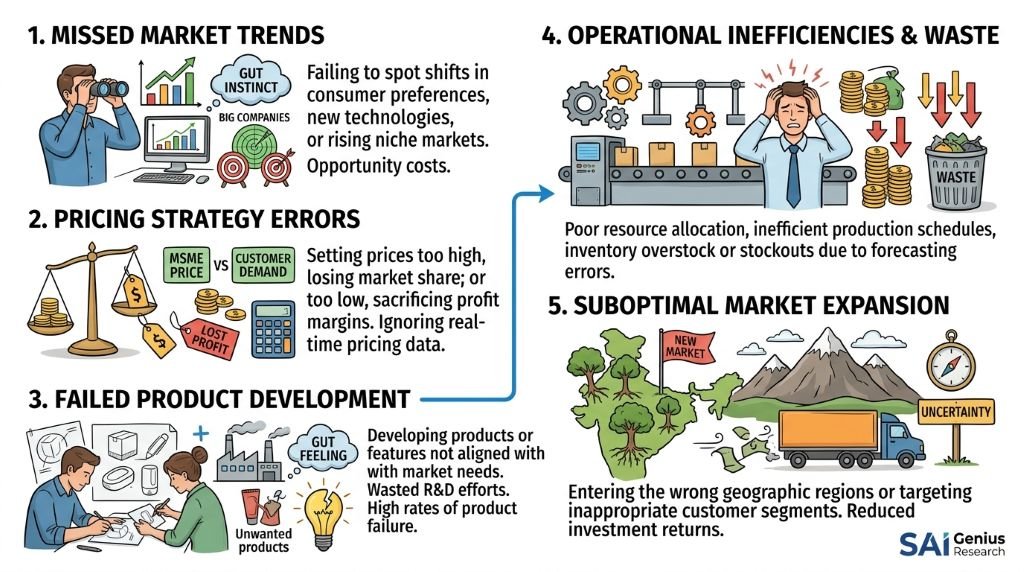
Here are the 5 places where SAI GENiUS research has most consistently found that cost.

Misconception 1: "I Know My Market Because I Have Been in It for 20 Years"
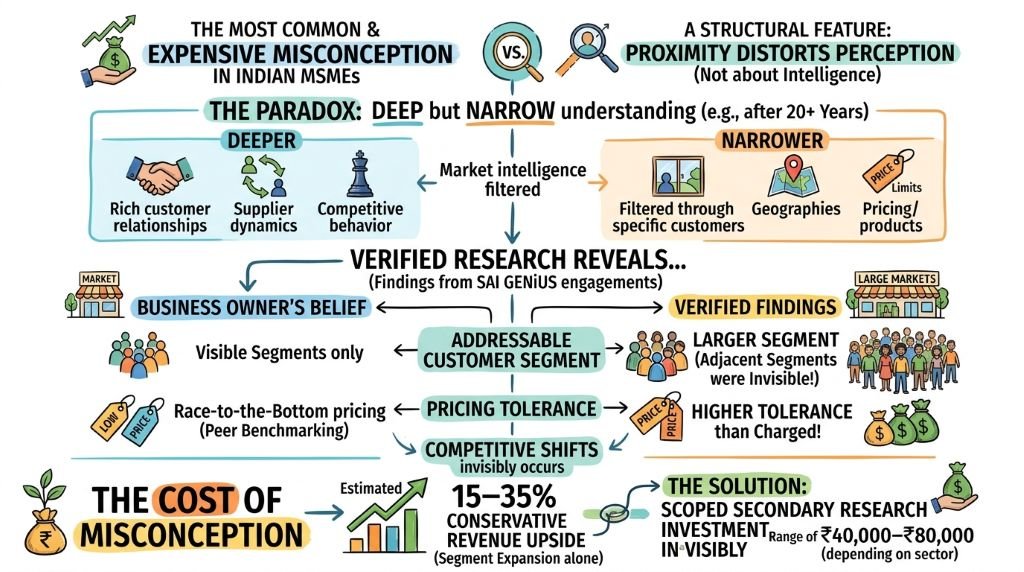
This is the most common and most expensive misconception in the Indian MSME ecosystem — and it is not a reflection of intelligence or competence. It is a structural feature of how proximity to a business distorts market perception.
When you have operated in a market for 20 years, your understanding of it is simultaneously deeper and narrower than you realize. Deeper, because no research report will give you the textural understanding of customer relationships, supplier dynamics, and competitive behavior that 20 years of daily operation produces. Narrower, because your market intelligence is filtered through the specific customers you serve, the specific geographies you operate in, and the specific price points and product categories that your business has historically prioritized.
In 20+ SAI GENiUS client engagements with Indian MSME owners, the most consistent research finding is this: the market the business owner believes they are operating in and the market that verified research reveals are different in at least 2 significant dimensions. Most commonly, the addressable customer segment is larger than the owner believed (because adjacent segments have been invisible from within the current operation), the pricing tolerance of the market is higher than the owner was charging (because peer benchmarking within a cluster creates race-to-the-bottom pricing norms), or a competitive shift has occurred that is not yet visible within the existing customer base.
The estimated cost of this misconception, across engagements: conservative revenue upside of 15–35% from segment expansion alone, in cases where verified research identified accessible adjacent segments the business was not serving.
The research investment that would have identified it: a scoped secondary research engagement in the range of ₹40,000–₹80,000, depending on sector and complexity.
Misconception 2: "Our Pricing Is Competitive Because We Match What Others in Our Cluster Charge"
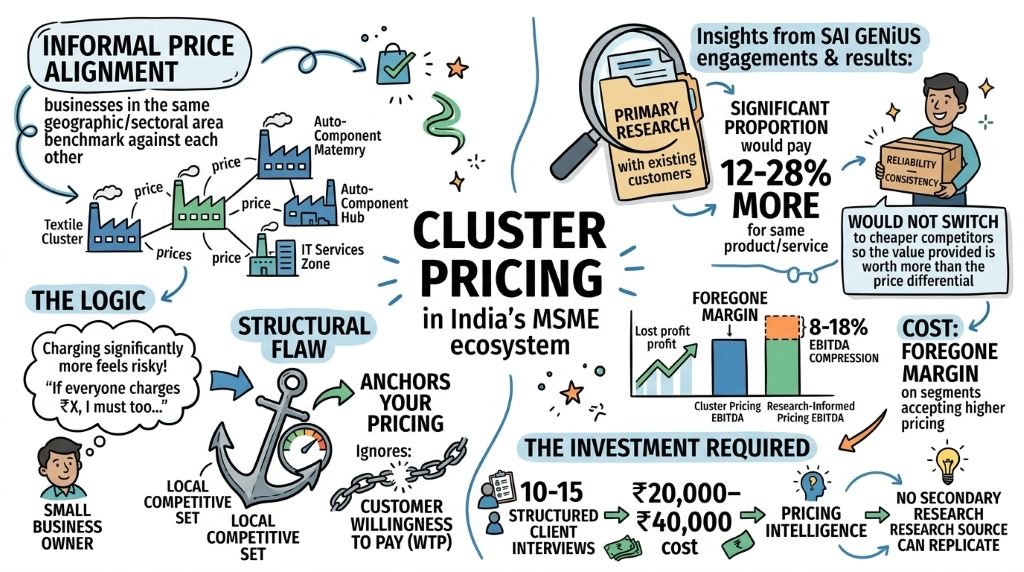
Cluster pricing — the informal price alignment that occurs when businesses operating in the same geographic or sectoral cluster benchmark against each other — is one of the most pervasive and least examined strategic decisions in India’s MSME ecosystem.
The logic is intuitive: if every textile manufacturer in your area charges ₹X per metre, charging significantly more feels risky. But cluster pricing has a structural flaw that most MSME owners do not examine: it anchors your pricing to your local competitive set, not to what your specific customers — with their specific needs, their specific quality requirements, and their specific switching costs — are actually willing to pay.
In multiple SAI GENiUS engagements involving manufacturing and professional services SMEs, primary research with existing customers revealed that a significant proportion of the client base would have paid 12–28% more for the same product or service — and would not have switched to a cheaper competitor — because the relationship, reliability, and delivery consistency the business provided was worth more than the price differential to those specific customers.
The cost of cluster pricing: foregone margin on every transaction with the customer segments that would have accepted higher pricing. Estimated impact: 8–18% EBITDA compression relative to research-informed pricing, depending on sector and customer mix.
The research investment that would have identified it: 10–15 structured customer interviews with existing clients — a primary research exercise that costs ₹20,000–₹40,000 when conducted professionally and produces a pricing intelligence output that no secondary research source can replicate.
Misconception 3: "We Have No Real Competition in Our Area"
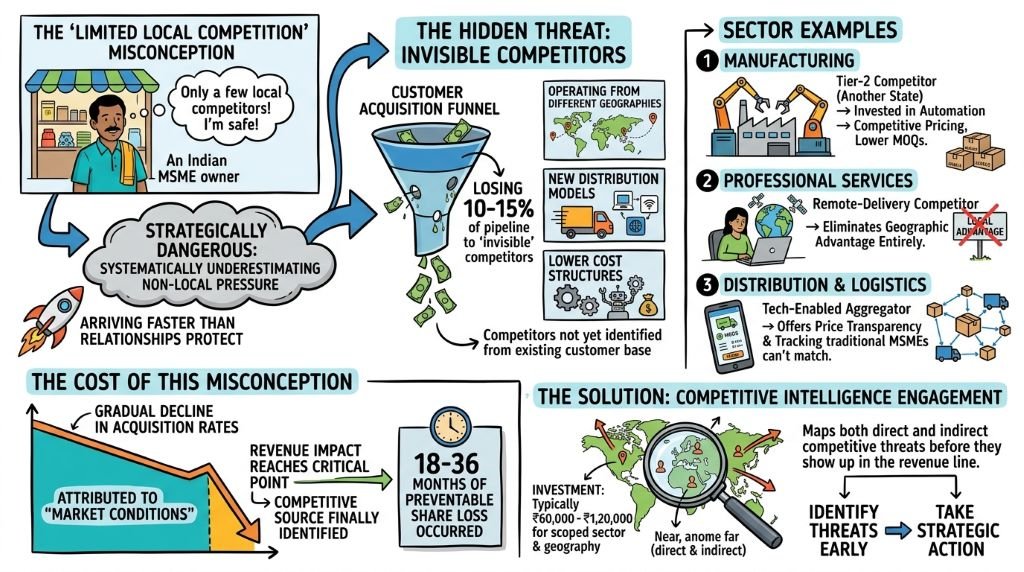
This is a misconception that is almost always factually accurate — and strategically dangerous. Most established Indian MSME owners genuinely do face limited direct local competition. What they are systematically underestimating is the non-local competitive pressure that is arriving faster than their customer relationships can protect them.
In sector after sector — textiles, food processing, industrial components, professional services — SAI GENiUS research has documented the same pattern: an established local SME with strong customer relationships and a genuine quality reputation is losing 10–15% of its customer acquisition pipeline to competitors it has not yet identified, operating from different geographies, different distribution models, or different cost structures that make them invisible from within the existing customer base.
The specific form this takes varies by sector. In manufacturing, it is often a Tier-2 competitor in a different state that has invested in automation and can now offer competitive pricing at lower minimum order quantities. In professional services, it is a remote-delivery competitor that has eliminated the geographic advantage entirely. In distribution and logistics, it is a technology-enabled aggregator that is offering customers a rice transparency and tracking capability the traditional MSME operator cannot match.
The cost of this misconception: customer acquisition rates that decline gradually and are attributed to “market conditions” rather than competitive incursion — until the revenue impact is large enough that the competitive source is finally identified. By which point, 18–36 months of preventable share loss have already occurred.
The research investment that would have identified it: a competitive intelligence engagement — typically ₹60,000–₹1,20,000 for a scoped sector and geography — that maps both direct and indirect competitive threats before they show up in the revenue line.
Misconception 4: "Our Customers Will Tell Us If Something Is Wrong"
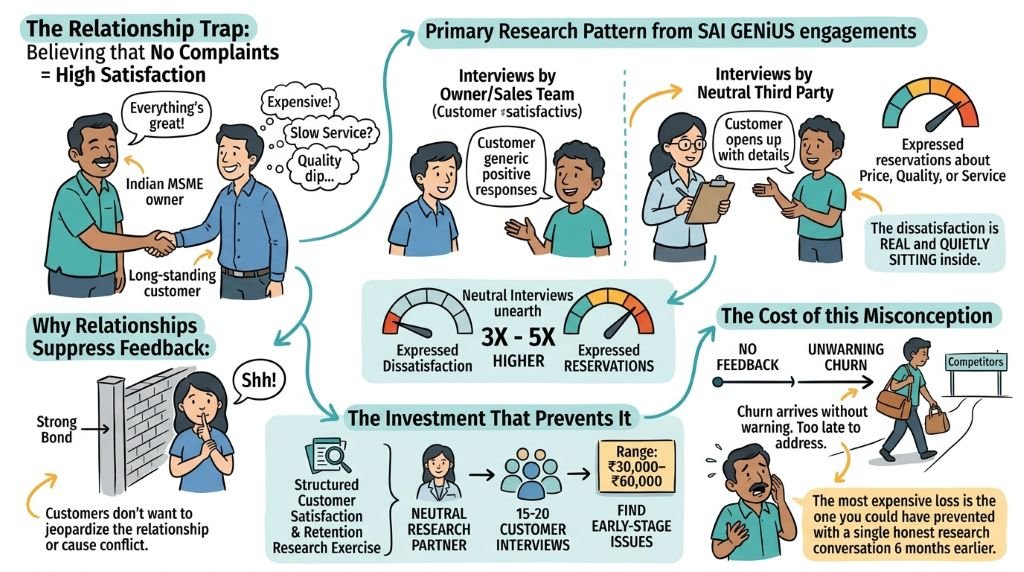
The assumption that customer dissatisfaction surfaces through direct feedback is one of the most consistently disproved beliefs in business research — across sectors, geographies, and business sizes. Indian MSME owners who have strong, long-standing customer relationships are particularly susceptible to this misconception, because the relationship strength itself suppresses the kind of honest feedback that would reveal early-stage dissatisfaction.
In primary research conducted across SAI GENiUS client engagements, the pattern is consistent: when customers are interviewed by a neutral third party rather than by the business owner or their sales team, the proportion expressing reservations about price, quality, or service is significantly higher — sometimes 3 to 5 times higher — than what the business owner has received through direct customer communication. The relationship is real. So is the unexpressed dissatisfaction sitting quietly inside it.
The cost of this misconception: churn that arrives without warning, and is too late to address by the time the customer has already made the decision to switch. The most expensive customer loss is not the one you could not have prevented — it is the one you could have prevented with a single honest research conversation 6 months earlier.
The research investment that would have identified it: a structured customer satisfaction and retention research exercise — 15–20 customer interviews conducted by a neutral research partner — in the range of ₹30,000–₹60,000.
Misconception 5: "We Cannot Afford Research — We Will Invest When We Are Bigger"
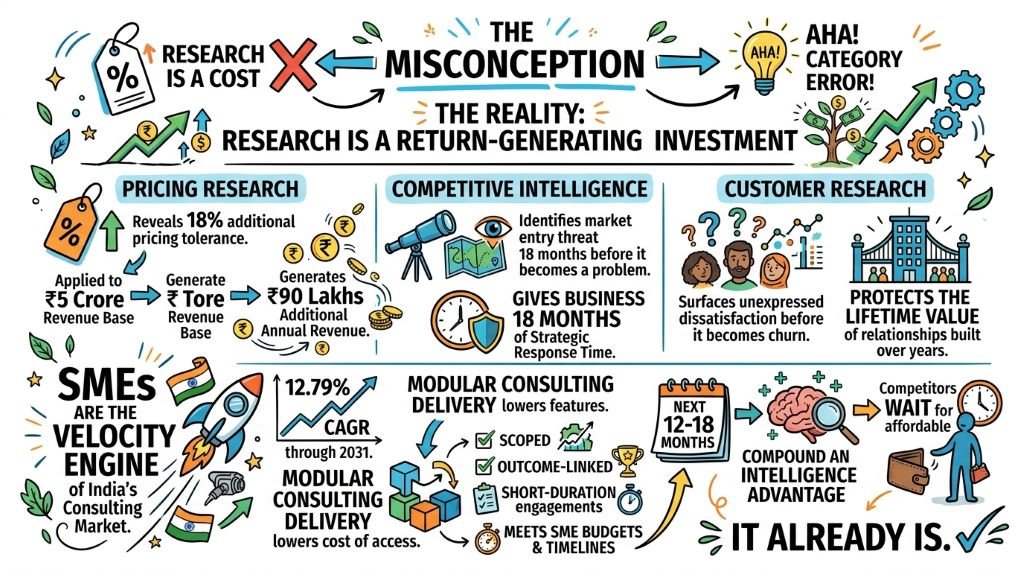
This is the misconception that enables all the others. And it is, at its core, a category error: the assumption that research is a cost rather than a return-generating investment.
Every verified research finding that changes a major business decision — pricing, market entry, competitive strategy, customer retention — generates a return that can be estimated. A pricing research engagement that reveals 18% additional pricing tolerance, applied across a ₹5 crore revenue base, generates ₹90 lakhs of additional annual revenue. A competitive intelligence engagement that identifies a market entry threat 18 months before it becomes a revenue problem gives the business 18 months of strategic response time. A customer research engagement that surfaces unexpressed dissatisfaction before it becomes churn protects the lifetime value of the relationships the business has spent years building.
SMEs are the velocity engine of India’s consulting market, posting a 12.79% CAGR through 2031 — a growth arc supported by modular consulting delivery that lowers the cost of access for smaller budgets. The market has already responded to the “we cannot afford research” reality by developing delivery models — scoped, outcome-linked, short-duration engagements — that meet SME budgets and timelines. The businesses that access these models in the next 12–18 months will compound an intelligence advantage while competitors wait for research to become affordable.
It already is.
What To Do Next — Monday Morning Actions
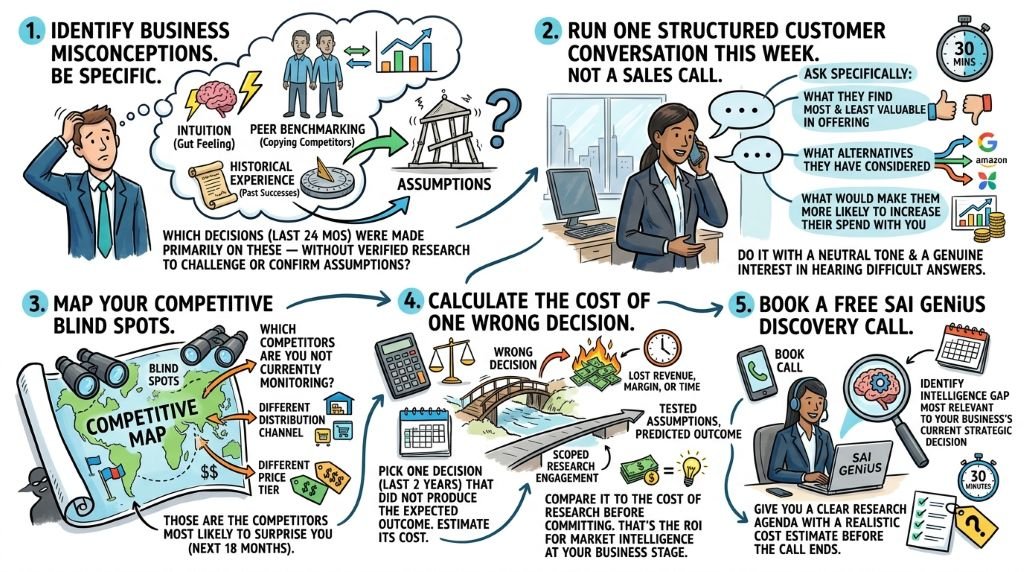
1. Identify which of the 5 misconceptions your business is most likely carrying. Be specific. Which decisions in the last 24 months were made primarily on intuition, peer benchmarking, or historical experience — without verified research to challenge or confirm the assumption?
2. Run one structured customer conversation this week. Not a sales call. A research conversation — 30 minutes with an existing customer, asking specifically about what they find most and least valuable in your offering, what alternatives they have considered, and what would make them more likely to increase their spend with you. Do it with a neutral tone and a genuine interest in hearing difficult answers.
3. Map your competitive blind spots. Which competitors are you not currently monitoring — because they are in a different geography, a different distribution channel, or a different price tier? Those are the competitors most likely to surprise you in the next 18 months.
4. Calculate the cost of one wrong decision. Pick a specific decision from the last 2 years that did not produce the outcome you expected. Estimate the revenue, margin, or time cost of that outcome. Compare it to the cost of a scoped research engagement that would have tested the assumption before you committed. That comparison is the ROI calculation for market intelligence at your business stage.
5. Book a free SAI GENiUS discovery call. In 30 minutes, we will identify the specific intelligence gap most relevant to your business’s current strategic decision — and give you a clear research agenda with a realistic cost estimate before the call ends.
Related Posts
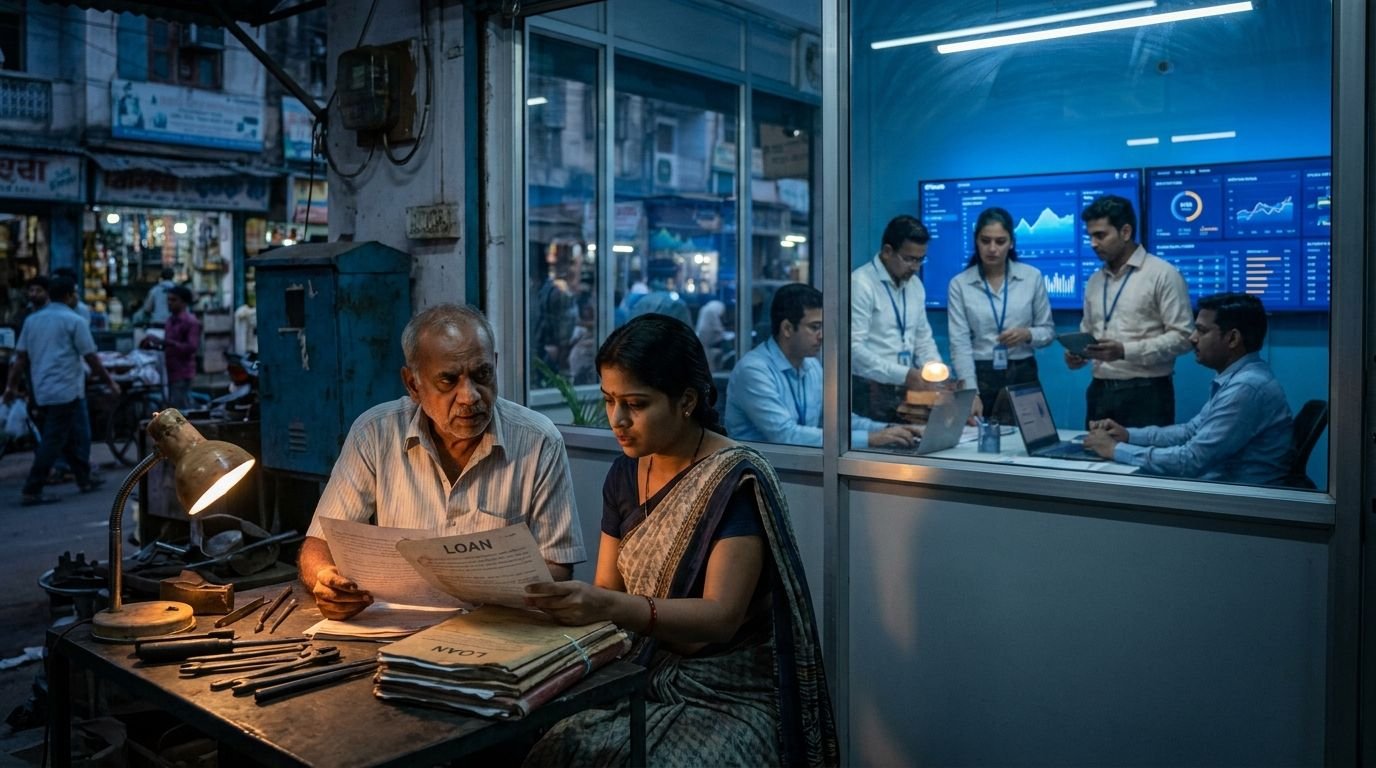
India’s MSME Credit Gap Is ₹20–25 Trillion. Here Is Why It Has Not Been Solved and What the Market Intelligence Actually Reveals About Why FinTech Solutions Keep Failing to Close It.
The Most Cited Gap in Indian Finance and the Most Misunderstood