

The Problem With Being Third-Largest
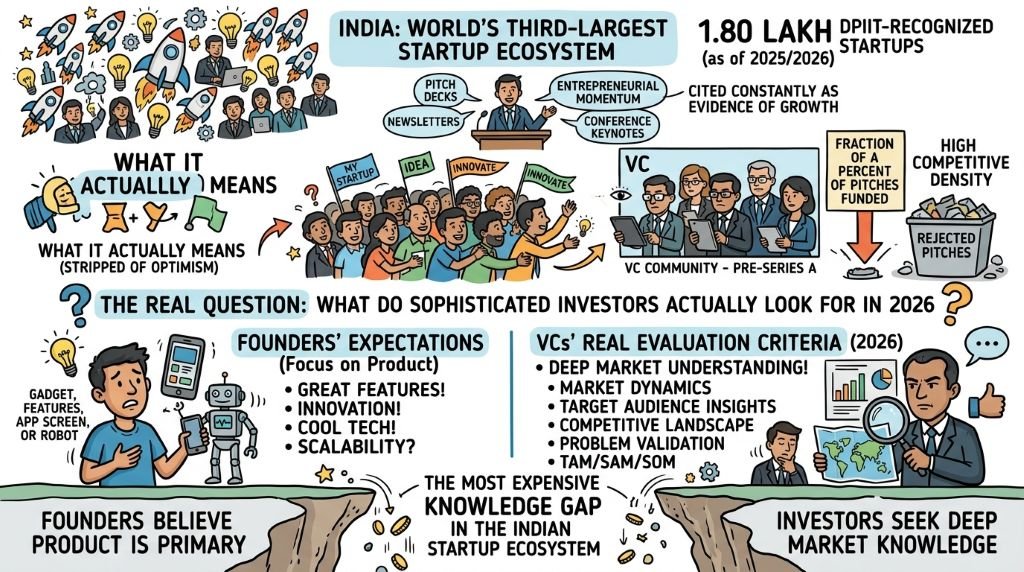
India is the world’s third-largest startup ecosystem, with 1.80 lakh DPIIT-recognized startups as of 2025. That number is cited constantly — in pitch decks, in newsletter introductions, in conference keynotes — as evidence of India’s entrepreneurial momentum.
Here is what it actually means, stripped of the optimism: 1.80 lakh startups are competing for the attention of a VC community that, at the pre-Series A stage, funds a fraction of a percent of the pitches it reviews. In a market of that competitive density, the question is not whether your startup will be evaluated. It is what the evaluation will focus on — and whether you will be prepared for what sophisticated investors are actually looking for in 2026.
The answer, consistently, is not what most founders expect. Indian VCs at the pre-Series A stage are not primarily evaluating your product. They are evaluating your founder’s understanding of the market the product is entering. And the gap between what founders believe investors want to see on market intelligence — and what investors are actually looking for — is the most expensive knowledge gap in the Indian startup ecosystem.
What Sophisticated Indian VCs Are Actually Looking For in 2026
The market slide in most Indian startup pitch decks contains one of three things: a global market size figure from a syndicated research report, a bottom-up calculation that was built in 30 minutes and cannot survive a follow-up question, or a number from a competitor’s pitch deck that has been recycled without verification.
None of these is market intelligence. They are market decoration — numbers that give the appearance of research without producing the substance of it.
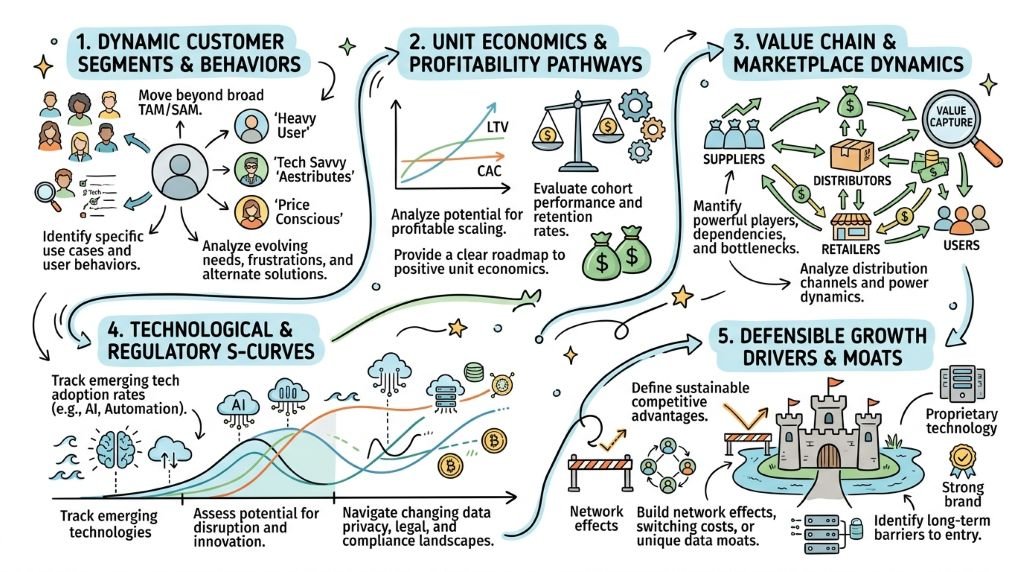
What a sophisticated investor actually needs to see in 2026, across 5 specific dimensions, is the following.
Intelligence Element 1: A Defensible India-Specific TAM — Not a Global Number Divided by Population
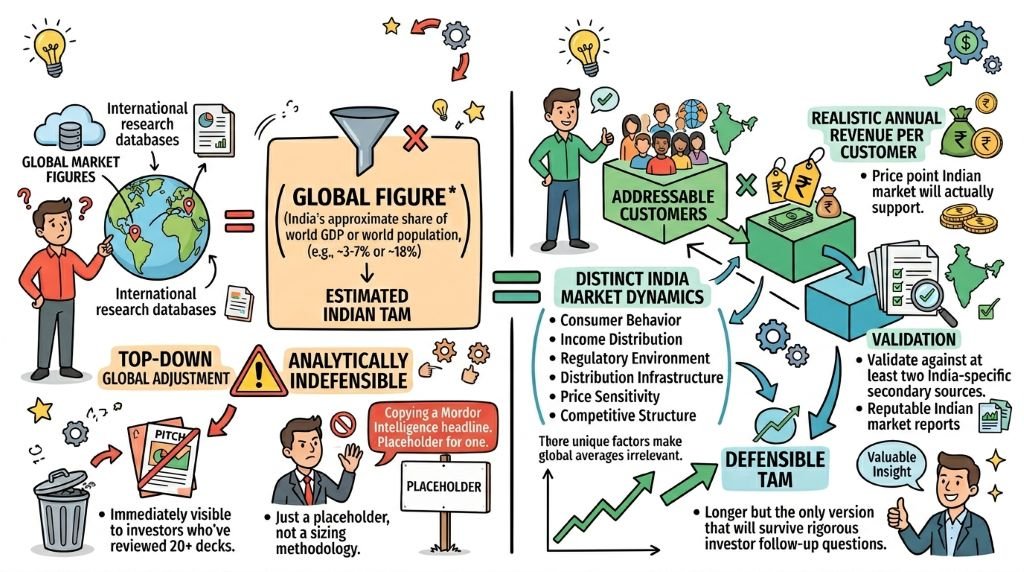
The most common market sizing error in Indian startup pitch decks is the use of global market figures from international research databases, adjusted downward by India’s approximate share of world GDP or world population. This methodology is analytically indefensible and immediately visible to any investor who has reviewed more than 20 decks.
India’s market dynamics — consumer behavior, income distribution, regulatory environment, distribution infrastructure, price sensitivity, and competitive structure — are sufficiently distinct from global averages that a global-to-India adjustment is not a market sizing methodology. It is a placeholder for one.
A defensible India-specific TAM is built bottom-up: from the number of addressable customers in the target segment, multiplied by the realistic annual revenue per customer at a price point that the Indian market will actually support, validated against at least two India-specific secondary sources. This takes longer than copying a Mordor Intelligence headline. It is also the only version of market sizing that will survive a rigorous investor follow-up question.
Intelligence Element 2: A Competitive Landscape That Goes Beyond the 4 Logos on the 2x2 Matrix
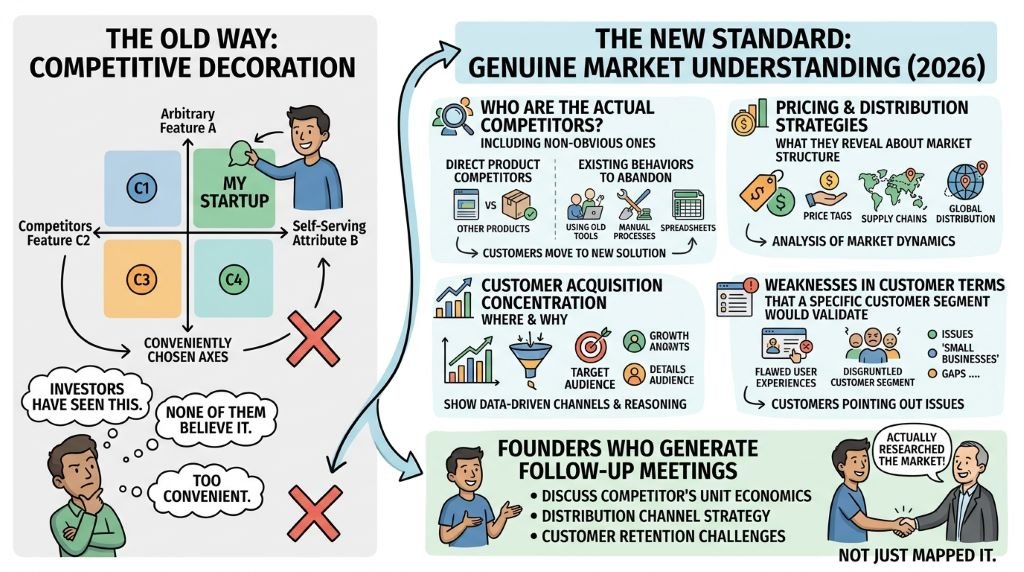
The competitive slide in most Indian startup decks shows 4 competitors placed on a matrix with axes that the founding team designed to put their own product in the top-right quadrant. Every investor has seen this. None of them believe it.
What investors are looking for in 2026 is competitive intelligence that demonstrates genuine market understanding: who the actual competitors are (including the non-obvious ones — the existing behaviors your product is asking customers to abandon, not just the direct product competitors), what their pricing and distribution strategies reveal about market structure, where their customer acquisition is concentrated and why, and what their weaknesses are in terms that a specific customer segment would validate.
The 2×2 matrix with conveniently chosen axes is not competitive intelligence. It is competitive decoration. The founders who generate follow-up meetings are the ones who can discuss a competitor’s unit economics, distribution channel strategy, or customer retention challenge with enough specificity that the investor understands the founding team has actually researched the market — not just mapped it.
Intelligence Element 3: Customer Segment Definition That Is Specific Enough to Be Falsifiable
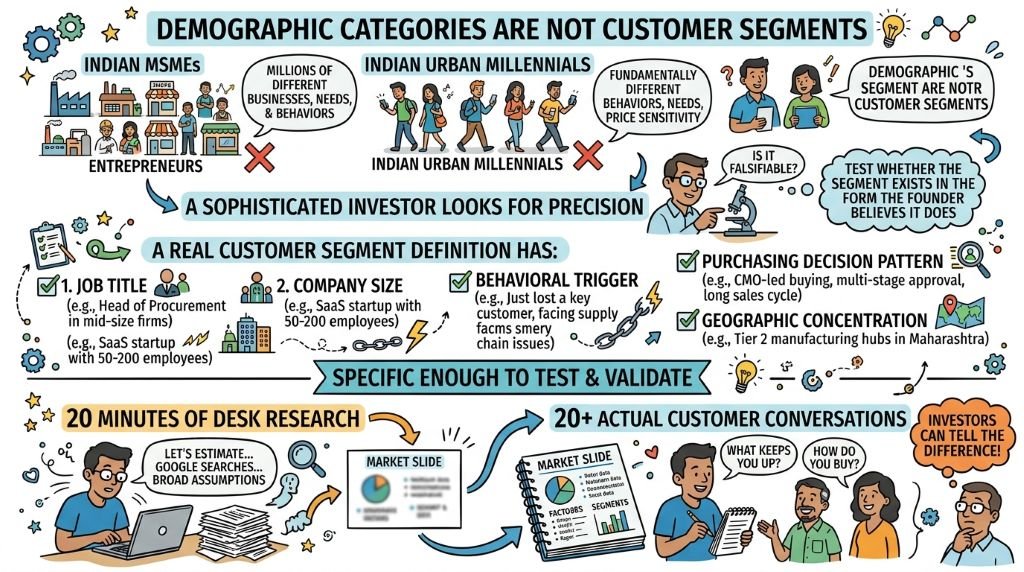
“Indian MSMEs” is not a customer segment. “Indian urban millennials” is not a customer segment. These are demographic categories — broad enough to contain millions of people with fundamentally different behaviors, needs, price sensitivities, and decision-making patterns.
A customer segment definition that satisfies a sophisticated investor in 2026 is specific enough to be falsifiable: it names a job title, a company size, a behavioral trigger, a purchasing decision pattern, or a geographic concentration that makes it possible to test whether the segment actually exists in the form the founder believes it does.
The founders who define their segments this precisely are the ones who have done primary research — actual conversations with actual customers — before building their market slide. And the investors who review hundreds of decks per year can tell the difference between a customer segment description that came from 20 customer interviews and one that came from 20 minutes of desk research.
Intelligence Element 4: A GTM Strategy With Channel-Level Specificity and CAC Assumptions That Can Be Defended
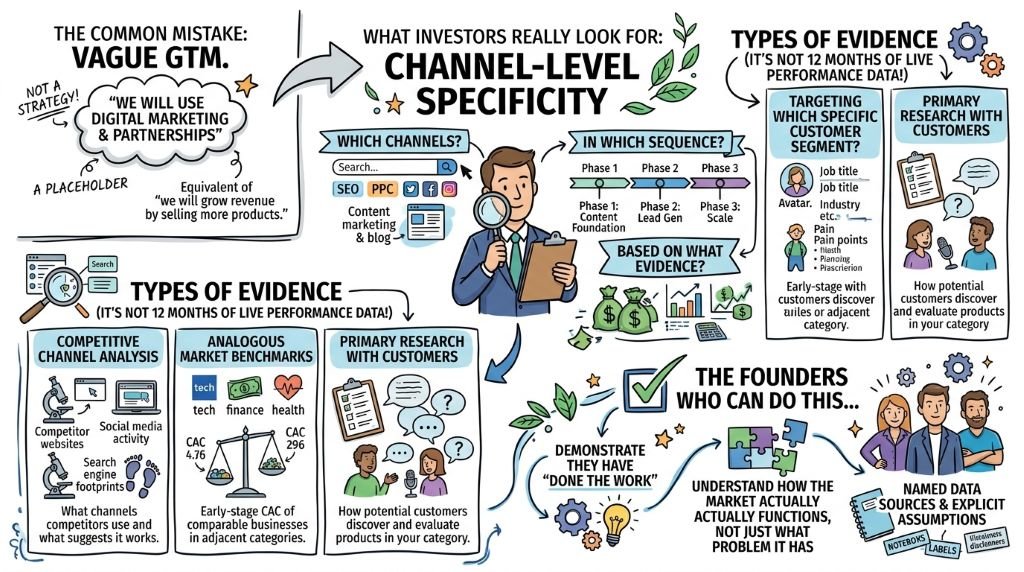
“We will use digital marketing and partnerships” is not a GTM strategy. It is a placeholder for one — the strategic equivalent of “we will grow revenue by selling more products.”
What investors are looking for is channel-level specificity: which channels, in which sequence, targeting which specific customer segment, at what estimated CAC, based on what evidence. The evidence does not need to be 12 months of live performance data. It can be competitive channel analysis (what channels are your direct competitors using and what does their digital footprint suggest about which are working), analogous market benchmarks (what CAC did comparable businesses in adjacent categories achieve at an early stage), or primary research with potential customers about how they discover and evaluate products in your category.
The founders who can walk an investor through a GTM channel strategy with that level of specificity — with data sources named and assumptions made explicit — are the founders who demonstrate that they have done the work to understand how their market actually functions, not just what problem it has.
Intelligence Element 5: Market Timing Evidence — Why Now Is the Right Moment for This Specific Business
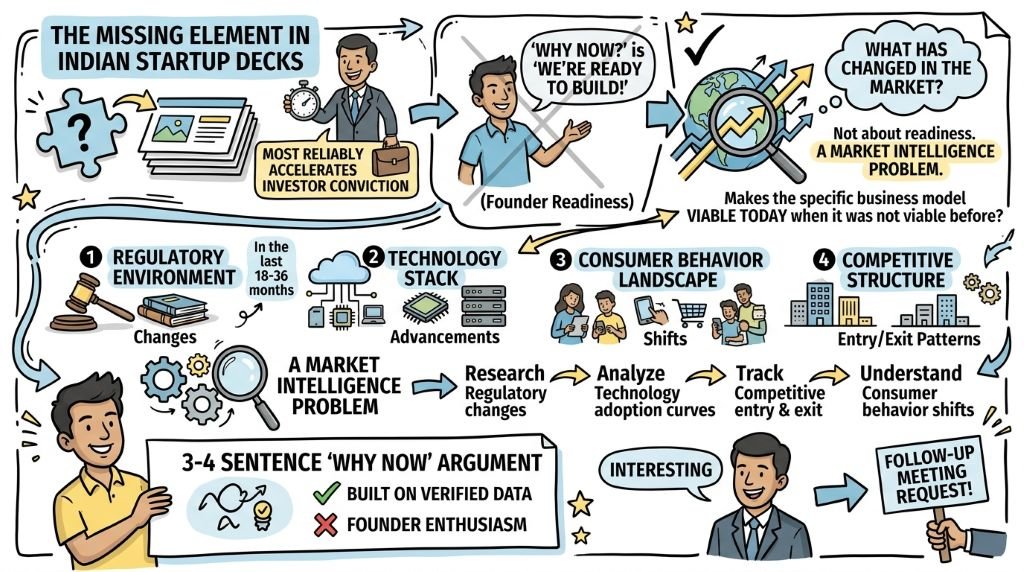
This is the intelligence element that is missing most consistently from Indian startup decks — and it is the one that, when present, most reliably accelerates investor conviction.
“Why now?” is not a question about your readiness to build. It is a question about the market: what has changed in the regulatory environment, the technology stack, the consumer behavior landscape, or the competitive structure in the last 18–36 months that makes this specific business model viable today when it was not viable before?
The answer to that question is a market intelligence problem. It requires research into regulatory changes, technology adoption curves, competitive entry and exit patterns, and consumer behavior shifts — the kind of research that produces a 3–4 sentence “why now” argument that is built on verified data rather than founder enthusiasm. That argument, when it is credible and specific, is often the single element that converts an investor’s “interesting” into a follow-up meeting request.
How to Build Investor-Grade Intelligence in 10–15 Days Without a ₹10 Lakh Budget
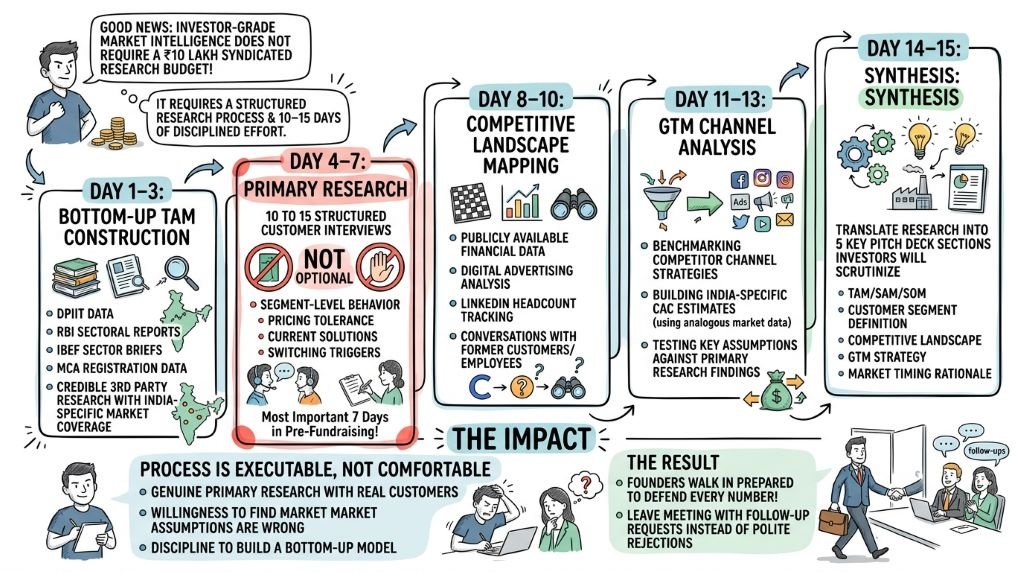
The good news is that investor-grade market intelligence does not require a ₹10 lakh syndicated research budget. It requires a structured research process and approximately 10–15 days of disciplined effort.
Day 1–3: Bottom-up TAM construction using India-specific secondary sources — DPIIT data, RBI sectoral reports, IBEF sector briefs, MCA registration data, and one or two credible third-party research publications with India-specific market coverage.
Day 4–7: Primary research — 10 to 15 structured customer interviews, specifically designed to surface segment-level behavior, pricing tolerance, current solutions, and switching triggers. This is not optional. It is the most important 7 days in any pre-fundraising research process.
Day 8–10: Competitive landscape mapping — using a combination of publicly available financial data, digital advertising analysis, LinkedIn headcount tracking, and, wherever possible, conversations with former customers or employees of direct competitors.
Day 11–13: GTM channel analysis — benchmarking competitor channel strategies, building India-specific CAC estimates by channel using analogous market data, and testing key assumptions against the primary research findings.
Day 14–15: Synthesis — translating the research into the 5 specific pitch deck sections that investors will scrutinize: TAM/SAM/SOM, customer segment definition, competitive landscape, GTM strategy, and market timing rationale.
This process is executable. It is not comfortable — it requires genuine primary research with real customers, a willingness to find out that your market assumptions are wrong before the investor finds out for you, and the discipline to build a bottom-up model when a top-down global figure would be faster to produce.
But the founders who do it are the ones who walk into investor meetings prepared to defend every number on every slide — and who leave those meetings with follow-up requests instead of polite rejections.
What To Do Next — Monday Morning Actions
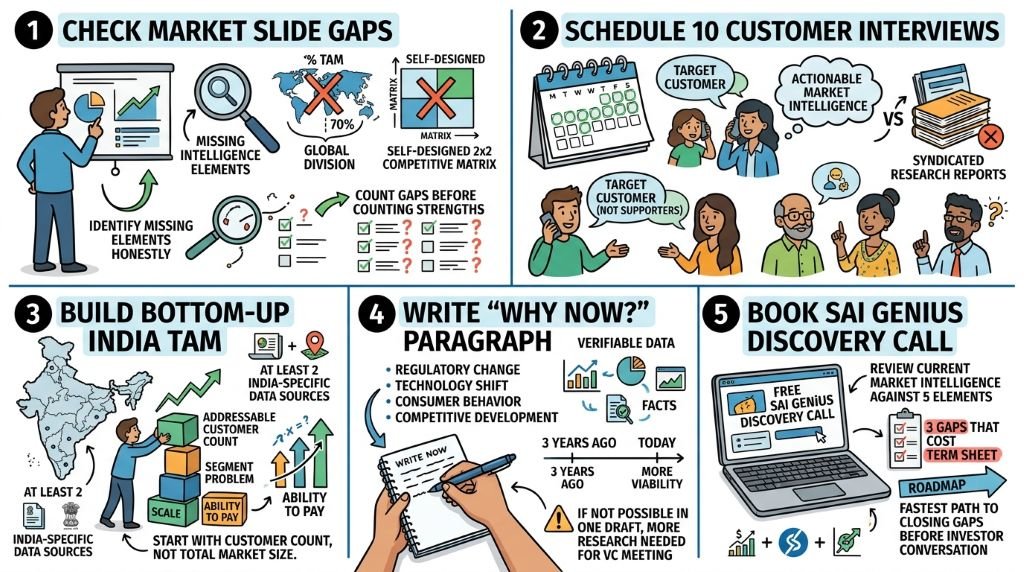
1. Pull up your current market slide and identify which of the 5 intelligence elements are missing. Be honest. If your TAM is a global figure divided by a percentage, it is missing. If your competitive slide is a 2×2 matrix you designed, it is missing. Count the gaps before you count the strengths.
2. Schedule 10 customer interviews for the next 2 weeks. Not conversations with people who already support you — conversations with the specific type of customer your business needs to acquire at scale. These 10 conversations will give you more actionable market intelligence than any syndicated research report.
3. Build a bottom-up India TAM using at least 2 India-specific data sources. Start with the addressable customer count — not the total market size, but the number of customers in your specific segment who have the problem your product solves, at the scale at which they can pay your price.
4. Write one paragraph answering “Why now?” using only verifiable data. What regulatory change, technology shift, consumer behavior evolution, or competitive development makes your business viable today in a way it was not 3 years ago? If you cannot write that paragraph in one draft, your market timing argument needs more research before it will hold up in a VC meeting.
5. Book a free SAI GENiUS discovery call. We will review your current market intelligence against the 5 elements in this article and give you a specific, prioritized research agenda — the 3 gaps that are most likely to cost you a term sheet, and the fastest path to closing each one before your next investor conversation.