advanced divider
India Market Trends
HealthTech

The Problem With a 7x Market in 9 Years

image

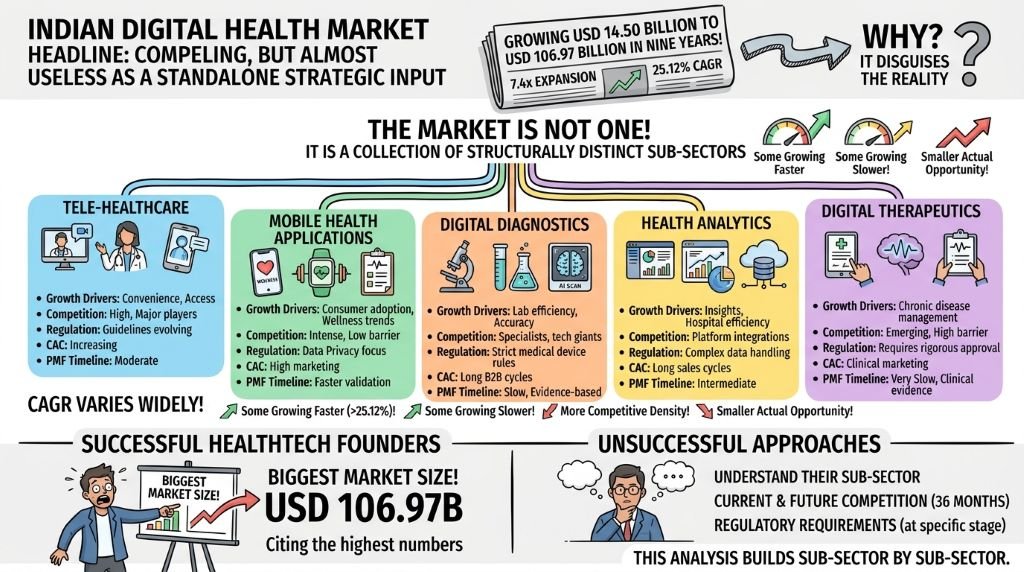
A market growing from USD 14.50 billion to USD 106.97 billion in nine years — a 7.4x expansion at a 25.12% CAGR — is a compelling headline. It is also, as a standalone strategic input, almost useless.

Here is why. The Indian digital health market,t at USD 106.97 billion by 20,33 is not one market. It is a collection of structurally distinct sub-sectors — tele-healthcare, mobile health applications, digital diagnostics, health analytics, and digital therapeutics — each with different growth drivers, different competitive structures, different regulatory environments, different customer acquisition economics, and different timelines to product-market fit. The CAGR that describes the aggregate market disguises the fact that some sub-sectors within it are growing at rates significantly higher than 25.12%, while others are growing more slowly, with significantly more competitive density, at a stage where the accessible opportunity for a new entrant is considerably smaller than the headline number suggests.

The HealthTech founders who are building for the right opportunity within India’s digital health market are not the ones who cited the highest market size in their pitch deck. They are the ones who understood which sub-sector they were actually in, what the competitive reality of that sub-sector looks like today and will look like in 36 months, and what the regulatory environment requires from a product at their specific stage of development.

That is the analysis this article builds — sub-sector by sub-sector.

advanced divider
India Market Trends
Sub-Sector 1: Tele-Healthcare — The Dominant Segment, and What Dominance Actually Means for Strategy
image

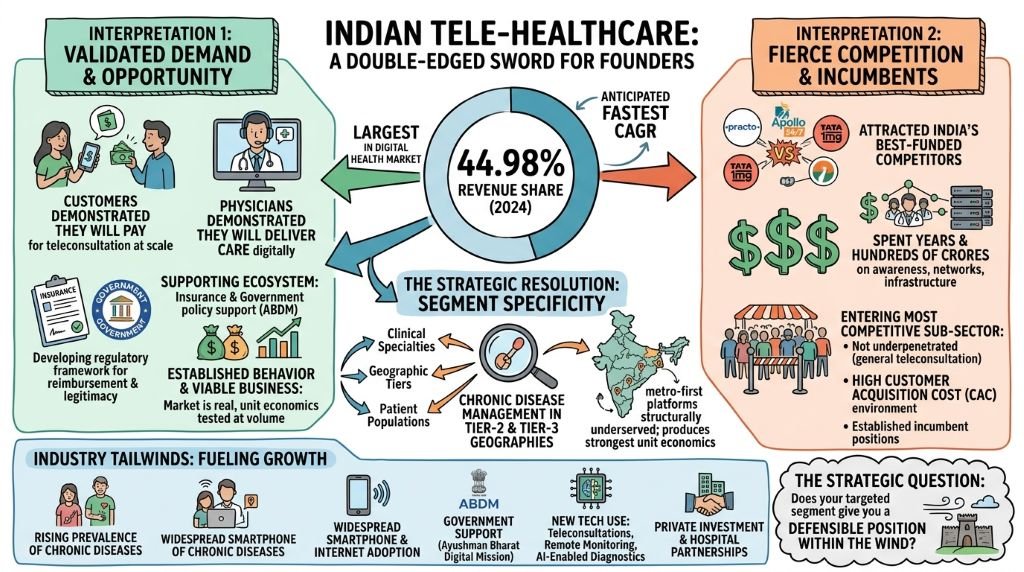
The tele-healthcare segment dominated the Indian digital health market with the largest revenue share of 44.98% in 2024 and is anticipated to grow at the fastest CAGR over the forecast period.

Nearly half of India’s entire digital health market revenue is concentrated in one sub-sector. For a HealthTech founder, that number requires two simultaneous and opposite interpretations.

The first interpretation is that tele-healthcare is where the validated demand is. Customers have demonstrated, at scale, that they will pay for teleconsultation services. Physicians have demonstrated that they will deliver care through digital platforms. Insurance companies and government payers have demonstrated, through ABDM integration and policy support, that the regulatory framework for reimbursement and legitimacy is developing. The market is real, the behavior is established, and the unit economics at the leading platforms have been tested at significant volume.

The second interpretation is that 44.98% revenue share, growing at the fastest CAGR in the sector, with government tailwind and established consumer behavior, is a description of a market that has already attracted India’s best-funded competitors. Practo, Apollo 24/7, Tata 1mg, and a cohort of well-capitalized challengers have spent years and hundreds of crores building consumer awareness, physician networks, and technology infrastructure in this sub-sector. A new entrant in general teleconsultation is not entering an underpenetrated market. They are entering the most competitive sub-sector in Indian digital health with the highest CAC environment and the most established incumbent positions.

The strategic resolution is segment specificity within tele-healthcare — not the general teleconsultation market, but specific clinical specialties, specific geographic tiers, or specific patient populations where the incumbent platforms have structural limitations. The largest of those opportunities, validated by the data, is chronic disease management in Tier-2 and Tier-3 geographies — a segment that the metro-first platforms are structurally underserving and that produces the strongest unit economics in the sub-sector.

Growth in tele-healthcare is driven by rising chronic disease prevalence, widespread smartphone and internet adoption, and government support through the Ayushman Bharat Digital Mission. Increasing use of teleconsultations, remote monitoring, and AI-enabled diagnostics, along with private sector investments and hospital partnerships, is accelerating adoption. These are the tailwinds. The strategic question for a new entrant is not whether the tailwinds are real — they are — but whether the specific segment they are targeting gives them a defensible position within the wind.


advanced divider
India Market Trends
Sub-Sector 2: The Diabetes Opportunity — Why the Largest Application Segment Is Also the Most Structurally Important
image

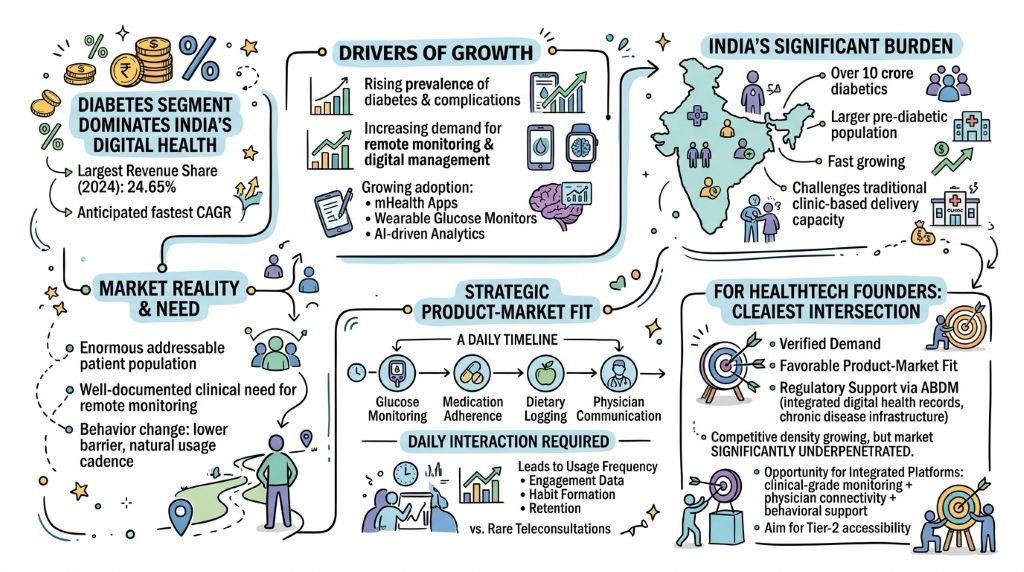
The diabetes segment dominated the Indian digital health market with the largest revenue share of 24.65% in 2024 and is anticipated to grow at the fastest CAGR over the forecast period. This growth is driven by the rising prevalence of diabetes and related complications in India, increasing demand for remote monitoring and digital disease management solutions, and growing adoption of mHealth apps, wearable glucose monitors, and AI-driven analytics.

India’s diabetes burden is one of the most significant public health challenges in the country, with over 10 crore diabetics and a substantially larger pre-diabetic population that is growing faster than the healthcare system’s capacity to manage it through traditional clinic-based delivery. The scale of this burden is simultaneously a health crisis and a market reality: the addressable patient population for digital diabetes management solutions is enormous, the clinical need for remote monitoring and ongoing management support is well-documented, and the behavior change required to adopt digital tools is, for chronic disease patients, lower than for acute care applications because the ongoing management need creates a natural usage cadence.

What makes the diabetes segment strategically distinct is not just its size but its product-market fit characteristics. A patient managing diabetes requires daily interaction with their management tools — glucose monitoring, medication adherence, dietary logging, physician communication. This creates the usage frequency that produces both the engagement data to improve the product and the habit formation that drives retention. Most digital health applications struggle with the usage frequency problem: a patient who uses a teleconsultation app twice a year generates very different retention economics than one who uses a chronic disease management platform daily. The diabetes segment produces the latter.

For HealthTech founders, the diabetes segment is the clearest intersection of verified demand, favorable product-market fit dynamics, and regulatory support through the ABDM’s push toward integrated digital health records and chronic disease management infrastructure. The competitive density within diabetes-specific digital health is growing — but relative to the size of the addressable patient population, the market remains significantly underpenetrated by solutions that combine clinical-grade monitoring, physician connectivity, and behavioral support in an integrated platform accessible to Tier-2 patients.

advanced divider
India Market Trends
Sub-Sector 3: mHealth — High Volume, Complex Economics, and the Platform Trap
image

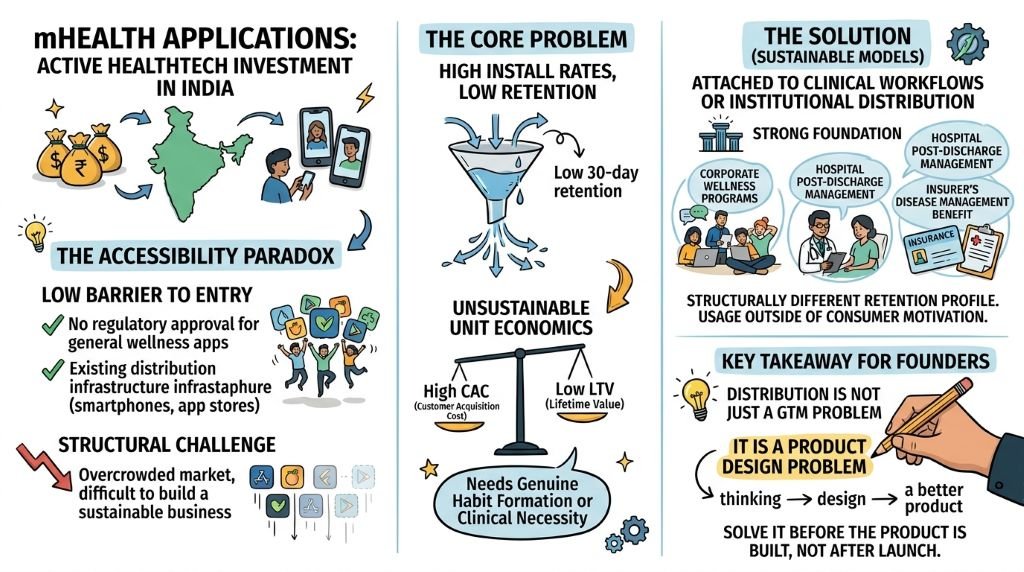
Mobile health applications represent one of the most active areas of HealthTech investment in India — and one of the most difficult product categories to build a sustainable business in. The barrier to entry is low: building an mHealth application requires no regulatory approval for general wellness applications, and the distribution infrastructure (the smartphone and app store ecosystem) is already in place at scale. This accessibility is both an opportunity and a structural challenge.

The mHealth market in India has an abundance of applications and a scarcity of applications with strong retention economics. Most wellness-oriented mHealth apps face the same structural problem: high install rates, low 30-day retention, and a CAC-to-LTV ratio that produces unsustainable unit economics unless the product finds a usage model that creates genuine habit formation or clinical necessity.

The mHealth applications that have demonstrated sustainable economics in India share a common characteristic: they are attached to a clinical workflow or an institutional distribution channel that generates usage outside of consumer-initiated engagement. An mHealth application distributed through a corporate wellness program, a hospital’s post-discharge management protocol, or an insurer’s disease management benefit has a structurally different retention profile than one dependent entirely on consumer motivation to self-manage. For HealthTech founders building in mHealth, the distribution strategy is not a GTM problem — it is a product design problem, and it needs to be solved before the product is built, not after it is launched.

advanced divider
GTM Strategy
Sub-Sector 4: Health Analytics and Digital Diagnostics — The Infrastructure Layer
image

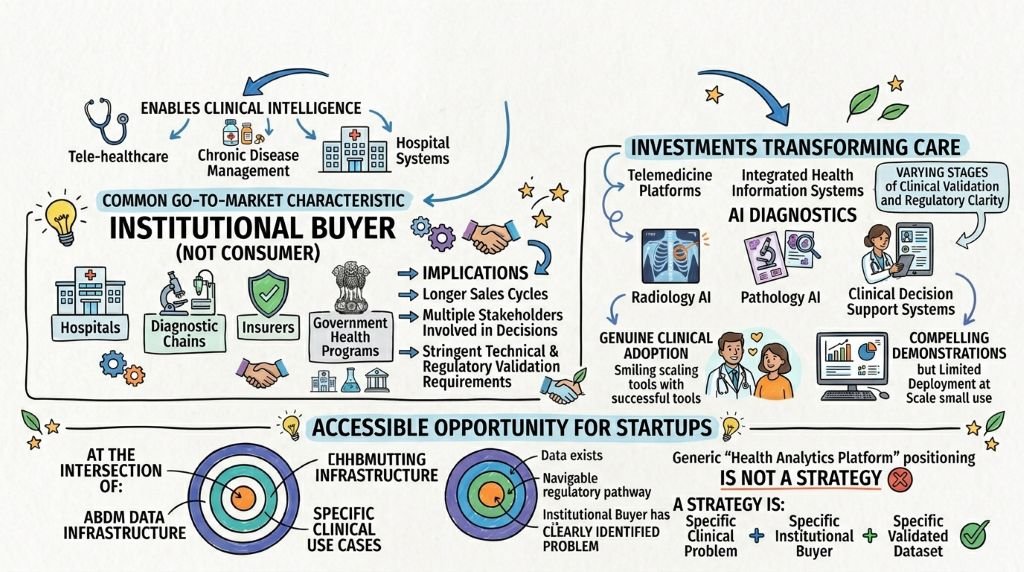
Health analytics and digital diagnostics represent the infrastructure layer of India’s digital health market — the sub-sectors that enable the clinical intelligence that tele-healthcare, chronic disease management, and hospital systems increasingly depend on.

These sub-sectors share a common go-to-market characteristic: the buyer is institutional rather than consumer. Hospitals, diagnostic chains, insurers, and government health programs are the primary customers, which means sales cycles are longer, procurement decisions involve multiple stakeholders, and the technical and regulatory validation requirements are more stringent than in consumer-facing sub-sectors.

Investments in telemedicine platforms, AI diagnostics, and integrated health information systems are transforming hospitals, primary care, and remote care. AI-enabled diagnostic tools — radiology AI, pathology AI, and clinical decision support systems — are at varying stages of clinical validation and regulatory clarity in India, and the distinction between applications that are generating genuine clinical adoption and those that are generating compelling demonstrations but limited deployment at scale is critical for any founder or investor evaluating the space.

The accessible opportunity in health analytics for startups is most clearly defined at the intersection of ABDM data infrastructure and specific clinical use cases where the data exists, the regulatory pathway is navigable, and the institutional buyer has a clearly identified problem the product solves. Generic “health analytics platform” positioning in this sub-sector is not a strategy. Specific clinical problem, specific institutional buyer, specific validated dataset — that is.

advanced divider
India Market Trends
The 3 Sub-Sectors With the Largest Accessible Opportunity Relative to Current Competitive Density
image

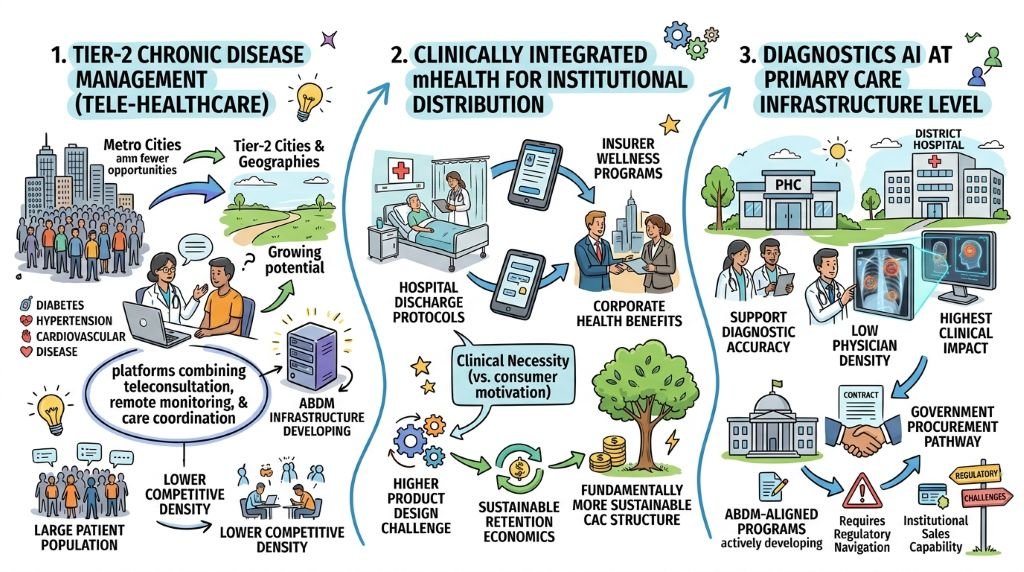
Synthesizing the sub-sector analysis, the three areas where the combination of verified demand, manageable competitive density, and favorable regulatory environment creates the most accessible opportunity for well-positioned HealthTech startups in 2026 are:

First, Tier-2 chronic disease management within tele-healthcare — specifically platforms combining teleconsultation, remote monitoring, and care coordination for diabetes, hypertension, and cardiovascular disease in geographies where the metro-first platforms are structurally underserving. The patient population is large, the ABDM infrastructure is developing to support it, and the competitive density relative to the addressable market is significantly lower than in metro general teleconsultation.

Second, clinically integrated mHealth for institutional distribution — applications built into hospital discharge protocols, insurer wellness programs, or corporate health benefits that generate usage through clinical necessity rather than consumer motivation. The product design challenge is higher, but the retention economics and CAC structure are fundamentally more sustainable.

Third, diagnostics AI at primary care infrastructure level — AI tools that support diagnostic accuracy at the level of primary healthcare centers and district hospitals, where physician density is lowest and diagnostic support has the highest clinical impact. This market requires regulatory navigation and institutional sales capability, but the underservice is structural and the government procurement pathway through ABDM-aligned programs is actively developing.

advanced divider
India Market Trends
HealthTech
What To Do Next — Monday Morning Actions
image

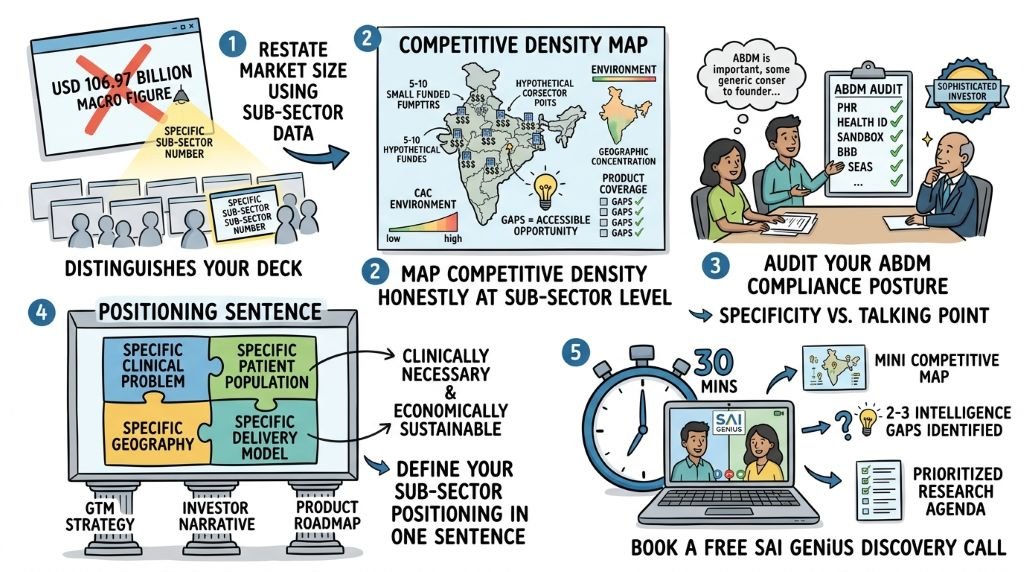
1. Restate your market size using sub-sector data, not the macro figure. Replace “India digital health market USD 106.97 billion by 2033” in your pitch deck with the specific sub-sector number that describes the market you are actually building in. That specificity will immediately distinguish your deck from the majority.

2. Map your competitive density honestly at the sub-sector level. Who are the 5–10 best-funded competitors in your specific sub-sector, not the broader digital health category? What is their CAC environment, their geographic concentration, and their product coverage? The gaps in that map are your accessible opportunity.

3. Audit your ABDM compliance posture before your next investor meeting. The ABDM is the sector’s most significant regulatory development — and the gap between founders who can speak to it with specificity and those who treat it as a talking point is immediately visible to any sophisticated HealthTech investor.

4. Define your sub-sector positioning in one sentence. Not “we are building in India’s digital health market.” The specific clinical problem, the specific patient population, the specific geography, and the specific delivery model make your product both clinically necessary and economically sustainable. That sentence is the foundation of your GTM strategy, your investor narrative, and your product roadmap.

5. Book a free SAI GENiUS discovery call. In 30 minutes, we will map your specific sub-sector’s competitive landscape, identify the 2–3 most relevant market intelligence gaps for your current stage, and give you a prioritized research agenda before the call ends.

Related Posts