


The Number Behind the Number
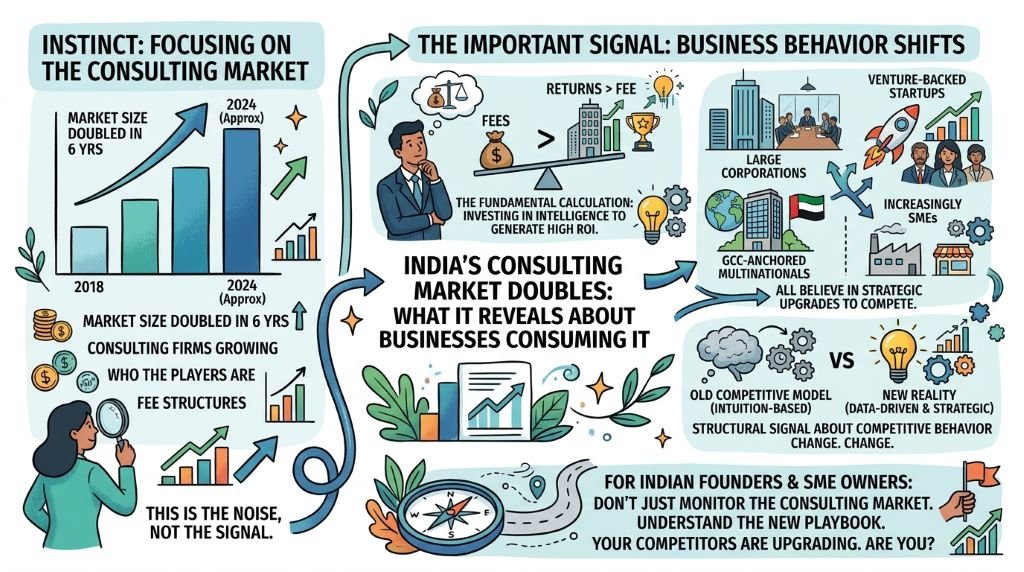
When a market doubles in six years, the instinct is to focus on the market itself — who the buyers are, which firms are growing, and how fees are changing. But the more important signal for an Indian founder or SME owner is not what is happening in the consulting market. It is what the consulting market’s growth tells you about what the businesses consuming it are doing.
India’s consulting market does not grow in a vacuum. It grows because businesses — large corporations, venture-backed startups, GCC-anchored multinationals, and now increasingly SMEs — are paying for intelligence that they believe will generate returns greater than the fee. When the market doubles, it means the universe of businesses that believe that calculation is worth making has approximately doubled. That is a structural signal about competitive behavior — and it is one of the most important market shifts that most Indian business owners are not monitoring.
Here is what the data is actually telling you.
Implication 1: The Intelligence Gap Between Corporations and SMEs Is Getting Larger — But the Closing Window Is Now Open
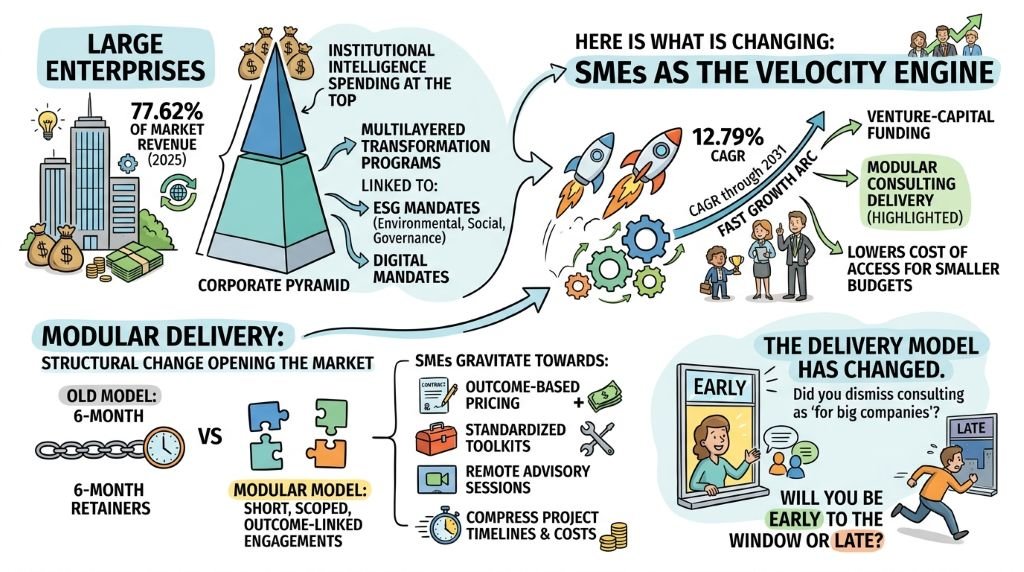
Large enterprises contributed 77.62% of India’s management consulting services market revenue in 2025, underpinned by multilayered transformation programs linked to ESG and digital mandates. That means the vast majority of institutional intelligence spending in India is happening at the top of the corporate pyramid — and has been for years.
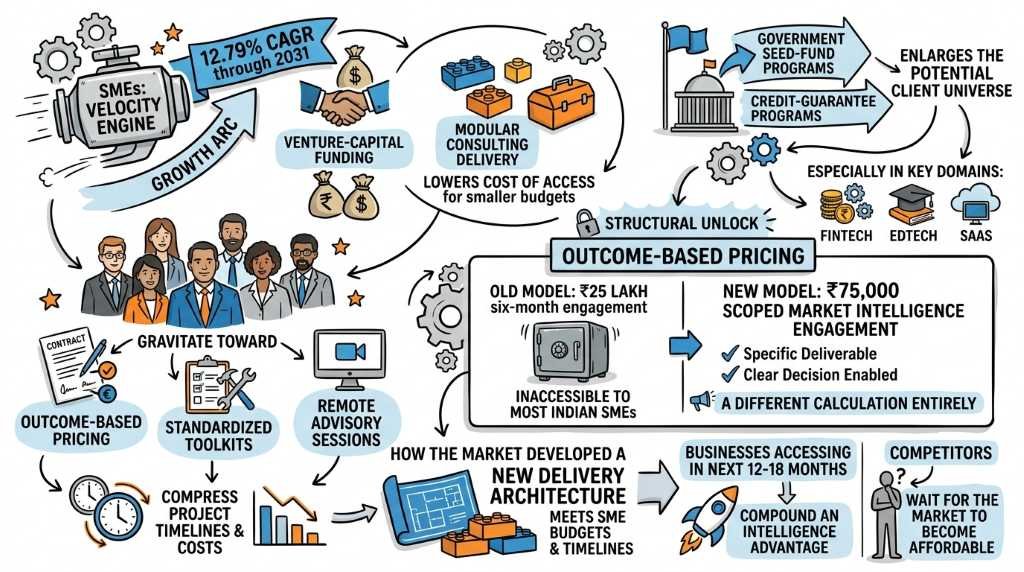
Here is what is changing: 6SMEs are the velocity engine, posting a 12.79% CAGR through 2031, a growth arc supported by venture-capital funding and modular consulting delivery that lowers the cost of access for smaller budgets. SMEs gravitate toward outcome-based pricing, standardized toolkits, and remote advisory sessions that compress project timelines and costs.
Modular delivery — short, scoped, outcome-linked engagements rather than 6-month retainers — is the structural change that is opening the market. If you are an Indian SME owner who has dismissed consulting as “for the big companies,” the delivery model has changed. The question is whether you will be early to the window or late.
Implication 2: Your Largest Competitors Are Shifting Budget From IT Maintenance to Transformation — and the Gap Is Compounding
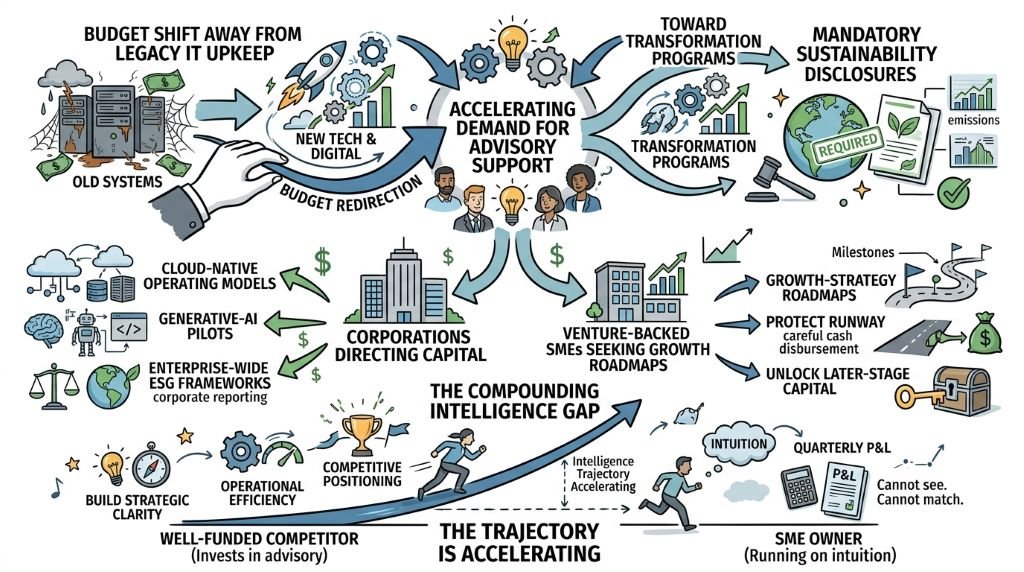
A decisive budget shift away from legacy information-technology upkeep toward transformation programs, coupled with mandatory sustainability disclosures, is accelerating demand for advisory support. Corporations are directing capital into cloud-native operating models, generative-AI pilots, and enterprise-wide ESG frameworks, while venture-backed SMEs seek growth-strategy roadmaps that protect runway and unlock later-stage capital.
The compounding effect here is underappreciated. Every quarter that a well-funded competitor invests in transformation advisory is a quarter they are building strategic clarity, operational efficiency, and competitive positioning that an SME owner running on intuition and quarterly P&L reviews cannot see and cannot match. The intelligence gap is not just a snapshot — it is a trajectory, and the trajectory is accelerating.
Implication 3: Strategy Consulting's 31.50% Market Share Tells You Exactly Where Your Competitors' Priorities Are
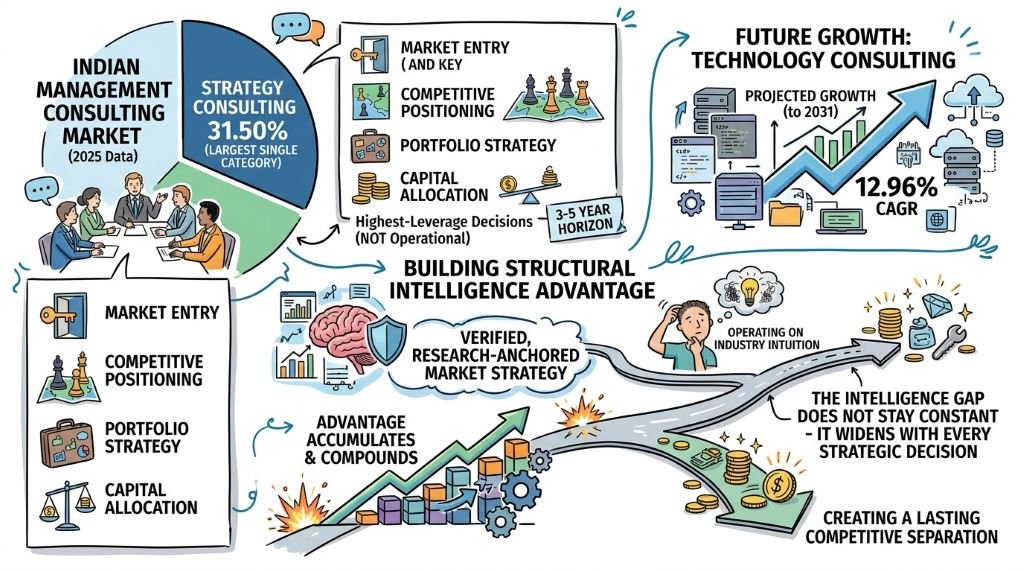
By service type, strategy consulting commanded 31.50% of the Indian management consulting services market share in 2025, whereas technology consulting is projected to grow at a 12.96% CAGR to 2031.
Strategy consulting being the largest single category means that the primary spend in India’s intelligence market is on the highest-leverage decisions — market entry, competitive positioning, portfolio strategy, and capital allocation. These are not operational problems. They are the decisions that determine whether a business is in the right market, competing for the right customers, and deploying capital in the right direction over a 3–5 year horizon.
The businesses’ commissioning strategy consulting is not just about solving today’s problem. They are building a structural intelligence advantage that accumulates over time. When one company has a verified, research-anchored market strategy and a competitor is operating on industry intuition, the gap does not stay constant — it compounds with every strategic decision made from that foundation.
Implication 4: Technology Consulting's 12.96% CAGR Means Architectural Decisions Are Now Competitive Strategy
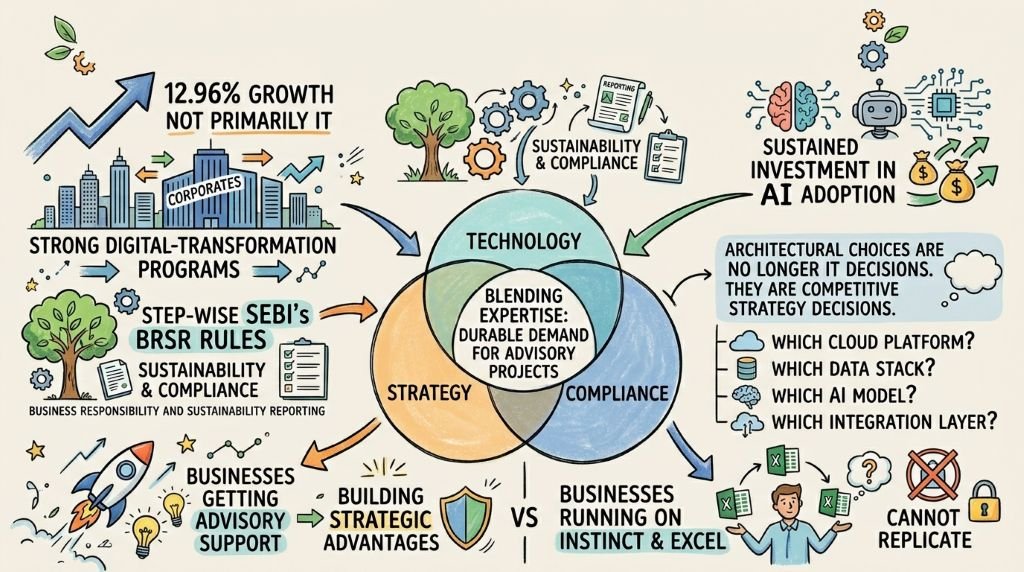
Technology consulting, growing at 12.96,% is not primarily a story about IT. It is a story about the fact that 6strong digital-transformation programs among large corporates, the step-wise rollout of SEBI’s Business Responsibility and Sustainability Reporting (BRSR) rules, and sustained investment in artificial-intelligence (AI) adoption create durable demand for advisory projects that blend technology, strategy, and compliance expertise.
The blending of technology, strategy, and compliance in a single engagement category is the key phrase. Architectural choices — which cloud platform, which data stack, which AI model, which integration layer — are no longer IT decisions. They are competitive strategy decisions. And the businesses that are getting advisory support for those decisions are building strategic advantages that businesses running on Excel spreadsheets and instinct cannot replicate.
Implication 5: Healthcare and Life Sciences' 13.88% CAGR Is the Fastest in the Market — and It Tells You Where the Regulatory and Competitive Pressure Is Highest
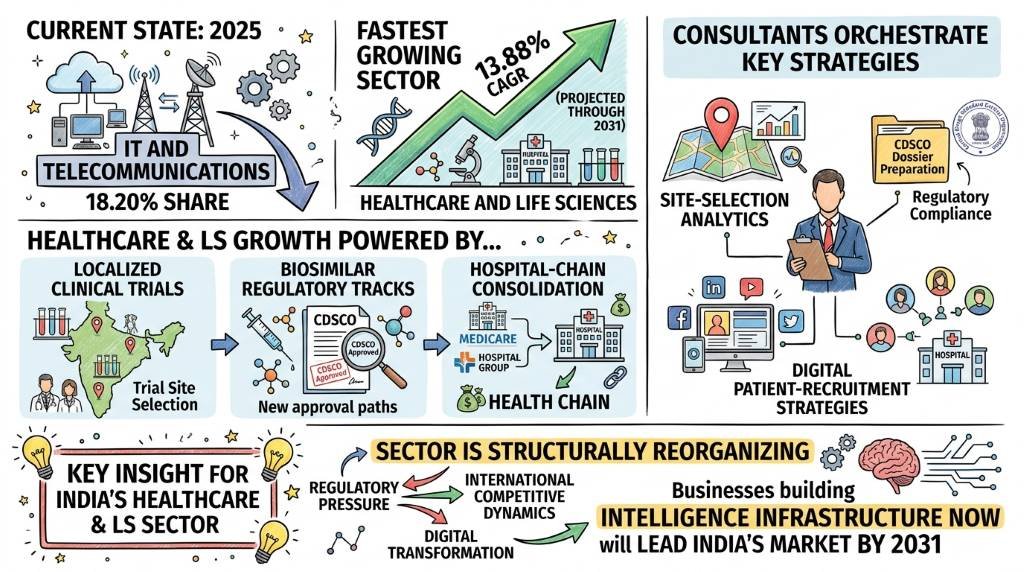
By end-user industry, IT and telecommunications controlled 18.20% share in 2025, yet healthcare and life sciences are advancing at a 13.88% CAGR to 2031. 1 Healthcare and life sciences lead the growth league at 13.88% CAGR through 2031, powered by localized clinical trials, biosimilar regulatory tracks, and hospital-chain consolidation. Consultants orchestrate site-selection analytics, Central Drugs Standard Control Organisation dossier preparation, and digital patient-recruitment strategies.
If you are building in healthcare or life sciences in India, this is the most important data point in this article. The sector is not just growing — it is structurally reorganizing under regulatory pressure, international competitive dynamics, and digital transformation simultaneously. The businesses that will lead India’s healthcare market by 2031 are the ones building the intelligence infrastructure to navigate all three forces right now.
Implication 6: The GCC Effect Is Creating a B2B Advisory Opportunity That Most Indian Businesses Have Not Priced Into Their Strategy
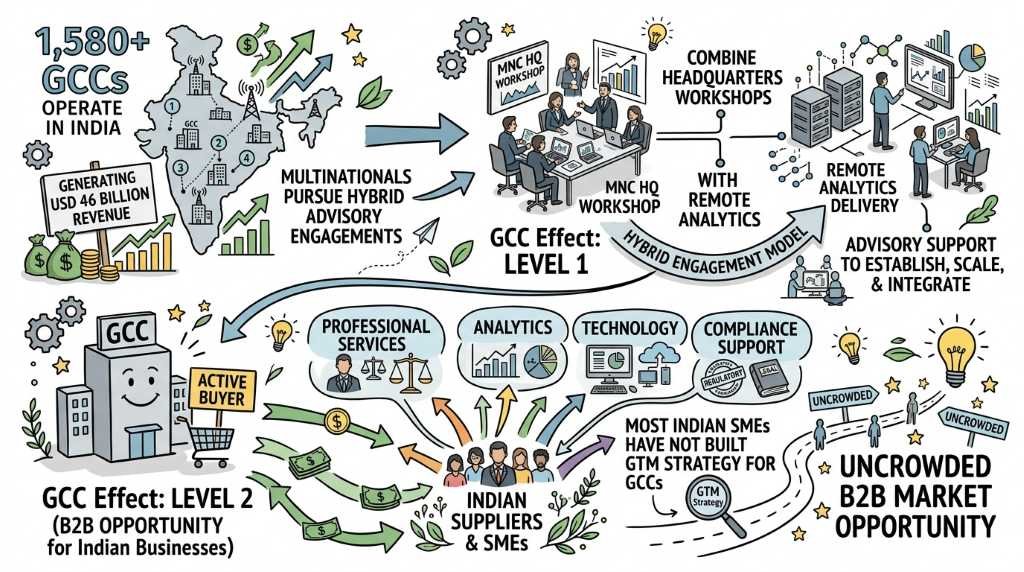
More than 1,580 global capability centers already operate in India, prompting multinationals to pursue hybrid advisory engagements that combine headquarters workshops with remote analytics delivery. 6 Parallel momentum comes from GCCs that now exceed 1,580 sites, generating USD 46 billion in revenue and demanding hybrid engagement models with implementation depth.
The GCC effect operates on two levels. First, it is a direct driver of consulting demand — multinationals need advisory support to establish, scale, and integrate capability centers. Second, and more importantly for Indian businesses, it is a B2B market opportunity. GCCs are active buyers of professional services, analytics, technology, and compliance support from Indian suppliers. Most Indian SMEs have not built a go-to-market strategy for this buyer segment — which means the opportunity is relatively uncrowded.
Implication 7: ESG Compliance Is Becoming a Market-Access Requirement — Not a Nice-to-Have
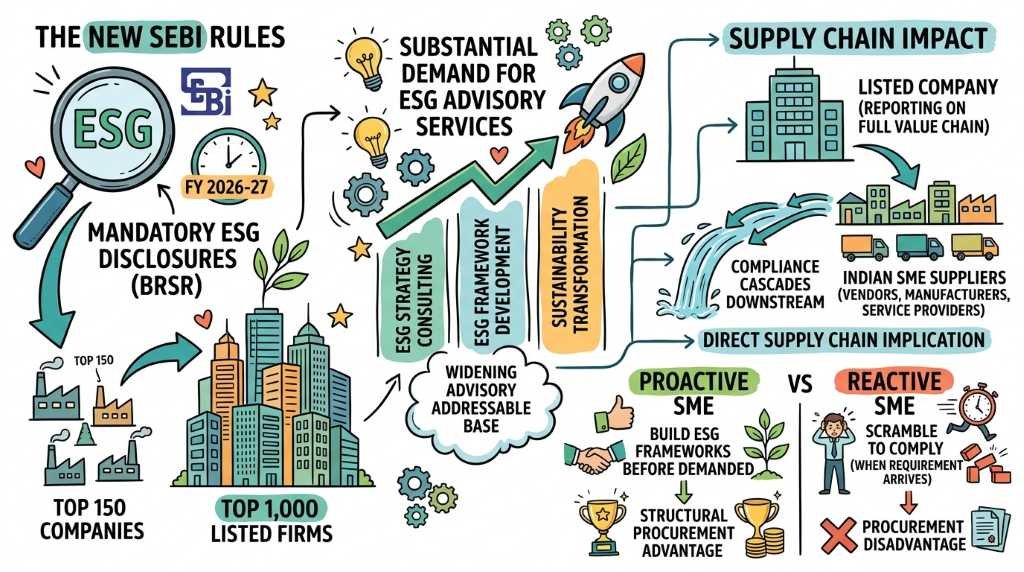
Mandatory ESG disclosures are widening the advisory addressable base from the top 150 companies to the full cohort of 1,000 listed firms by FY 2026-27. 10 SEBI has mandated significantly tightened ESG disclosure requirements, with the top 1,000 listed companies now required to submit Business Responsibility and Sustainability Reports. This regulatory evolution creates substantial demand for ESG strategy consulting and ESG framework development, driving the need for sustainability transformation services.
For Indian SMEs that supply listed companies — as vendors, manufacturers, or service providers — this is a direct supply chain implication. As listed companies are required to report on their full value chain’s ESG compliance, the compliance requirement will cascade downstream to their suppliers. The businesses that build ESG frameworks before they are demanded by clients will have a structural procurement advantage over those that scramble to comply when the requirement arrives.
Implication 8: Outcome-Based Pricing Is the Structural Change That Makes This Market Accessible — Right Now
SMEs are the velocity engine, posting a 12.79% CAGR through 2031, a growth arc supported by venture-capital funding and modular consulting delivery that lowers the cost of access for smaller budgets. SMEs gravitate toward outcome-based pricing, standardized toolkits, and remote advisory sessions that compress project timelines and costs. Government seed-fund and credit-guarantee programs enlarge the potential client universe, especially in fintech, edtech, and software-as-a-service domains.
Outcome-based pricing is the structural unlock. A ₹25 lakh six-month engagement is inaccessible to most Indian SMEs. A ₹75,000 scoped market intelligence engagement with a specific deliverable and a clear decision it enables — that is a different calculation entirely. The market has not changed its price point uniformly. It has developed a new delivery architecture that meets SME budgets and timelines. The businesses that access this architecture in the next 12–18 months will compound an intelligence advantage while their competitors wait for the market to become affordable.
What To Do Next — Monday Morning Actions
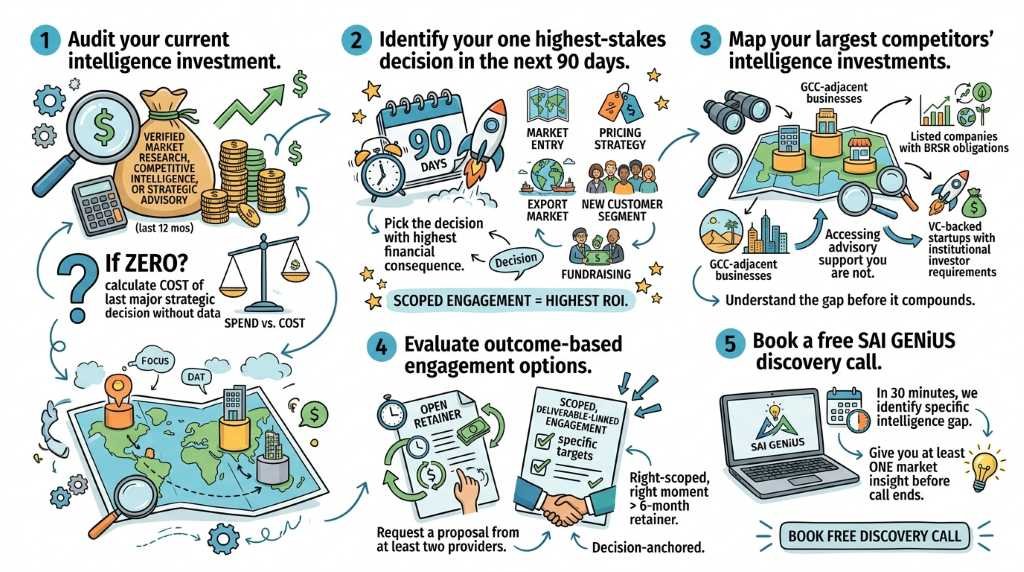
1. Audit your current intelligence investment. How much did your business spend on verified market research, competitive intelligence, or strategic advisory in the last 12 months? If the answer is zero, calculate the cost of the last major strategic decision you made without verified data. That is the cost of the gap.
2. Identify your one highest-stakes decision in the next 90 days. Market entry, pricing strategy, new customer segment, export market, fundraising — pick the decision with the highest financial consequence. That is where a scoped market intelligence engagement delivers the highest ROI.
3. Map your largest competitors’ intelligence investments. Are they GCC-adjacent businesses? Listed companies with BRSR obligations? VC-backed startups with institutional investor requirements? If yes, they are almost certainly accessing advisory support that your business is not. Understand the gap before it compounds further.
4. Evaluate outcome-based engagement options. Request a proposal from at least two research or advisory providers structured as scoped, deliverable-linked engagements rather than open retainers. The ₹15 lakh consulting engagement is not the only entry point — and the right-scoped engagement at the right moment is worth more than a retainer that runs for six months without a specific decision to anchor it.
5. Book a free SAI GENiUS discovery call. In 30 minutes, we will identify the specific intelligence gap most relevant to your current strategic decision — and give you at least one market insight relevant to your sector before the call ends.
Related Posts
Why Ahmedabad Is Becoming India’s Most Underrated Business Intelligence Hub and What That Means for Every Gujarat Business Owner.
Every Gujarat-based founder, MSME owner, and business builder who has assumed that high-quality strategic intelligence…

The India GTM Velocity Framework™: How to Sequence Market Entry Across Tier-1, Tier-2, and Tier-3 India and Why the Sequence Matters More Than the Market.
Why Sequence Is the Problem Most Founders Do Not Recognise As One

India’s Digital Health Market Is Heading to USD 106.97 Billion by 2033. Here Is What HealthTech Founders Actually Need to Know About the Opportunity and the Risk.
Tele-Healthcare — The Dominant Segment, and What Dominance Actually Means for Strategy