


advanced divider
INDIA MARKET TRENDS
GTM STRATEGY

Why Sequence Is the Problem Most Founders Do Not Recognise As One

image

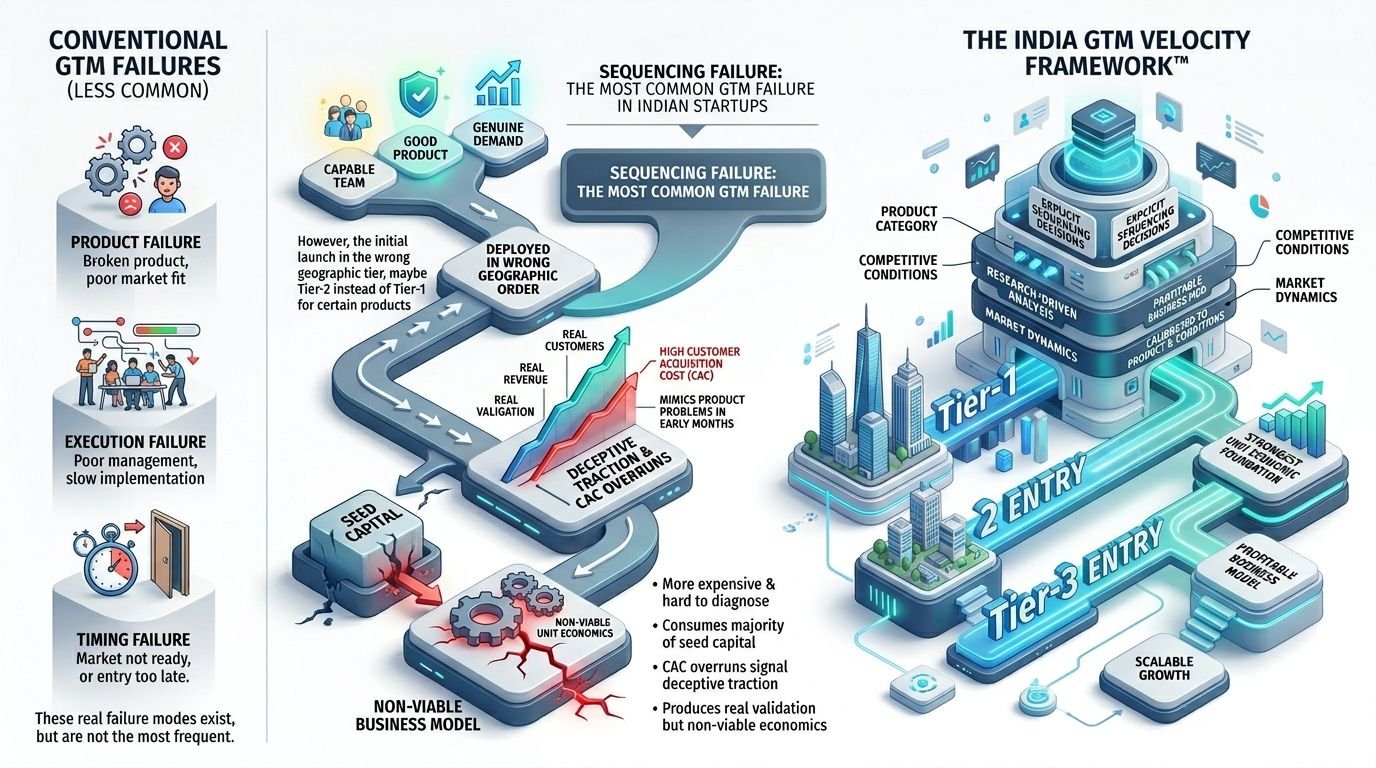
When Indian startup GTM strategies underperform, the failure is attributed to product, execution, or timing. These are real failure modes, but they are not the most common ones. The most common GTM failure in the Indian startup ecosystem is sequencing failure: a product that works, executed by a capable team, in a market with genuine demand, deployed in the wrong geographic order.

Sequencing failure is both more expensive and harder to diagnose than conventional failure modes. It consumes the majority of seed capital before it is identified. CAC overruns that signal a sequencing problem look identical, in their early months, to overruns that signal a product problem. And it produces real customers, real revenue, and real product validation all at a CAC that makes the business model non-viable.

The India GTM Velocity Framework™ makes sequencing decisions explicit, research-driven, and calibrated to the specific product category and competitive conditions that determine whether Tier-1, Tier-2, or Tier-3 entry produces the strongest unit economic foundation.

advanced divider
INDIA MARKET TRENDS

The Four Sequencing Dimensions

image

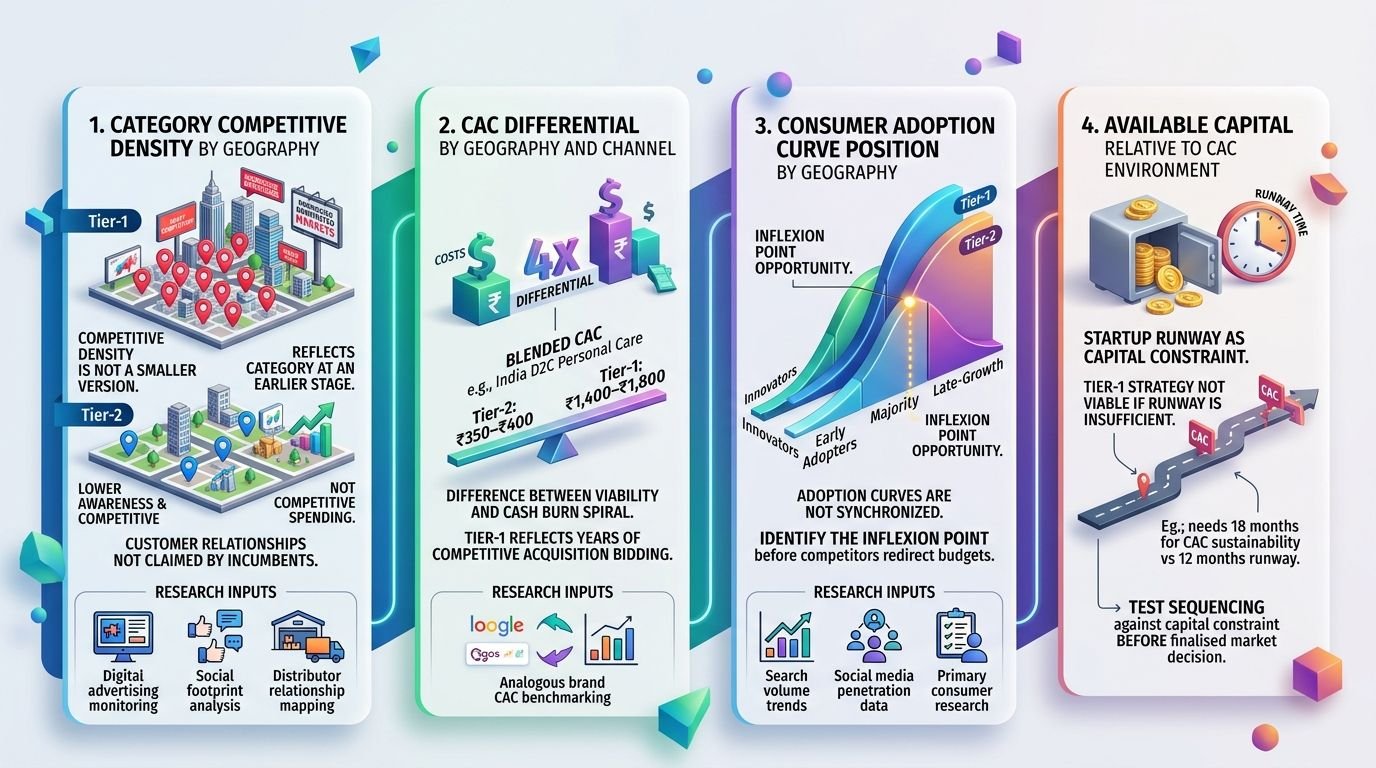
The framework assesses market entry sequence across four dimensions each independently researchable before launch.

 Category Competitive Density by Geography. Competitive density is not a smaller version of the same landscape in Tier-2. It reflects the same category at an earlier stage of development, lower awareness, lower competitive spending, and customer relationships not yet claimed by well-capitalised incumbents. Research input: competitive presence mapping using digital advertising monitoring, social footprint analysis, and distributor relationship mapping.

CAC Differential by Geography and Channel. The blended CAC for a D2C personal care brand in Tier-2 India runs ₹350–₹400, against ₹1,400–₹1,800 in Tier-1 — a 4x differential that is the difference between a viable unit economic model and a guaranteed cash burn spiral. This differential exists across most consumer categories because Tier-1 markets reflect years of competitive acquisition bidding that Tier-2 markets have not yet experienced. Research input: analogous brand CAC benchmarking by geography and channel.

Consumer Adoption Curve Position by Geography. Adoption curves are not synchronised across India’s city tiers. A category in late-growth in Tier-1 is often in early-growth in Tier-2, creating a sequencing opportunity for founders who can identify that inflexion point before funded Tier-1 competitors redirect their acquisition budgets. Research input: search volume trends, social media penetration data, and primary research with Tier-2 consumers in the target category.

Available Capital Relative to CAC Environment. A Tier-1-first strategy requiring 18 months to reach CAC sustainability is not viable for a startup with 12 months of runway. The sequencing decision must be tested against the capital constraint before the market decision is finalised.

advanced divider
INDIA MARKET TRENDS

The 5 Category Types Where Tier-2-First Produces 40–60% Better Unit Economics

image

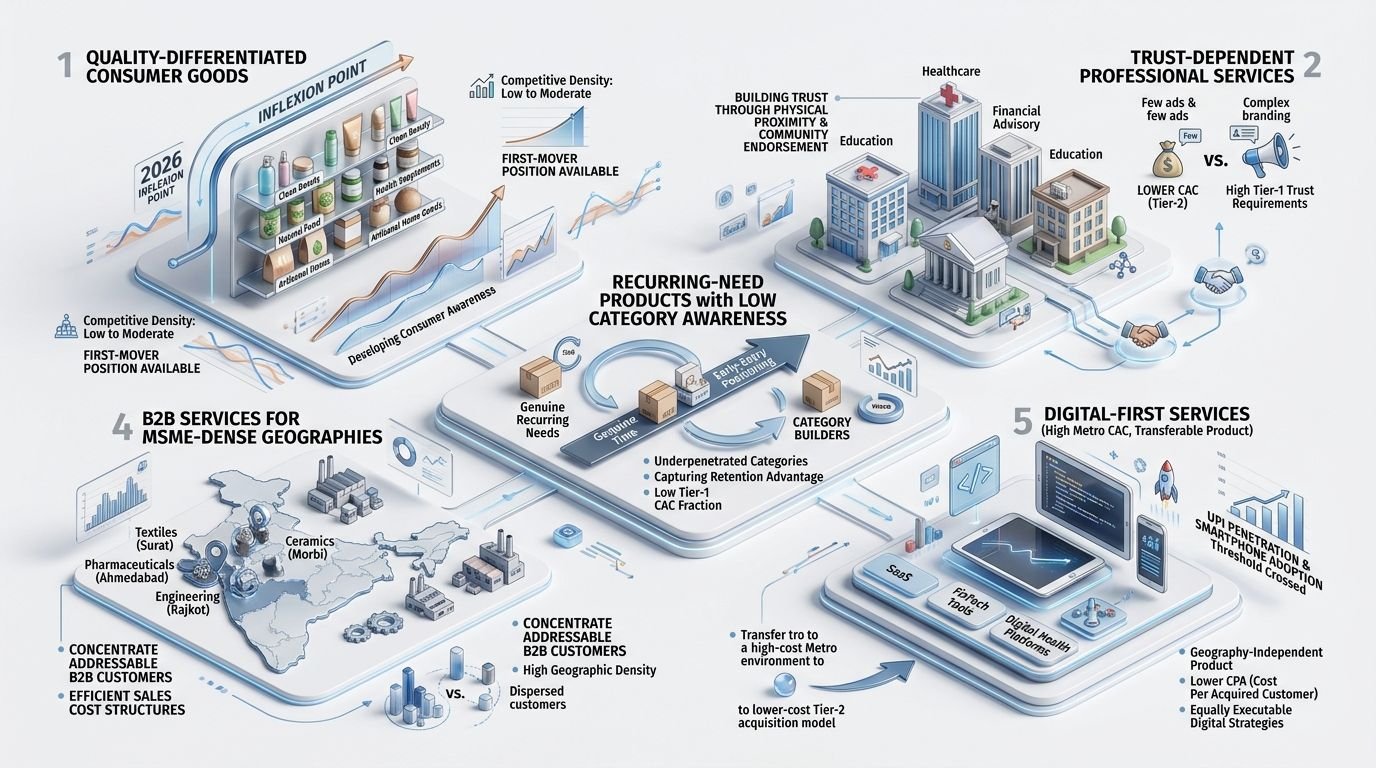
Quality-Differentiated Consumer Goods. Clean beauty, natural food, health supplements, and artisanal home goods are at the precise Tier-2 inflexion point in 2026, where consumer awareness of quality differentiation is developing, and competitive density has not yet made first-mover positioning unavailable.

Trust-Dependent Professional Services. Healthcare, financial advisory, legal services, and education build trust in Tier-2 through physical proximity and community endorsement dynamics that produce significantly lower CAC than the brand advertising and institutional reputation-building that Tier-1 trust requires.

Recurring-Need Products With Low Category Awareness. Products addressing genuine recurring needs in underpenetrated Tier-2 categories benefit from early-entry positioning as category builders, capturing the retention advantage of category leadership at a fraction of Tier-1 CAC.

B2B Services for MSME-Dense Geographies. India’s industrial clusters — textiles in Surat, ceramics in Morbi, pharmaceuticals in Ahmedabad, engineering in Rajkot concentrate addressable B2B customers at a geographic density that makes sales cost structures fundamentally more efficient than in metros, where the same customer volume is dispersed.

Digital-First Services With High Metro CAC and Transferable Product. For SaaS, FinTech tools, and digital health platforms where the product is geography-independent but the acquisition environment is not, UPI penetration and smartphone adoption in Tier-2 India have crossed the threshold at which digital acquisition strategies are equally executable, at significantly lower cost per acquired customer.

advanced divider
INDIA MARKET TRENDS

The 3 Category Types Where Tier-1-First Remains Strategically Correct

image

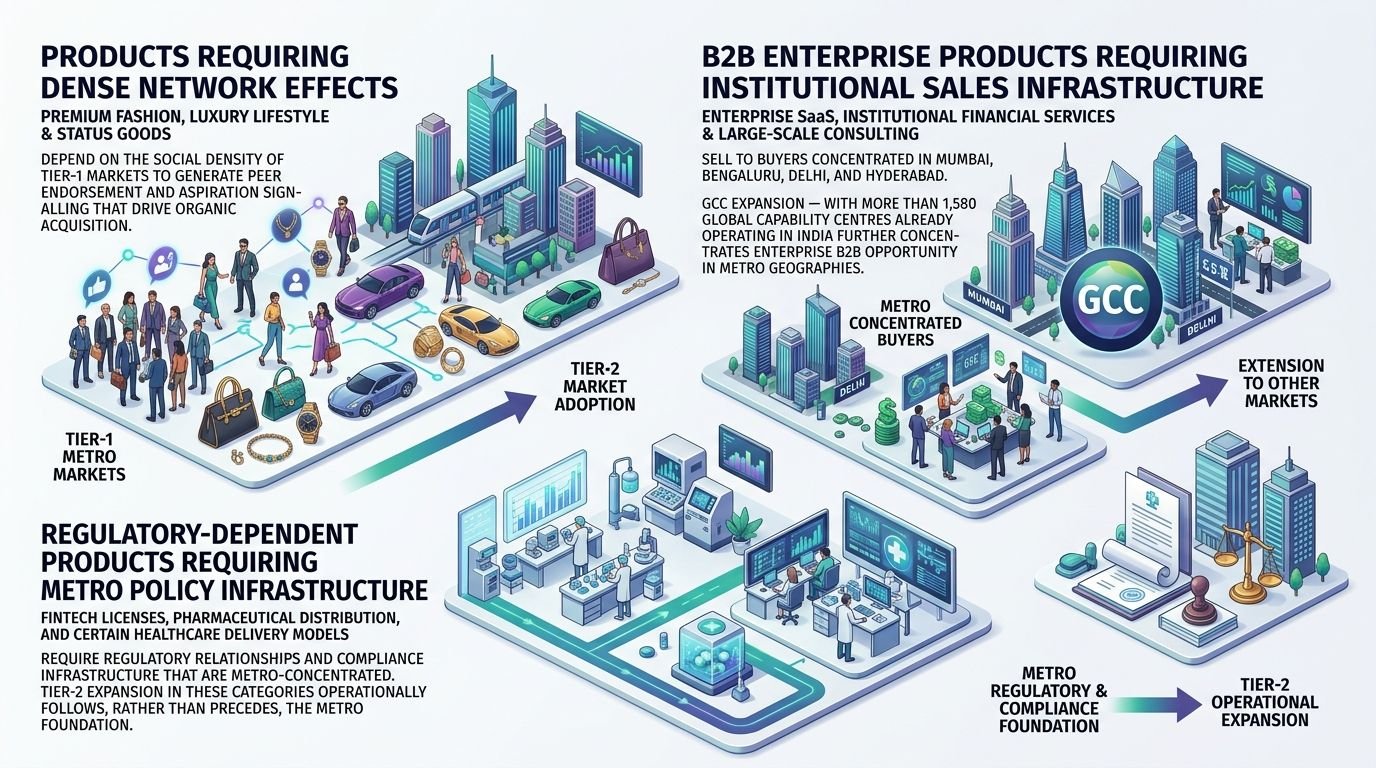
Products Requiring Dense Network Effects. Premium fashion, luxury lifestyle, and status-adjacent consumer goods depend on the social density of Tier-1 markets to generate the peer endorsement and aspiration signalling that drive organic acquisition. Tier-2 adoption follows metro adoption in these categories it does not precede it.

B2B Enterprise Products Requiring Institutional Sales Infrastructure. Enterprise SaaS, institutional financial services, and large-scale consulting sell to buyers concentrated in Mumbai, Bengaluru, Delhi, and Hyderabad. GCC expansion with more than 1,580 global capability centres already operating in India further concentrates enterprise B2B opportunity in metro geographies. Sequencing follows buyer geography, not founder preference.

Regulatory-Dependent Products Requiring Metro Policy Infrastructure. Specific FinTech license classes, pharmaceutical distribution, and certain healthcare delivery models require regulatory relationships and compliance infrastructure that are metro-concentrated. Tier-2 expansion in these categories operationally follows, rather than precedes, the metro foundation.

advanced divider
INDIA MARKET TRENDS
GTM STRATEGY

What To Do Next — Monday Morning Actions

image

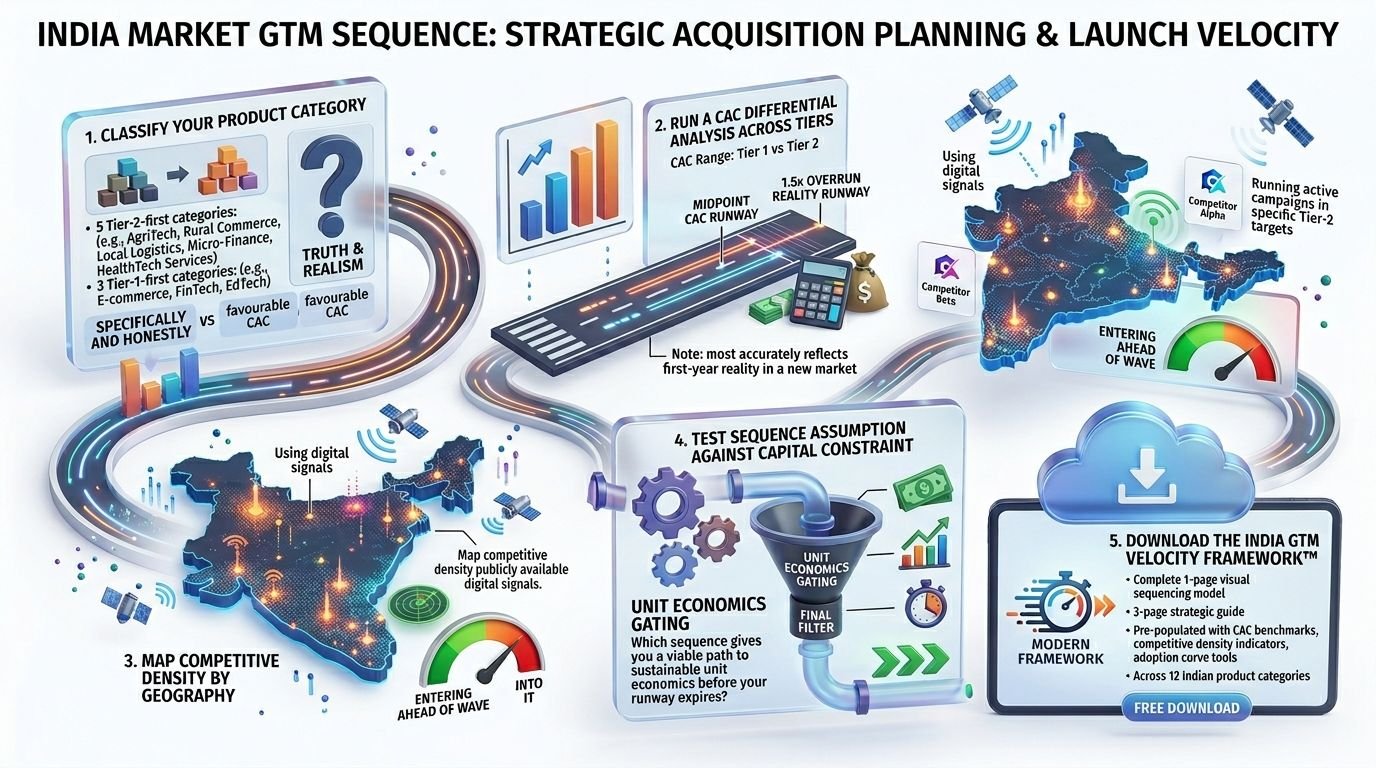
1. Classify your product against the 5 Tier-2-first and 3 Tier-1-first category types specifically and honestly, not based on which classification produces the most favourable CAC assumption in your financial model.

2. Run a CAC differential analysis for your category across Tier-1 and Tier-2. Model your runway at the midpoint of each CAC range and at 1.5x the overrun factor that most accurately reflects first-year reality in a new market.

3. Map your competitive density by geography using publicly available digital signals. Which competitors are running active acquisition campaigns in your specific Tier-2 targets? Are you entering ahead of the competitive wave or into it?

4. Test your sequence assumption against your capital constraint. Which sequence gives you a viable path to sustainable unit economics before your runway expires? That calculation is the final sequencing filter.

5. Download the India GTM Velocity Framework™, the complete 1-page visual sequencing model and 3-page strategic guide, pre-populated with CAC benchmarks, competitive density indicators, and adoption curve assessment tools across 12 Indian product categories.

Related Posts